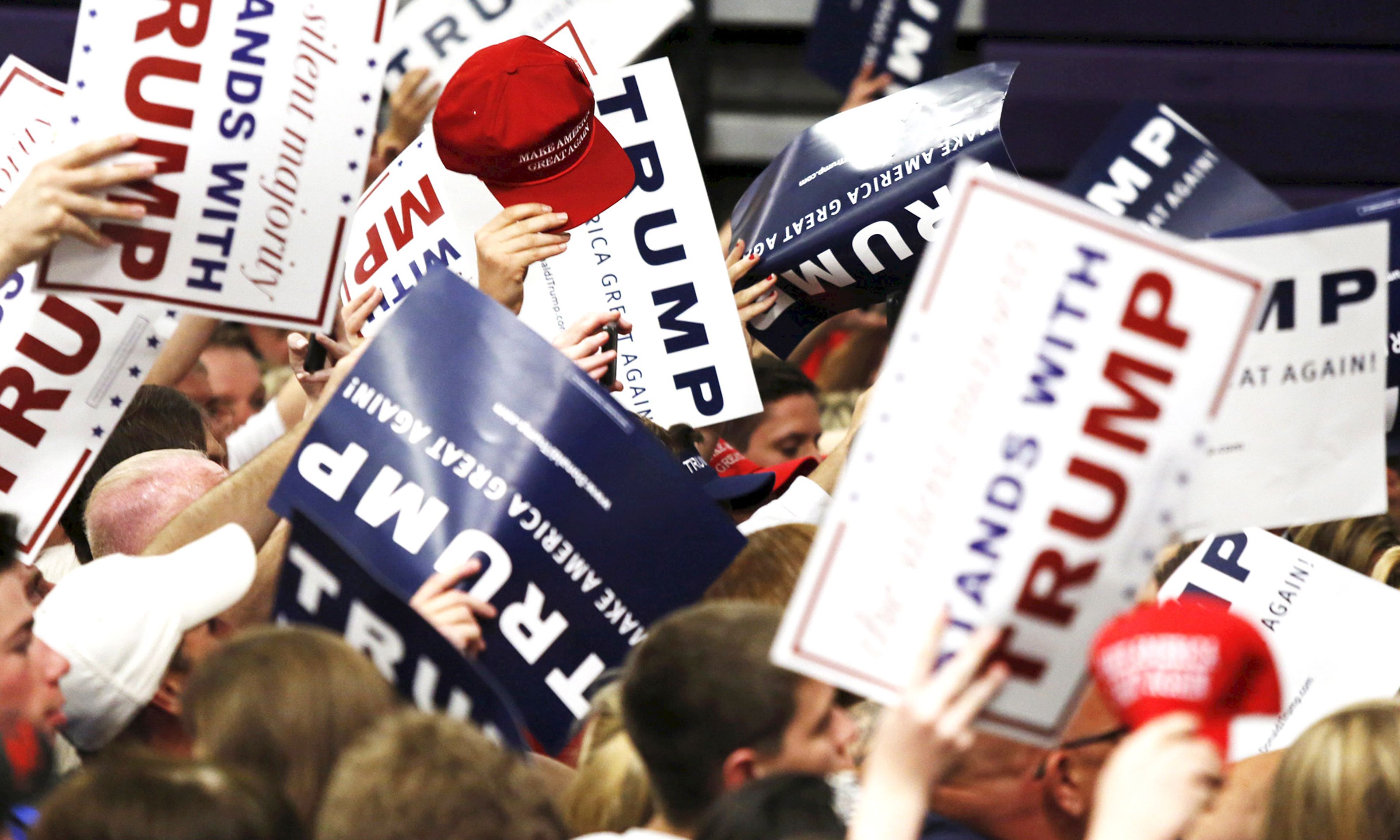
In a recent study published in The American Sociologist, Musa al-Gharbi, a Paul F. Lazarsfeld Fellow in Sociology at Columbia and a research associate at Heterodoxy Academy, shows that much of the research on Trump and his supporters is fundamentally flawed. Although his main focus in his paper is racism and the 2016 presidential election, Gharbi concludes that, on a range of subjects, “activist scholars” can undermine the reliability and impact of social science. Here, he talks to National Review.
Madeleine Kearns: In your study “Race and the Race for the White House: On Social Research in the Age of Trump,” you use three case studies to expose serious — sometimes basic — methodological errors. We’ll get into that shortly. First, how did your study come about?
[jwplayer jlGRweix-wKJ9CRQU]
Musa al-Gharbi: Basically, looking at the dynamics of the 2016 electoral cycle, I knew Trump was going to win. I was arguing all 2015 and 2016 that this was probably going to happen. But I grew increasingly frustrated because it seemed like most other scholars and analysts were outright refusing to understand that Trump was a real candidate, with a real support base, and a real chance. There were all these columns during the primaries about how he could never win the nomination, right up until the point Ted Cruz finally ceded.
After Trump won the Republican nomination, they paid a little more attention. But as soon as Hillary Clinton secured the Democratic nomination, they were right back to believing that Trump’s defeat was more or less inevitable. I saw that there was this epistemological block preventing people from understanding that people support Trump, and from understanding why they do. Since the election, this situation has not meaningfully improved. If anything, it has only gotten worse. Many seem more concerned with finding excuses for why Clinton lost than with dispassionately analyzing how Trump won.
MK: Why do you think so many commentators refused to take Trump seriously?
MG: Part of it is that Trump was thought of as so beyond the pale that they just couldn’t imagine someone actually voting for him, let alone enough people for him to win. Because he violated their personal sensibilities so severely. They thought that the only way someone could vote for Trump would be if there was some something wrong with them: They must be crazy, sexist, racist, or just incredibly ignorant.
MK: Are Democrats less likely to vote according to prejudice? Or are more informed generally?
MG: I talk about this in the paper. In the section where I discuss Arlie Russell Hochschild’s Strangers in Their Own Land, I flag that there’s extensive research showing that the Democrats are, on average, no more informed than Republican voters. There’s this idea in the head of a lot of Democrats that “we” vote on the issues and “we” are rational and informed — but actually, when you study it, “How informed are Democrats with respect to Republicans?,” it’s about the same. Most voters are pretty ignorant about the issues across the board. Democratic voters aren’t any more rational or informed on average.
MK: In your critique of Ta-Nehisi Coates’s The First White President, you identify three major distortions in his argument. Yet despite those flaws, his theories have been highly influential in the academy and the media at large. How do you account for the popularity of his narrative?
MG: So there are a few things. First, I think Coates is a compelling writer. That helps. But if I’m going to tell you how I really feel, I think there’s an appetite out there, especially for secular progressives, for the kind of yarn he spins. McWhorter described it as religious in nature. I think that’s about right.
There’s a metaphysics, with “whiteness” operating as a malevolent force in the world, and an “original sin” at the root of all society’s ills — albeit without any apparent hope for progress or redemption. But even that is convenient, right? Because if there’s no real hope, then white liberals, especially the elite class, they don’t really have to change anything about the way they’re acting, about how they are profiting from the system. They don’t have to make any meaningful sacrifices — because what would be the point of that, given that progress is impossible? But they still get to rail against others, such as conservatives, for not recognizing themselves as sinners, for not offering up the right supplications, for blaspheming, etc.
If they recognized a prospect for meaningful improvement, if they took that seriously and really wanted to make it happen, then they’d have to rethink their whole way of doing business. Because it takes hard work and compromise connecting with people who are different from you — especially if they have a stake in the order you’re trying to change. It often takes time for investments to bear fruit, so you have to be disciplined and patient; it takes faith and commitment to one another to hold a coalition together when tensions arise; it takes grace and charity in the face of misunderstandings or missteps to keep the ball rolling. There is no room for absolutism when you’re trying to solve real-world problems.
[pullquote align=”left”]If you say that anyone who opposes affirmative action is a racist, then you’re basically saying that people who hold conservative views are racist. Because conservatives tend not to support affirmative action, on principled grounds.[/pullquote]
But the joy of Coates, I think, is that his work lets people off the hook for any of that. They can revel in this dystopian fantasy world under the pretense of “keeping it real” — and get all the perks of religious fundamentalism without ever putting any “skin in the game.”
It’s funny, in an interview, Coates expressed shock that his work is so enthusiastically gobbled up by white people who “want to show they know something.” I found myself surprised by his surprise: Of course academics and media types would eat this up. What a gift his writing is for us!
MK: Let’s talk about your second case study, the critique of Thomas Wood’s “Racism motivated Trump voters more than authoritarianism.” In your analysis of Wood’s own data, you seem to be quite generous. Are you saying that even when granting him his first premise — “symbolic racism” — his conclusion is still strange?
MG: Wood’s analysis utilized a symbolic-racism scale. I personally find symbolic-racism scales to be problematic. Basically, the idea behind symbolic racism is that if you do a poll and ask “Do you hate blacks?” it’s very unlikely that they’ll say “Yeah, I hate blacks.” It might have been different in the 1930s or the ’50s — “Don’t want them around, don’t want them in the diner” — but now it’s less okay to say things like that. Which is great! But there’s this theory that people aren’t actually any less racist in their hearts and in their souls, they just don’t express how they really feel anymore.
Then the question is, well, how can you identify whether or not they do harbor racist thoughts if they’re not willing to say racist things out loud to others? And so the idea behind symbolic racism is to find some kind of proxy for racism. This is why it’s called symbolic racism. They look at opinions on something that is not directly tied to race but that scholars think a racist would support, or that blacks would not support. So the most common types are like “Do you believe that prejudice is a really big impediment to African Americans today?” And if you answer “no” to that, they code you as racist. Or “Do you support affirmative action?” No? Then you’re racist.
But if you say that anyone who opposes affirmative action is a racist, then you’re basically saying that people who hold conservative views are racist. Because conservatives tend not to support affirmative action, on principled grounds.
And there are some very strong, data-driven arguments for why affirmative action can sometimes harm the people it’s supposed to help. But for these social researchers, one, a lot of them don’t really engage with that literature in any meaningful way, and, two, they just code as racist anyone who disagrees with them on this particular issue. So there’s a degree of ideological prejudice embedded in the research design.
MK: So is “prejudicial study design” when you start with a question that is angled in a certain way so as to lead to a certain conclusion?
MG: Yeah, absolutely. Social science is maybe more prone to prejudicial study design than other fields are, because basically the subject of what we do as social scientists is the same as what politics is about overall.
What is politics? It’s people hashing out how society should be best arranged. What do social scientists do? We try to determine how society could be best arranged. This is why it’s so important to get more ideological diversity in social-research fields:
If you have only progressives, or the Left, in the academy and engaged in the social-science enterprise, then you’re just going to have a very limited understanding of what social problems are, for instance. Because people who are on the right and those who are on the left have different understandings of what counts as a social problem in the first place. Is inequality a social problem that must be “solved”? Or is it just a feature of the world that we try to eliminate at our own peril?
Even for agreed-upon problems, there are differences in the types of solutions that work best: Should the goal be to energize individuals and communities to resolve problems as they see fit, finding ways to free people up, and to lift them up (which would be the position on the right)? Or are experts better positioned to determine how to intervene? Should the state defer to them for designing and implementing policies — consolidating resources in order to give technocrats maximal leverage over social problems (which tends to be the trend on the left)?
So you have different definitions of what counts as a problem, and different definitions of how problems can be best resolved. But it’s important that you have this interplay. Because if you exclude one side or the other, you’re going to end up with an overly narrow understanding of social problems and possible solutions.
MK: How can this problem be avoided?
MG: Ideally, social science would involve people with lots of different backgrounds and perspectives and commitments. And different methodological perspectives — sociologists, political scientists, economists — each of them arguing with one another over what theory is best for understanding this, what tools are useful for exploring this, what do the data show. And then, at least in theory, some kind of consensus should eventually emerge on certain questions. And new questions are raised, and the project continues.
[pullquote align=”left”]To have a white person tell a black person how he should feel about something, on the basis of his race no less, is crazy. For a progressive, or someone who identifies as a liberal, to presume to be able to do that to a black person is even worse. But it’s not as uncommon as one might think.[/pullquote]
Having this back-and-forth is healthy. It helps you notice assumptions and flaws and errors in your research. For instance, in the “Trump studies” paper, I point out a number of glaring elementary errors that these scholars are making. Yet they know better. One hundred percent of them know better. Not just do the scholars know better, but the people who edit and review these papers know better but somehow didn’t catch the problems. And then the other scholars who cited them — these are all widely cited works — also knew better and didn’t catch them. And then many of the journalists who covered these stories, or much of the public who might have encountered these works, they often also knew better. But they didn’t catch the problems. They were not only written but prominently published, and then widely cited and otherwise endorsed. Everyone knows better, but nobody sees it. It’s right in front of their face but they don’t see it. This is why they need someone to call attention to it. Someone who is inclined toward skepticism of the thesis they want to advance.
MK: You were saying earlier that there’s a general sense among social scientists that conservatism is a pathology. Is that view a prejudice in the same way that racism is a prejudice?
MG: Oh yeah, so we were talking about Kanye West. Or just black conservatives in general. So there’s this idea that if you don’t tow the line, the progressive line for a lot of race issues, then you’ve “internalized racism.” This is an idea that actually goes back to Marx — he called it “false consciousness.”
But the problem with false consciousness, especially as a social-scientific concept, is that it isn’t falsifiable: You go up to someone and say “You have false consciousness because you believe this or endorse this,” and they go “I don’t have false consciousness: Here are the reasons I come down here, here are the reasons I believe this,” then you say “Aha! That’s just what someone with false consciousness would say.” So it’s not falsifiable. By Popper’s definition of science, this kind of thing is just not science.
And they do this with a lot of blacks, especially black conservatives. Someone might argue persuasively, “Here’s why I believe what I believe.” And how are they responded to? “You’ve just internalized racism. You’ve sold out to the man. You’ve lost your way.” I mean, I got kind of annoyed because Colbert did this thing on Kanye. And he was basically making the same kind of argument: Kanye’s black, he’s a rapper, he shouldn’t support Trump. To have a white person tell a black person how he should feel about something, on the basis of his race no less, is crazy. For a progressive, or someone who identifies as a liberal, to presume to be able to do that to a black person is even worse. But it’s not as uncommon as one might think.
MK: What are some of the other problems in this approach?
MG: For one, being prejudiced against conservatives and being prejudiced against African Americans and Hispanics are not as separated as people think. Take the institutions of higher learning, for instance. If you try to ban non-progressives or make a hostile environment for conservatives in the universities, that’s not going to affect only white people. On average, blacks and Hispanics are more socially conservative and more religious than whites. So if you say “You have socially conservative views so you don’t belong here,” that’s more likely to affect a black person than a white person — because people of color are just more likely to be conservative or religious.
And people lose this. Because the black vote is overwhelmingly Democratic, they assume, “Oh, they vote Democrat, they must be liberal,” but in fact we vote how we do largely because Democrats are viewed as better allies for civil rights and the like. Not because blacks wholeheartedly endorse leftist orthodoxy.
[pullquote align=”left”]If you want to understand things like racism or discrimination, you have to study behaviors, you have to look at social context, and you have to look at individuals over time rather than extrapolate on the basis of a single survey or observation.[/pullquote]
In fact, up to 45 percent of blacks identify as conservative. So if you make a hostile environment for non-progressives and then say, “Oh, I wonder why there are so few blacks and Hispanics here? Why aren’t the universities more diverse?,” it’s like, well, if you want to bring in more minorities, then you’re going to have to broaden your ideological acceptance too. This is true with regard to immigrants as well: People who are fresh off the boat from Africa, or the Middle East, Latin America, or anywhere in the world, really, other than Western Europe — chances are they’re going to hold a lot of beliefs that are going to be, shall we say, less than “woke.”
So if you’re saying “Only progressive views are acceptable here,” you’re not only excluding blacks and Hispanics but also immigrants generally and many other groups whom progressives ostensibly champion. Many on the left think that these two causes are distinct: We want to eliminate conservatives and bring in all all these minorities and empower them. But if you’re really going to bring in these minorities and let them have freedom of expression, freedom of conscience — if you really want them to contribute their unique views and perspectives — then you’re going to have to be accepting of a much broader range of ideologies than many on the left would like to accommodate.
MK: Back to Wood’s study: What would be a better way to measure people’s racial attitudes?
MG: Well, I mean, basically what we try to do right now is take an answer to some loosely related, or unrelated, survey question and try to see into people’s hearts about race. I’m just skeptical of that entire enterprise, to be honest.
MK: Because there is a lack of hard evidence?
MG: So this is the problem. Obviously I think racism is a real thing. And discrimination happens, and it must be resisted. The problem is, I don’t think you can understand whether or not someone’s racist from a series of questions in a one-off poll. Because racism is fundamentally about habits of behavior and about patterns of interactions in the world. If you want to understand things like racism or discrimination, you have to study behaviors, you have to look at social context, and you have to look at individuals over time rather than extrapolate on the basis of a single survey or observation.
You can’t, just on the basis of a poll, impute to people how they really think, because the way people answer questions — “I feel this way about X” — doesn’t always reflect how they act in the world, right? A prime example, to turn it around, would be “The Case for Reparations” by Ta-Nehisi Coates. If you polled progressives and asked “Do you believe reparations are good?” many would say, “Yes, of course!” Hundreds of thousands shared Coates’s article on social media.
But then how do they act in the world?
Like, if they truly believe that some portion of their wealth is ill-earned and should be given to African Americans, then they can give it. There’s literally nothing preventing them from doing so, other than their own lack of commitment. They’re not putting their own money where their mouth is. They’re not even actively lobbying to extract reparations from others. It’s just virtue-signaling.
So this is a case where people say “This is what I support” while their actions don’t reflect that in any way. In the same way, in a poll, you can say something that could be coded as racist, but your actions in the world might not reflect racism. You might not discriminate against people of color, for instance. Indeed, your interactions with people of color may be more virtuous than others who answer the “right” way in polls.
So I have a problem with using one-off polls to impute things like racism. I think there are racists. But ultimately it’s how you act in the world that matters here, rather than what you say in a poll.
To put it another way, what are activists trying to fight? Is it primarily language or fleeting attitudes (which is what is captured in polls)? Or is it harmful actions and unjust institutions? If it’s the latter, you’ve got to go where the fish are: into the real world.
MK: So what should social science be, how should social science work, and how does it fit within the broader framework of scientific method and inquiry?
MG: Okay, so that’s tough [laughs] . . .
Feynman had this famous test to measure whether you understand an idea: If you can’t explain it, to a child is what he said, but basically if you can’t explain it to a non-specialist, then you don’t really understand it yet yourself.
[pullquote align=”left”]Trying to advance some idiosyncratic cause tends to be incompatible — fundamentally incompatible — with following the evidence wherever it leads. [/pullquote]
And what’s really clear from a lot of social research that you see today is that we’ve really mucked things up. For instance, as a philosopher, I’ve often found people like Judith Butler or Foucault to be rewarding, but if you wanted to explain what they were arguing in any given paragraph to a child [laughs], good luck! And it’s not because the truth is so messy or complicated that it can’t be effectively reduced. It’s because we make things more technical or abstract than they need to be . . . often to conceal how little is “there” in a lot of this work.
So the big thing is to be clear and straightforward about the claims you are making, and to empirically substantiate them. If you have some kind of theory in your head about how the world works, or about what’s happening in the world, great. But you’ve got to be able to express it in a concise and accessible way, and to back it up with appropriate data and observations.
MK: One of the conclusions you reach at the end of the piece is that all of this is a smoking gun for those who are highly skeptical about the entire enterprise of social science. What would be your defense of social science?
MG: So my defense is that there are a lot of social problems in the world. Societies are complex, interests diverge, some people are just bad actors, environmental crises occur, facts can be unclear, and so problems emerge — real problems about how we can peaceably live together, coordinate our actions, and learn from one another, etc.
At its best, social science can help us understand those problems and address them — through grounded theory and empirical research.
But of course, you’re going to have a very limited and distorted understanding of the world if you want to filter everything through some particular ideological lens. Ditto if you have some narrow ax to grind. Trying to advance some idiosyncratic cause tends to be incompatible — fundamentally incompatible — with following the evidence wherever it leads. This is how you get “black swan” catastrophes, or just well-intentioned social programs that don’t do much good or even bring harm to the people they are intended to help.
And then, when it comes to relating your findings to policymakers or the public, you’ve got to be able to speak to people across a range of interests and backgrounds. Otherwise you’re probably never going to get the consensus you need to get stuff done.
This is the big problem right now. A lot of people, especially on the right, are skeptical of social research and its value — justifiably in some instances, I think, given the demonstrated bias against conservatives and religious people in social research. But we all lose in this process, because good work can do a lot of good in the world.
I should add: It’s not just the Right that we have a problem connecting with. Overall, Americans are far more conservative and religious than most academics. And in many other parts of the world, that distance is even greater. We’ve got to do a lot more to close that gap if we want our research to be more credible and impactful.





Comments