Editor’s Note: A version of this piece originally appeared in City Journal. It is reprinted here with permission.
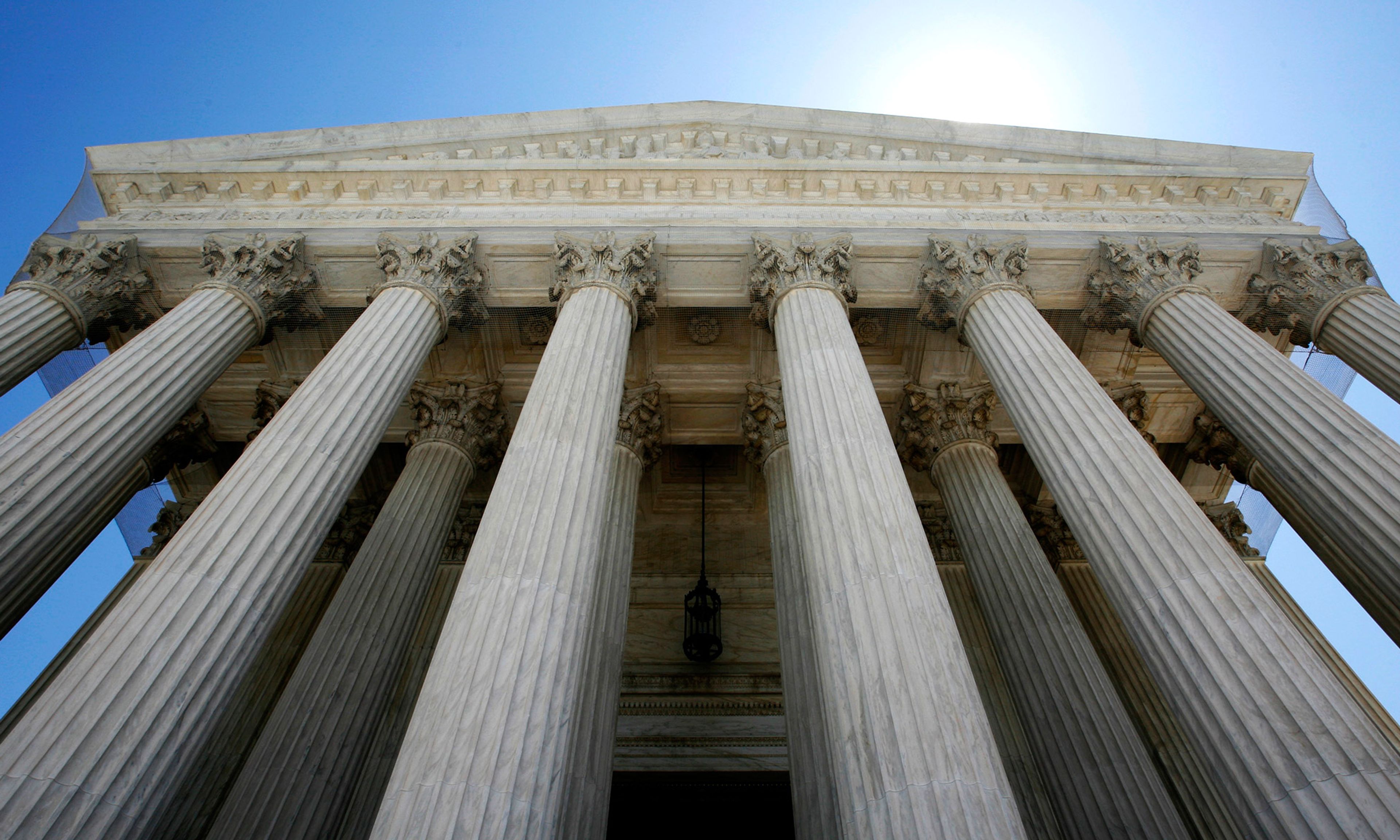
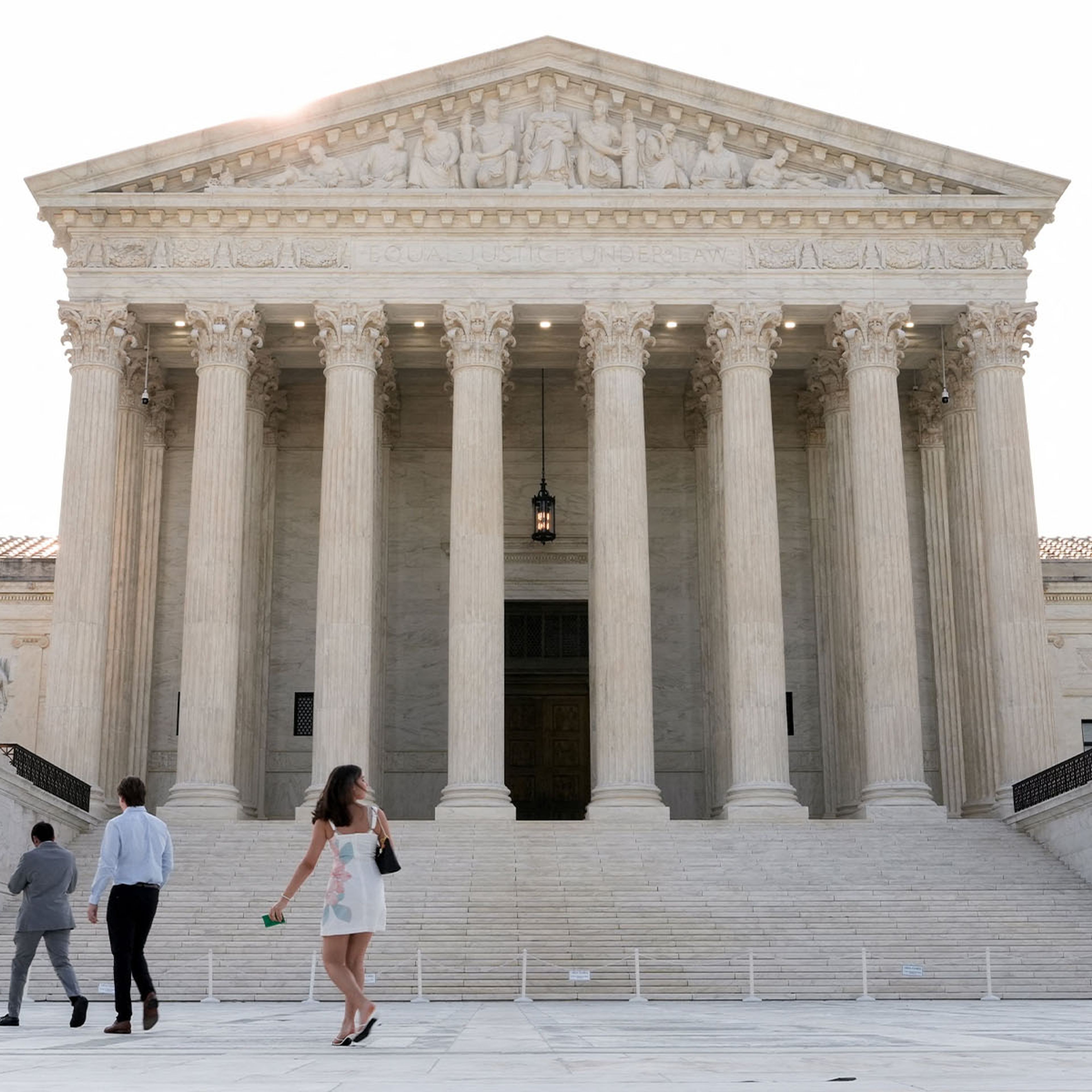
As it hears Janus v. American Federation of State, County, and Municipal Employees, Council 31, the Supreme Court will decide whether public-sector unionism violates the First Amendment rights of workers who refuse to join unions. The case will be one of America’s most consequential for government labor–management relations. If the Court rules for the plaintiffs, state- and local-government workers in 22 states will no longer have to subsidize organized labor as a condition of employment; instead, they will be free to choose the organizations to which to contribute money, or to contribute not at all. Janus thus affords the Court an opportunity to reinstate workers’ rights to free speech and association, and to restore some political balance by preventing public-employee unions from using money forcibly pried from workers opposed to or unenthusiastic about their agenda.
If it rules this way, the Supreme Court would overturn a 40-year-old precedent, Abood v. Detroit Federation of Teachers. Most observers think that the justices will do it: Janus marks the fourth time in five years that the Court has accepted a case about the constitutionality of public-sector unionism. The spate of recent cases, on this view, reflects the conservative majority’s desire to overturn Abood. Perusal of the Court’s jurisprudence going back to the 1950s shows that it has long struggled to determine the constitutionality of various laws that encourage unionism in the private as well as the public sector. Constitutional history also underscores the conundrums created by importing private-sector labor practices into a government setting.
[jwplayer HRcSYP99-wKJ9CRQU]
Twenty-eight U.S. states currently have right-to-work laws, ensuring that employees in unionized workplaces cannot be compelled to join a union as a condition of employment, or pay union fees, though they still largely receive the same benefits as unionized workers. Twenty-two states, however — the states that the Janus ruling will affect — are non-right-to-work, meaning that workers in unionized workplaces must either become union members or pay the union fees.
How does current law in non-right-to-work states facilitate strong unions? To form a union, workers must hold an election determining whether they want a union to serve as the “exclusive representative” of all employees in a “bargaining unit.” If a one-time majority says yes, a specific union (AFSCME, SEIU, the Teamsters, or another) is so designated. Every union wants the right to be workers’ exclusive representative because that right is a powerful one. Employers must bargain with the designated union over wages, benefits, and working conditions. The union can bar individual workers and other unions from negotiating with management. Other unions or groups cannot represent workers in that bargaining unit. From the union’s point of view, a representational monopoly yields “labor peace.”
The flipside of the exclusive-representation right is the union’s legal obligation equally to represent all workers in a bargaining unit, regardless of whether they’re union members. This creates what political scientists call a collective-action problem. Workers may all be better off if they collectively join the union, but any individual worker will be even better off if he refuses to join, avoiding union fees while still reaping the benefits. To overcome this incentive to “free ride,” unions have employed social pressure, ideological appeals, and selective benefits (everything from reduced prices on rental cars to dental insurance) to get workers to join. Yet these methods are often insufficient. Some workers are opposed in principle to unions and don’t want to give them money. Others disagree with the union’s political activities and don’t want to pay for them. Still others see their occupational interests differently, such as when high-performers object to union efforts to equalize salary and promotion schedules.
Consequently, unions have sought a more reliable method for inducing membership: coercion. The most direct approach is to get government to pass laws that make free-riding illegal and require workers to support the union — the rule in the 22 non-right-to-work states. In these states, organized labor has prevailed on the government to let them charge nonmember workers an “agency” or “fair-share” fee for acting on their behalf in collective bargaining and contract administration. The union usually sets agency fees at 80 percent to 100 percent of union dues (though, in some cases, they have been set as low as 65 percent of dues). Because these employees will pay the union roughly the same amount as union members, the policy also removes a financial incentive for workers not to join the union. The result is that non-right-to-work states have higher rates of union membership than those that do not.
Some agency-fee-paying workers may think that, because they never joined the union, they aren’t paying for its political and ideological activities. Not so. To stop subsidizing the politics, they would have to object demonstratively to union political activities, usually by writing an annual letter to union leadership. They can then get a refund of the percentage of their monies that the union says it spent on politics. Unions typically claim that they spend only about 10 percent to 20 percent of their revenues on political causes. For example, a worker who contributes $1,200 a year to the union but refuses to join it and declares himself an “objector” will receive a refund of, say, $120. No external review or accounting verifies these calculations.
Organized labor’s logic is circular. Because a union is the exclusive representative, it requires agency fees; because it can collect agency fees, it must be the exclusive representative. The Supreme Court has repeatedly identified tensions between this logic and the First Amendment’s provisions on freedom of speech and association. For instance, private-sector unions long sought a “closed shop,” which made union membership a condition of employment. When every worker must be a union member, everyone pays the same union dues — for unions, it’s a simple solution.
However, the Taft-Hartley Act of 1947 outlawed the closed shop, and the Supreme Court upheld that position in Radio Officers’ Union v. National Labor Relations Board (1954) and Labor Board v. General Motors (1963). Thenceforth, unions could not strong-arm American workers into joining them; that requirement, the law now held, violated their rights to freedom of association.
But that was hardly the end of the story. If workers couldn’t be forced to join unions, then, the unions argued, they should at least have to pay, via agency fees, for the costs of collective bargaining and contract administration. In Railway Employees’ Department v. Hanson (1956), the Supreme Court embraced the union’s free-rider argument, ruling that agency fees were constitutional in the private sector. Forced contributions to private unions were constitutional, in other words, even if forced membership was not. It was also constitutional for government to encourage workers to join unions. However, in Machinists v. Street (1961), the Court held that federal law barred private unions from using nonmembers’ agency fees for political purposes.
As states and localities adopted collective-bargaining laws for their public employees in the 1960s and 1970s — the National Labor Relations Act didn’t cover these workers — public-sector unions, like their private-sector counterparts, began charging workers agency fees if they refused to join. A group of teachers in Detroit sued, arguing that mandated fees violated their First Amendment rights. In their view, all the issues at stake in collective bargaining in public education — such as teacher pay, tenure, and benefits — were “inherently political,” resulting from decisions that elected representatives should make. Mandatory contributions were a form of “compelled speech.”
In Abood v. Detroit Federation of Teachers (1977), the Court ruled in favor of organized labor. Justice Potter Stewart’s six-justice majority opinion conceded that requiring government workers to support a union “has an impact upon their First Amendment interests” and may “interfere in some way with an employee’s freedom to associate for the advancement of ideas, or to refrain from doing so, as he sees fit.” But the Court accepted labor’s view that agency fees were legitimate in order to prevent free riders in the public as much as in the private sector. The Abood majority also accepted the union interest in “labor peace,” holding that “confusion and conflict . . . could arise if rival teachers’ unions, holding quite different views . . . sought to obtain the employer’s agreement.”
The Court also held, though, that the agency shop was constitutional only “insofar as the service charges are applied to collective bargaining, contract administration, and grievance-adjustment purposes.” The justices unanimously agreed that a union couldn’t spend objector’s agency-fee dollars on political and ideological activity “not germane” to collective bargaining. Only members’ dues could be used for such things.
Justice Louis Powell’s concurring opinion (joined by Justice Harry Blackmun) was deeply skeptical of the constitutionality of agency fees in the public sector. For Powell, the differences between public and private employment were more “fundamental” than the majority opinion allowed. It was nearly impossible, he maintained, to distinguish public-sector collective bargaining from political activity — the bargaining constantly bleeds into the political activity. Powell suggested, too, that requiring objectors to opt out placed a heavy burden on individuals to “step forward, declare their opposition to the union, and initiate a proceeding,” which was an infringement on First Amendment rights. If a worker is shy, intimidated, or neglectful, for example, he could easily end up subsidizing speech that he didn’t approve of.
Because the Abood Court failed to set up clear procedures by which workers could object to union fees and get some of their money back, the unions, unsurprisingly, made it tough for objecting workers to do either. Some Chicago teachers sued about this, noting that their union-set agency fees amounted to 95 percent of dues and that objectors seeking refunds had to navigate a labyrinth — thus violating their First Amendment speech rights and Fourteenth Amendment due-process rights. In Chicago Teachers Union v. Hudson (1986), a unanimous Court held that the union’s administrative procedures were “fundamentally flawed” and failed to protect nonmembers’ free-speech rights. Hudson thus forged a new right for objecting non-union workers. Labor unions were henceforth required to provide (if asked) an accounting statement detailing the expenses designated as chargeable (collective bargaining and contract administration) and non-chargeable (political and ideological activities).
Nevertheless, Hudson left the unions in control of the books. Unsurprisingly, they typically say that they spend very little on politics and lots on collective bargaining. Though workers can object to these claims, very few are sufficiently motivated to immerse themselves in union finances and pursue matters through the cumbersome formal channels. Consider, in this light, Lehnert v. Ferris Faculty Association (1991), a case in which a group of faculty at Michigan’s Ferris State College, a public institution with an agency shop, objected to some of their union’s spending as political, and thus not chargeable. The Court found in the plaintiffs’ favor, true, but the faculty members had to go all the way to the U.S. Supreme Court to get their money back.
The reality is that, in states with agency shops, some 20 to 30 percent of workers are probably paying for political activities with which they disagree. Even if the workers renounce their union membership and register as objectors, the union still determines what is political spending and what isn’t. No one should be surprised that unions often make these calls with their own interests in mind.
These issues resurfaced in 2012 in Knox v. Service Employees International Union Local 100. A 7–2 majority held that an SEIU local in California violated the First Amendment rights of objecting nonmembers by adding a “special assessment” to normal dues (or agency fees), without providing a new Hudson notice. The Court noted that the objecting employees either had to pay for political activity — specifically, opposition to two ballot initiatives in 2005 — or had to loan money to the union for such activity.
Writing for the majority, Justice Samuel Alito called the Abood precedent “something of an anomaly” in the Court’s First Amendment jurisprudence. He argued that “compulsory fees constitute a form of compelled speech and association that imposes a significant impingement on First Amendment rights.” Alito even suggested that Abood was wrongly decided: “free-rider arguments,” he stated, “are insufficient to overcome First Amendment objections.” By holding otherwise, Abood made the subsidization of union speech by nonmembers inevitable. Government, Alito proposed, should take its thumb off the scale.
Alito also raised grave doubts about the constitutionality of requiring objectors to opt out of political spending. Shouldn’t the nonmember be asked if he or she wanted to opt in? By permitting opting out to become the default practice, the Court’s decisions, Alito suggested, “approach, if they do not cross, the limit of what the First Amendment can tolerate.” Furthermore, Alito pointed out, money is fungible. Even if unions levy special assessments for non-political purposes, such extra revenue frees up money for politics. In that sense, it’s hard to see how nonmember fees don’t always contribute to political activity.
Finally, Alito underscored how public unions’ accounting methods threaten nonmembers’ free-speech rights. Financial audits of a union’s books seek only to ensure that the union spends money on what it says it does. They don’t investigate the expenditure categories themselves, or question the union’s designation of an item as chargeable (or not) to nonmembers. The SEIU’s labeling of many of its spending items as “germane” to collective bargaining, Alito explained, made its categories so broad that they “would effectively eviscerate the limitation on the use of compulsory fees to support unions’ controversial political activities.” The trouble for the unions is that expanding the definition of what counts as a collective-bargaining expense concedes their opponents’ claim that all collective bargaining is political.
Knox set the stage for a 5–4 decision in Harris v. Quinn (2014). Justice Alito again wrote the majority opinion. Chipping away at Abood, he contended that it rested on “questionable foundations” by evading the difficulty of distinguishing collective bargaining and political expenditures in the public sector. “[T]he line,” he wrote, between union expenditures on collective bargaining and those on politics “is easier to see” in the private sector because “collective bargaining concerns the union’s dealings with the employer; political advocacy and lobbying are directed at the government.” In the public sector, by contrast, “both collective bargaining and political advocacy and lobbying are directed at the government.” In addition, Abood failed to anticipate the administrative problems that would arise in trying to classify chargeable versus non-chargeable expenses for objecting nonmembers. Alito concluded that First Amendment violations are inevitable in the public sector.
The Court’s liberal wing was unhappy with Alito’s arguments in both cases. In Harris, Justice Elena Kagan wrote a long dissent, joined by the other three liberal justices (Ruth Bader Ginsberg, Sonia Sotomayor, and Stephen Breyer). Abood was not an anomaly, Kagan maintained: Governments have “wide latitude” to manage their workforces. She pointed to examples of constitutional restrictions of public employees’ free-speech rights from the law-enforcement or national-security contexts, but her primary defense of Abood was that it is a “deeply entrenched” precedent: Abandon it, and the Court would wind up overturning many state laws, the basis of “thousands” of labor contracts throughout the country.
Yet just two years later, in Friedrichs v. California Teachers Association (2016), the five conservative justices’ questions during oral argument suggested that they were ready to overturn Abood. Justice Antonin Scalia set the tone: “The problem is that everything that is collectively bargained with the government is within the political sphere, almost by definition.” Yet a month after oral argument, Justice Scalia died unexpectedly. A deadlocked court failed to issue an opinion, and Abood remained good law.
On Monday, the Court heard oral arguments in Janus v. AFSCME. Mark Janus, a child-support specialist in the Illinois Department of Healthcare and Family Services, claims that Illinois law violates his free-speech rights by requiring him to pay for union political activity with which he disagrees. A ruling in his favor will end agency shops across the country in government employment, having a seismic effect on public-sector unions and on politics at the national, state, and local levels.
Public-sector unions are panicking over the case’s likely outcome. The creation of a national right-to-work environment for the public sector means that government unions will lose members — and money. Based on a few states’ experience enacting right-to-work laws, observers predict that somewhere between 15 and 30 percent of current public employees in unions will rescind membership and opt out of agency fees. In Wisconsin, public-sector unions have shrunk by 40 percent since the state adopted right-to-work. Strong public-union states such as New York, California, Illinois, and New Jersey could see significant downgrading of union power. That power is the basis of unions’ influence in Washington, where they’re among the biggest spenders on campaigns and lobbying.
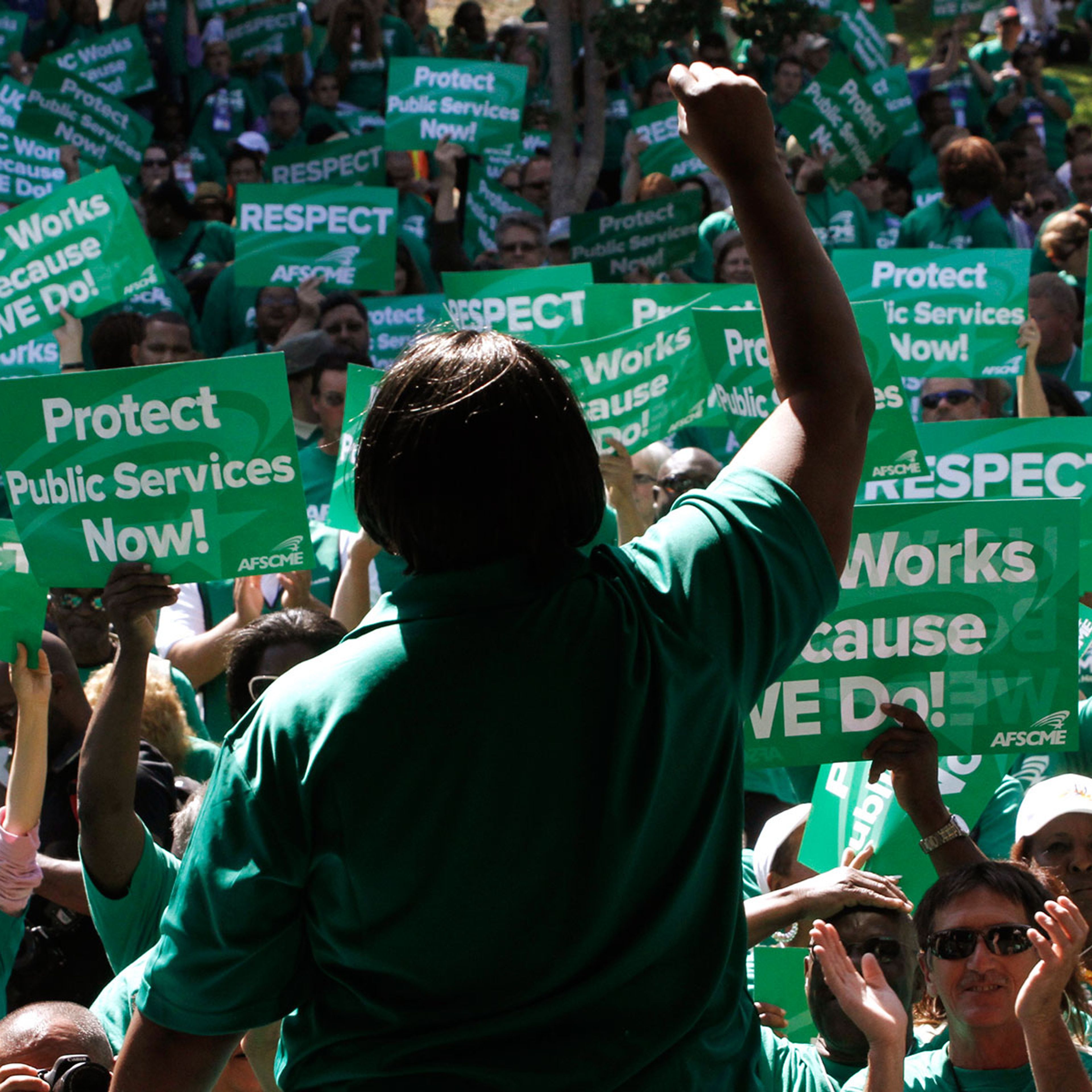
Facing this prospect, the unions have launched a massive effort to reinvigorate relations with their members. The American Federation of State, County and Municipal Employees (AFSCME), for example, has conducted 600,000 face-to-face conversations with workers, to get their input on what the union could be doing better. Decades of forced fees, which also goosed membership rolls, allowed union leaders to rest on their laurels. Amid the new crisis, the unions discovered that they had fallen badly out of touch with their memberships.
“At times we were treating all of our 1.6 million members as if they were activists, and they aren’t,” AFSCME president Lee Saunders admitted. “We were taking some things for granted.” The massive California Teachers Association, which has been engaged in a similar effort, had to figure out how to “package what [CTA] membership offers in a way that appeals” to prospective members. It has been developing a “data strategy to get to know our members well enough to be able to effectively market membership to them.”
While the unions intensify their communications with workers, they’re also trying to ensure that workers don’t hear any other messages about labor. Public-employee unions in Seattle are trying to use Washington State courts to stymie efforts by the Freedom Foundation, a conservative nonprofit, to identify and contact state workers to tell them how they can opt out of union political spending. The unions recently won a victory in the state appeals court, but the case will likely go to the state supreme court.
Janus could also alter nationwide political dynamics. Public-sector unions are potent forces at all levels of American government. AFSCME official Naomi Walker has said that abolishing fees “could undermine political operations that assist the Democratic Party” and that “the progressive infrastructure in this country, from think tanks to advocacy organizations . . . will crumble.” Anxiety about the left’s future explains why the “Better Deal” agenda of the Democratic party’s congressional leadership calls for a ban on “state laws that undermine worker freedoms to join together and negotiate.”
The general result of public-sector unions’ outsized influence in politics over the last 30 years, especially at the state and local levels, is ever-larger and more expensive government. Bigger government means more jobs and money for unions, of course, but in places where unions are strong, public finances tend to be in rough shape. Research by political scientists Sarah Anzia of the University of California at Berkeley and Terry Moe of Stanford University shows that unions increase the cost of government by boosting the salaries and benefits of public workers.
My own research finds that strong unions drive up liabilities for other post-employment benefits (OPEB), which consist mainly of retiree health insurance. Higher salaries and generous benefits yield higher government debt and higher interest rates on state and local bonds. Loosening the grip of public-sector unions on some state and local governments could thus create the political breathing room that policymakers need in order to address long-festering fiscal problems in some of the nation’s most populous states and cities.
Public-sector unions are powerful political actors because they’re organized — largely by government, which solves the unions’ collective-action problem by forcing all workers to pay them. Government eliminates competition among unions by designating a single union as the exclusive representative. It incentivizes workers to join unions by permitting agency fees. It subsidizes unions by collecting workers’ dues and fees. It provides “release time” for workers to become union leaders, while keeping their jobs.
In sum, these unions have gotten organized not because public workers demanded it but mostly because government has encouraged such organization. In the process, government has trampled on some public workers’ rights and fueled the rise of a muscular progressive interest group. The result is an imbalance of political power, with disastrous fiscal consequences for many states and cities.
A rebalancing is in order. The Supreme Court has a chance to provide it.


Comments