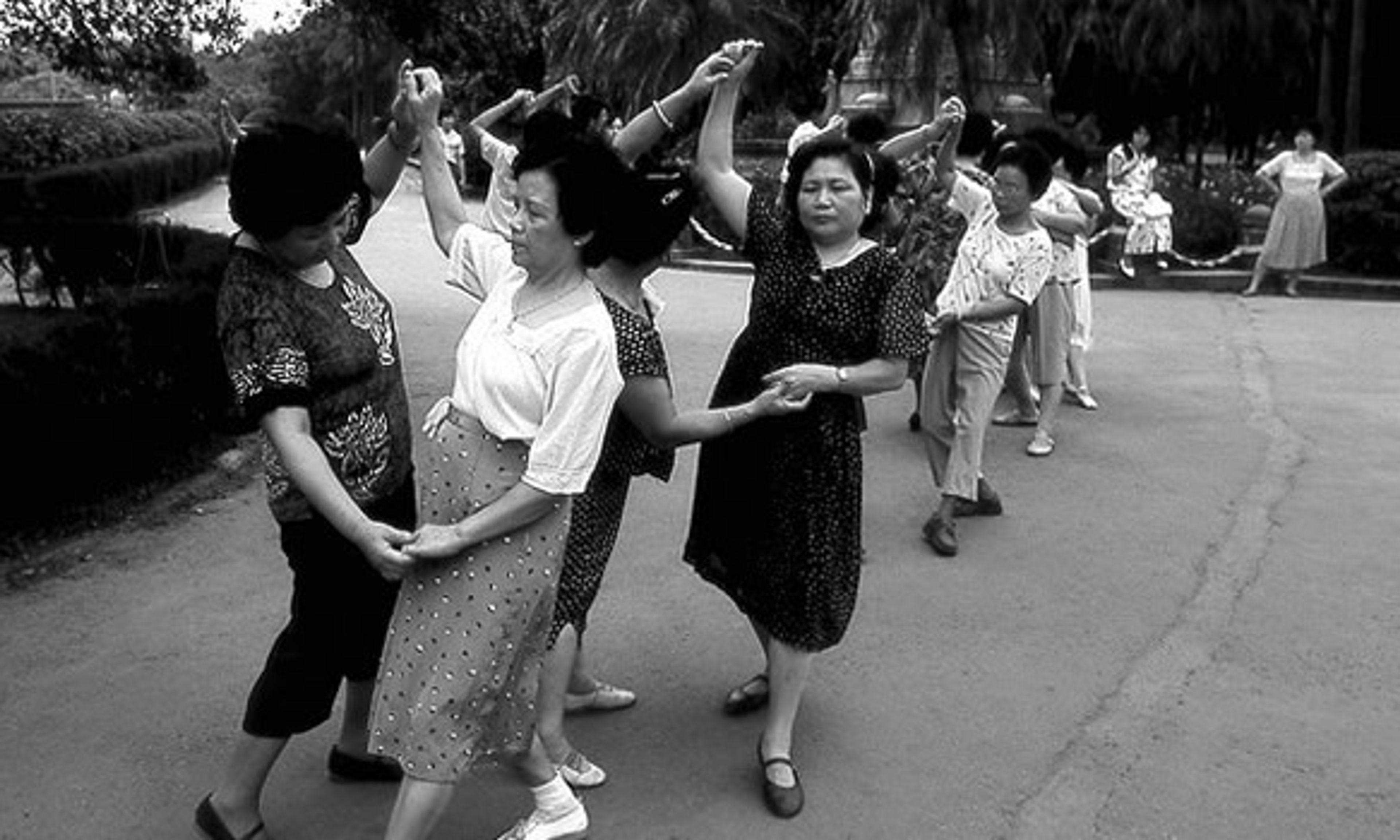
Taipei is bustling at night, as you know. It is one of those “cities that never sleep.” But it is equally bustling in the morning. People are going to work, of course — Taipei is a hard-working place, and they start early. But they also fill the parks.
What are they doing? Lots of things. Tai chi, as you would expect. And yoga? Can I tell the difference? There’s dancing, of various types. People dance in groups. And alone. A man dances with a woman, sort of ballroom style.
People chant. And sing — genuinely sing. In Daan Park, I encounter a group of about 50 who are singing together, in unison. Public singing is a rare thing in America, I find.
You got people playing badminton. I see a game of croquet. But, as in parks everywhere, lots of people just stroll or sit.
Very visible in this city — particularly in its parks — are old people. They seem more integrated than they do where I live. They often have nurses or assistants with them, but they also have people who look like their sons or daughters.
People in wheelchairs are on the fringes of the tai-chi groups (for example). If they can’t move their legs, they move their arms. They participate as much as they can. I have a feeling that some of these people have been doing these things routinely, for 60, 70 years. They want to keep going.
‐For previous parts of this journal, go to the following links: I, II, III, IV, V, VI, VII, and VIII.
‐In Part V, we met a Buckeye — Shaw-Chang Maa, of the Straits Exchange Foundation. He earned his Ph.D. from Ohio State. Chung-Jen Chang is another Buckeye — a Ph.D. from OSU. He works for the Ministry of Culture.
Chang is one of those who believe that “Taiwan” is merely a geographical designation — a name for an island. The name of the country is “Republic of China.”
He has worked in America, as well as studied there. “When people asked where you were from,” I ask, “what did you say?” “I said, ‘Taiwan, Republic of China.’” Like many others, Chang found that Taiwan was often confused with Thailand.
‐We talk about the division in the Taiwanese media — which mirrors, I believe, the division in Taiwanese politics. There are “Blues,” who are more unification-minded, and “Greens,” who are more independence-minded. “I don’t think there’s much of a middle,” says Chang.
‐In his view, are closer relations with China good? Oh, yes: “We have more chance to trade, more chance to make money.” If I have understood him correctly, Chang believes that ROC-PRC ties are key to the island’s economic health.
‐I’m curious about something: When did Taiwan’s media become truly free? When did government restrictions fall off altogether? Chang says, “About 1990.”
‐I pay a visit to a newspaper, the Apple Daily. In the lobby, I get a big surprise. There’s a bust of . . . Hayek? Yes. Underneath, there is an inscription, from the great economist’s Nobel lecture: “The recognition of the insuperable limits to his knowledge ought indeed to teach the student of society a lesson of humility which should guard him against becoming an accomplice in men’s fatal striving to control society.”
‐The editor of the paper is Wei-Min Ma. His parents came from the mainland, in 1949. I ask the standard question: Does he consider himself Chinese, Taiwanese, both? “When I was young,” he says, “I considered myself both. But now I think of myself as Taiwanese.”
I hear this a lot. And polls indicate that it is a national trend. There is a growing sense of “Taiwanese-ness.” A developing Taiwanese consciousness.
But I warn you that this subject is tricky — hard to be glib about. (What would writing be without glibness?)
‐So, I assume the Apple Daily is pro-Green and anti-Blue? That is, in favor of the Democratic Progressive Party (DPP) and against the Kuomintang (KMT)? Ma says the paper picks on whoever is in power. And the party now in power is the KMT. When the DPP-ers were in, the paper picked on them.
Ma believes the paper must hold the government to account, plain and simple. Besides, he says, you know journalists: They’re like teenagers. They like to fight.
‐Does the government try to pressure Ma and the Apple Daily? Sure, the editor says — but it doesn’t work.
‐Ma says that Chinese tourism to Taiwan will have a positive effect — they will see a different way of life. A freer way of life. Relatedly, he says that people in China are envious of Taiwan’s free press.
Can they read it? Can they see it? In China, I mean. Ma points out that Taiwanese websites are blocked in the PRC — but Chinese generally know how to get around the blocks. They “climb the wall,” as the saying goes.
‐This is nice: When planes from Taiwan land in China, flight attendants warn passengers to leave their copies of the Apple Daily behind. PRC authorities would not be pleased to see them.
I tell Ma he can be proud of this. Indeed he is.
‐Ma talks about journalists in China — his colleagues, or would-be colleagues. It’s very hard to be a proper journalist in China. Ma says that their situation is similar to the Taiwanese situation in about 1970: Some very brave people challenge government restrictions.
‐The Chinese government, says Ma, keeps telling people that China is too big to be free. That if the land is free, disasters will take place.
What a brazen line, no?
‐Like most Taiwanese, Ma is unhappy that his country is kept out of international organizations. It stifles Taiwan. It retards its development. It prevents Taiwan from sharing its example, from showing what it has accomplished.
Participation in international organizations, says Ma, would give Taiwan advantages it does not now enjoy — which is why China is determined to block Taiwan from these organizations. The PRC wants to isolate Taiwan completely.
I reflect that the word “isolate” comes from “island.”
‐From my discussions with other Taiwanese, I understand that the country would like to have at least observer status at the most modest, uncontroversial organizations: We’re talkin’ the International Civil Aviation Organization and the Framework Convention on Climate Change. For goo’ness’ sake.
As you may know, Taiwan is allowed to compete in the Olympics under the awkward name “Chinese Taipei.” And Taiwanese beauties — of whom there are many — may compete in beauty pageants under the same name.
Well, you take what you can get, I guess.
‐I ask Wei-Min Ma the terrible question: If the PRC moved on Taiwan, would the United States come to Taiwan’s defense? He says, quickly and somberly, “No.” At best, he says, the Americans would send weapons (which is a form of coming to Taiwan’s defense, true).
‐The trick now, says Ma, is to help China become democratic. Taiwan can set an example — show the Chinese their future, so to speak.
If Taiwan and the PRC unified, at this juncture, Taiwan would probably lose its democracy. If Taiwan separated, if Taiwan declared its independence — why, China would be very angry. Both the government and the people at large would be very angry. The Chinese would no longer envy Taiwan, they would simply be furious at it.
For decades, PRC propaganda has declared Taiwan an irrevocable part of China. (Same with Tibet, of course.)
So, says Ma, the best thing for Taiwan is the status quo — the status quo for the foreseeable future. That is the position of most Taiwanese.
‐Ma says that people in Taiwan have the feeling that their country is just a pawn — a pawn in a great game of East Asian chess, played by others. But Americans should remember something, he says: There is no country more pro-American than Taiwan. We have democratic values in common. Also, Taiwan is a model for China, and if China democratizes, that will be a significant benefit to the United States.
So, for reasons moral and geostrategic: “You shouldn’t abandon us.”
‐Over the years, Ma has met many Chinese, including government officials, who believe that their system can’t last: that it will give way to democracy. Ma says that the process of democratization may be slow and difficult, but it will occur. China will end up democratic.
“You’re an optimist,” I say. Ma smiles and says, “Taiwan is too close to China for pessimism. We can’t afford to be pessimistic. If we weren’t optimistic, we couldn’t live.”
My talk with Ma gives me a memory: When the Soviet Union collapsed, I said, “Remember, Jay: You didn’t think this was possible. So, in the future, when you think that such changes are impossible — remember the Soviet Union.”
Thanks for joining me, friends, and see you tomorrow.
To order Jay Nordlinger’s new book, Peace, They Say: A History of the Nobel Peace Prize, the Most Famous and Controversial Prize in the World, go here. To order his collection Here, There & Everywhere, go here.




Comments