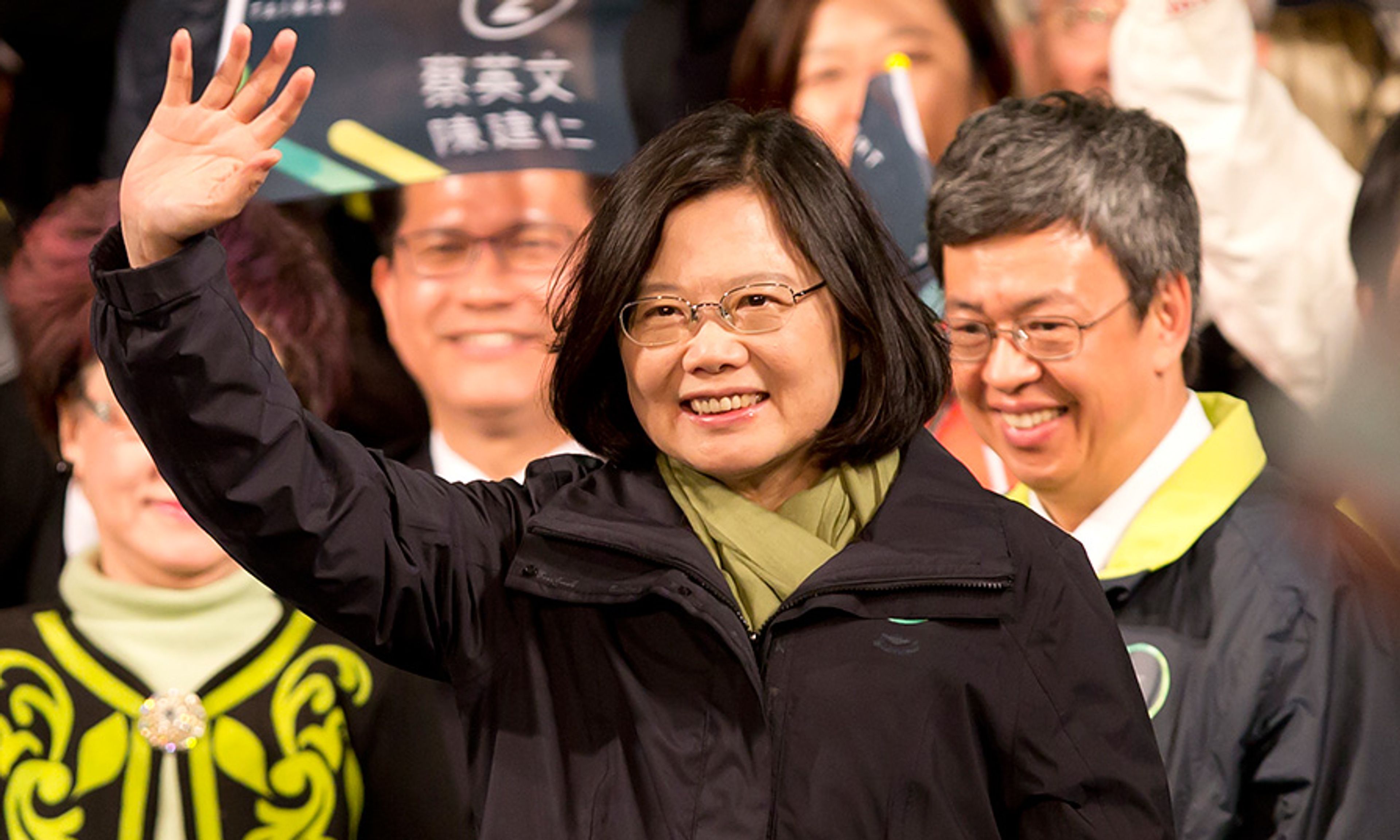
To refresh your memories: Like Korea, China is split into a Communist dictatorship and a free-market democracy. The former is the People’s Republic of China, generally called China, or Mainland China; the latter is the Republic of China, colloquially called Taiwan. This week, the Taiwanese had their presidential election. The result is a big deal — for them, and for us.
Beijing’s dictators insist that Taiwan is part of China and that they are, therefore, Taiwan’s legitimate rulers. Taiwan’s official position is similar — that there is only one China, and Taiwan is part of it. But in practice, within Taiwan there is a democratic divergence of opinion on the subject: The Kuomintang party — which founded the pre-Communist Chinese Republic, and which fled the mainland when the Chinese Communists won the civil war — is adamant in its support for eventual reunification, once Communism has been defeated. The Kuomintang regards Taiwan not as a separate country, but as the seat of China’s legitimate government-in-exile. The Democratic Progressive Party, on the other hand, sees Taiwan as a de facto sovereign country and would prefer it to shake off the restrictions of the one-China policy — namely, Taiwan’s inability to join international bodies like the U.N. or have diplomatic relations with any country that wants diplomatic relations with Beijing. The DPP is Taiwan’s primary and perennial opposition party; since the island’s bloodless democratic revolution in the Nineties, the DPP has won just two four-year presidential terms, and has never had a majority in the (one-house) legislature.
And that’s how Mainland China likes it. Despite having been the Communist Party’s mortal enemy in the civil war, the Kuomintang is functionally pro-China: It supports close relations with the Mainland, to keep the two territories culturally and economically connected in anticipation of an eventual free-market reunion. (Which, of course, is no ignoble ambition.)
Powerhouse that it is, Beijing believes it should always get what it wants.
These days, powerhouse that it is, Beijing believes it should always get what it wants. Mainland China responds to independent stirrings on Taiwan with military build-ups or war games on its side of the Taiwan Strait, and has even gone so far — in 2005 — as to pass an “anti-secession law,” which calls for the People’s Liberation Army to keep Taiwan in line, if necessary. And China’s threats are not idle. China has Taiwan outnumbered 60 to 1. Despite Taiwan’s having Israeli-style conscription, China’s military has 10 times more men than Taiwan’s, and spends 15 times as much. Even so: This election season, China overplayed its hand.
As Taiwan’s presidential campaigns warmed up, China’s dictator, Xi Jinping, warned the island’s voters away from the DPP, saying that if he sees Taiwan moving toward independence, the “earth will move and mountains will shake.”
#share#Free people don’t like being dictated to. They don’t like being threatened. If Xi’s pronouncement wasn’t enough to galvanize Taiwan against its pro-China party, something that happened the day before the election was:
A 16-year-old Taiwanese pop singer named Chou Tzuyu is a member of a Korean dance group called Twice. In a new Twice music video, the group’s Korean members showed off Korean flags, and its Japanese members showed off Japanese flags, and Miss Chou held up the flag of Taiwan. China considers Taiwan’s flag — which was the flag of pre-Communist China — a symbol of resistance to its authority. So much so, in fact, that it succeeded in getting the flag banned from the Olympics. So when Miss Chou appeared on TV holding it and smiling, China condemned her and instantly terminated her band’s contract to play a nationally televised show on China’s New Year’s Eve.
Soon thereafter — on the day before Taiwan’s election — a chastened and humiliated Miss Chou appeared in a hostage-style apology video, stone-faced and pale in front of a grey backdrop, reading a pre-written, abject apology for having dared to appear in public with her flag. Miss Chou bows deeply, says she feels “very, very sorry and guilty” for her “inappropriate words and actions,” adding that “there is only one China. The two sides of the Taiwan Strait are one.”
By election day, the video, intended for a Beijing audience, had spread across Taiwan like the Spanish flu. The BBC quoted one angry Taiwaner’s response to it: “Those of you who haven’t voted yet, use your vote to fight back. Today is D-Day.”
The DPP probably would have won the election anyway. The current president, Kuomintanger Ma Ying-jeou, is unpopular; he’s been in office for eight years, and during his administration, Taiwan’s gangbuster economy slowed down. But China’s belligerence turned the election into a landslide: The DPP beat the Kuomintang by a staggering 25 points, and picked up 28 seats in Taiwan’s 113-seat legislature, enough for a commanding majority.
There’s no other way to look at this than as a victory for democracy, and a blow to bullies and dictators — like Churchill promising the world that Britain would “outlive the menace of tyranny — if necessary, for years, if necessary, alone.”
“We shall defend our island, whatever the cost may be. . . . We shall never surrender.”
China responded to the election by calling for an end to “hallucinations of Taiwan independence,” and warning that if Taiwan’s new administration crossed “the red line,” Taiwan would “meet a dead end.”
#related#Churchill’s “never surrender” speech ends, “If — which I do not for a moment believe — this island or a large part of it were subjugated and starving, then our Empire beyond the seas, armed and guarded by the British Fleet, would carry on the struggle, until, in God’s good time, the New World, with all its power and might, steps forth to the rescue and the liberation of the old.”
Of course, Germany never invaded Britain, but the New World — that is, We the People — did in fact step forth to the rescue and the liberation of Europe. As we did in South Korea. If necessary, I believe we would do the same in Taiwan. Certainly, this true liberal democracy should have our help.
In the meantime, it has certainly earned our admiration.
— Josh Gelernter writes weekly for NRO and is a regular contributor to The Weekly Standard. He is a founder of the tech startup Dittach.




Comments