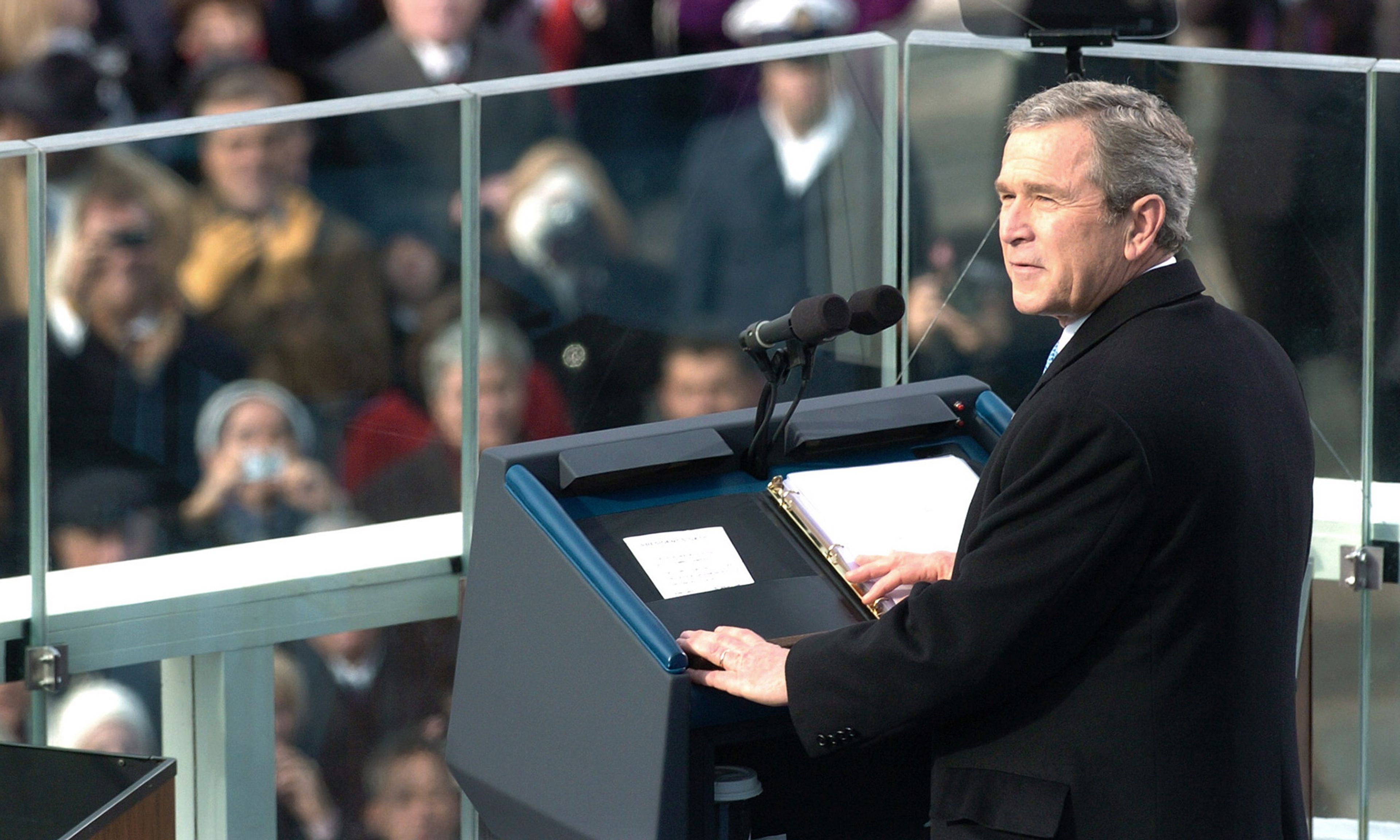
How does President Bush’s second inaugural address, meant to be the defining speech of his presidency, look in retrospect? Exactly the way it seemed at the time — a grossly simplistic vision of the universal victory of liberty that created an impossible standard for Bush to meet in his second term.
Inaugural addresses by their nature are soaring rather than programmatic, aspirational rather than concrete. The basic idealism of President Bush’s address is firmly within the mainstream of the American foreign-policy tradition and echoes the rhetoric of Ronald Reagan, especially his 1982 address to members of Parliament at Westminster Palace. Arguing that freedom is “the inalienable and universal right of all human beings,” Reagan expressed his confidence in the “march of freedom and democracy which will leave Marxism-Leninism on the ash-heap of history.”
Reagan’s speech included caveats (“We must be cautious about forcing the pace of change”), and so did Bush’s. Even as he set out “the ultimate goal of ending tyranny in our world,” Bush said that it “is the concentrated work of generations” and noted “the difficulty of the task.” But Bush seemed too often to believe his most sweeping formulations were an actual guide to how the world works, and, as such, the address formed the intellectual backdrop to the failures of the Iraq War.
According to immensely talented former Bush speechwriter Mike Gerson’s book Heroic Conservatism, Bush told Gerson he wanted the inaugural to be “the freedom speech.” The freedom speech was what he got, in Gerson’s characteristically writing-for-the-ages tones, without enough consideration of how the stirring words related to reality.
“The survival of liberty in our land,” Bush said, “increasingly depends on the success of liberty in other lands.” In the context of the War on Terror, this is false. Terrorists have thrived more in ungoverned spaces than in tyrannies. In this sense, the threat to the survival of our liberty is the absence of strong states — in places like northwest Pakistan, Iraq prior to the surge, Somalia — rather than the absence of freedom. Iran is a tyranny that sponsors terror and represents a threat to American interests, but if it were a garden-variety Middle Eastern authoritarian regime allied to the United States, we wouldn’t care so much about its political system.
Bush insisted that “America’s vital interests and our deepest beliefs are now one.” This assertion of a harmonic convergence between our interests and values is based on the belief that tyrannies foster terrorism, and also on the straightforward observation that the states most hostile to the United States are dictatorships. Not all tyrannies are incubators of terror, however, and some tyrannies are our allies. The world is much too complicated for there ever to be a perfect identity between our interests and our values, and compromise and judgments based on gradations of grey will always be the coin of international relations.
Bush didn’t merely exhort, he promised to act on his rhetoric. In the kind of language that caused worried embassies to call the White House in the aftermath of the address, Bush declared, “We will encourage reform in other governments by making clear that success in our relations will require the decent treatment of their own people.”
Back in the real world, Bush couldn’t possibly act consistently on this pledge. The administration spent years propping up a general who took power in a coup in Pakistan, believing he was better than the alternative, including the country’s democratic opposition. Its bulwark in the Persian Gulf was Saudi Arabia, a country notorious for its denial of basic freedoms. An embarrassed Condi Rice traveled to Egypt and didn’t even speak in public the name of dissident Ayman Nour because doing this would so irk the government, with which smooth relations were more immediately important than human rights.
The way Bush handled relations with each of these countries was eminently reasonable, but his inaugural address set up his pragmatism to appear as if it were self-betrayal.
The address was informed by an incomplete view of human motivation and psychology. “Eventually, the call of freedom comes to every mind and every soul,” Bush asserted. This is fine as aspirational rhetoric, but it’s probably not true. Countless millions of people all over the world are concerned more with survival than with freedom, more desperate for communal power than for liberty, more willing to fight for the preservation of tradition than for democracy. Especially in the remote places, tribal societies, and failed states that provide most of the landscape of the War on Terror.
Early in the war, Bush and his administration seemed to believe that Iraq was inhabited by the abstractions of his second inaugural, rather than real people motivated by more immediate concerns than the “call of freedom.” When Iraq nearly descended irrevocably into civil war in 2006, its downward slide would have been inexplicable to the George W. Bush of the second inaugural.
That descent was driven by a lack of order (because of insufficient U.S. troop levels and a weak Iraqi government), by history (the minority Sunnis were used to ruling the majority Shiites), by a power struggle (among and within the key ethnic groups), and by sheer bloodlust (once the cycle of revenge really got going). The pure concept of freedom as outlined in the second inaugural didn’t have much of anything to do with it, nor with the solution.
The surge was an application of force to restore order. A key element of it was the Anbar Awakening: the revolt of the Sunni tribes against al-Qaeda. They didn’t fight for an abstract notion of freedom, but to defend their way of life and their homes against foreign Islamic extremists. They fought for their honor and their traditions. Talk to the American military officers involved in the surge’s success and they will tell you how important it was to be immersed in Iraqi culture and know the key tribal players in their particulars — who really has influence, who hates whom and why, etc.
Bush gave a nod to the world’s distinctive cultural landscape in his address, but it was only a nod. “When the soul of a nation finally speaks, the institutions that arise may reflect customs and traditions very different from our own,” Bush said. The “soul of the nation” was presumed to speak only when a country embraces democratic institutions. But surely we have seen something of the soul of Russia in the czarist, Communist, and Putin eras, or the soul of China under the emperor, Mao, and its current authoritarian capitalism.
It can’t become an excuse for repression or savagery, but a statesman should have a keen appreciation of the world’s cultural differences, as expressed by Aleksandr Solzhenitsyn in his 1970 Nobel lecture: “The disappearance of whole nations would impoverish us no less than if all people were to become identical, with the same character and the same face. Nations are the wealth of humanity, its generalized personalities. The least among them has its own special colors, and harbors within itself a special aspect of God’s design.”
Foreign policy shouldn’t be over-ideologized. It has to be an intensely practical exercise, carried out with prudence and wisdom. Sweeping theories need not apply. The nation’s interests must be paramount, and usually — but not always — they will be coincident with the spread of more open and democratic societies.
It is true that in the fight with Islamic extremists, we have to offer a positive alternative. As Bush put it in an Oval Office interview recently, “The ability to defeat an enemy ideologically is to offer a better ideology.” But there is a lot of appealing ground between the dark vision of al-Qaeda and the universal vindication of the Declaration of Independence that Bush set out in his Second Inaugural. For most of the hearts and minds for which we are fighting in the greater Middle East, basically competent and just government is probably an alluring enough alternative — and difficult enough to achieve.
If a somewhat stable and democratic Iraq endures, Bush will have forged a historic accomplishment. He will have replaced an enemy with an ally, a dictatorship with something better. As conservatives debate a post-Bush foreign policy, they’d be well advised to start with how Bush saved Iraq post-2006 — in a culturally attuned counterinsurgency campaign with the minimalist goal of ousting al-Qaeda while accommodating traditional local players — rather than with the millennial vision of the second inaugural. In this case, it’s do as he did, not as he said.






Comments