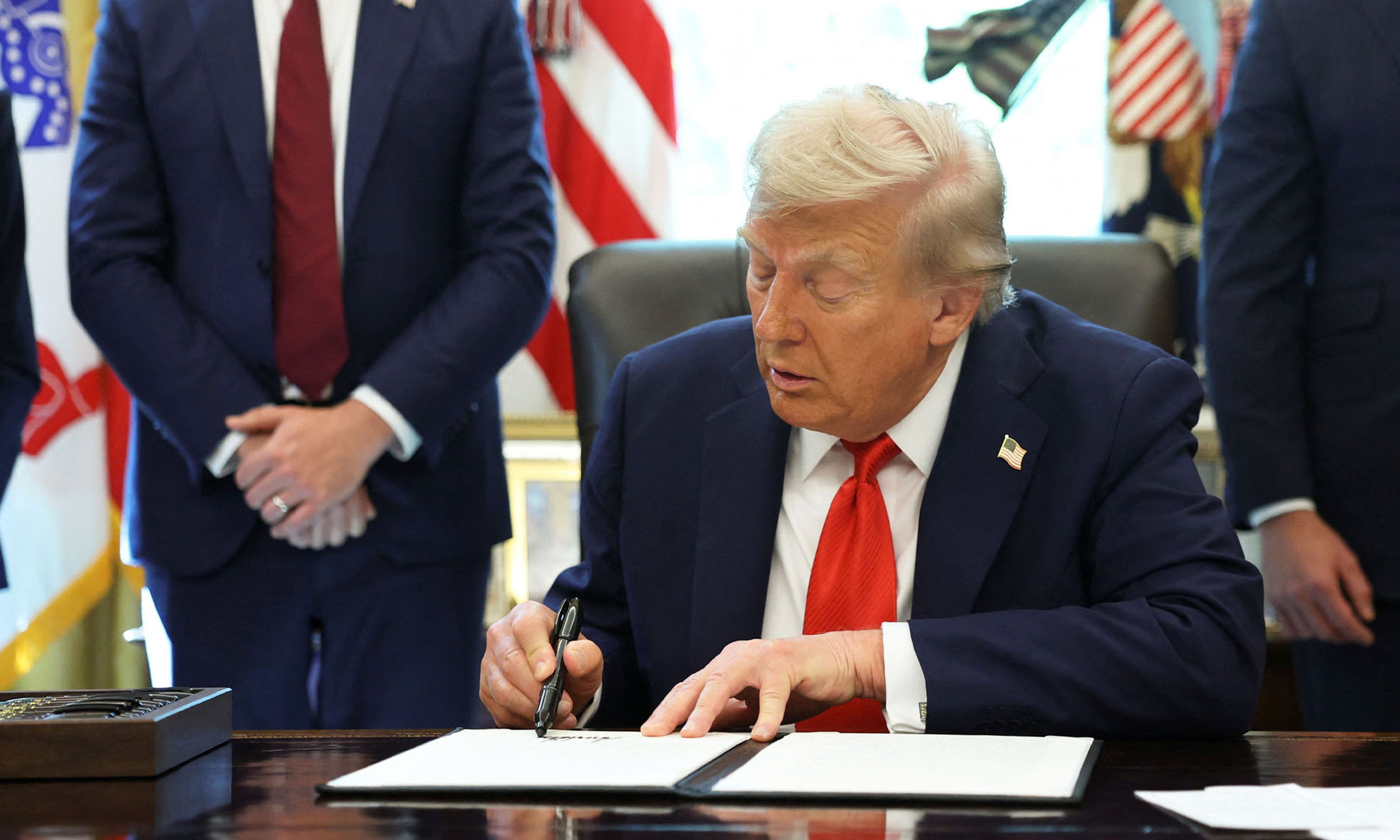
President Trump intends to crack down on critics of the United States who burn the American flag. Or, at least, President Trump wants to give the impression that he harbors such an intention. Yesterday, at an event in the Oval Office, Trump signed an executive order designed “to restore respect and sanctity to the American Flag,” and expressed the view that “people that burn the American flag should go to jail for one year.” People “don’t want to see our American flag burned and spit on,” Trump averred, before contending that the Supreme Court’s twice-issued defense of the practice was “very sad.”
In my estimation, those two decisions — issued, back-to-back, in 1989 (Texas v. Johnson) and 1990 (United States v. Eichman) — were correctly decided. Reflecting on the matter in 2012, Justice Antonin Scalia explained that, while he personally loathed flag-burners, the First Amendment “guarantees the right to express contempt for the government, Congress, Supreme Court, even the nation or the nation’s flag,” and that, as a judge rather than a politician, he was obliged to uphold the law. This view was decidedly unpopular. Even now, 36 years after that precedent was set, polling shows that a majority of voters wish that it were a federal crime to burn an American flag. Within that majority are President Trump and Vice President Vance — both of whom have expressed the view that the Supreme Court got it wrong. Politically, the pair are on the right side of public opinion. Legally, they do not have a leg to stand on. Until it is repealed or altered, the First Amendment is still in force. Until a subsequent case limits or reverses its holding, Texas v. Johnson will define it in this realm.

Comments