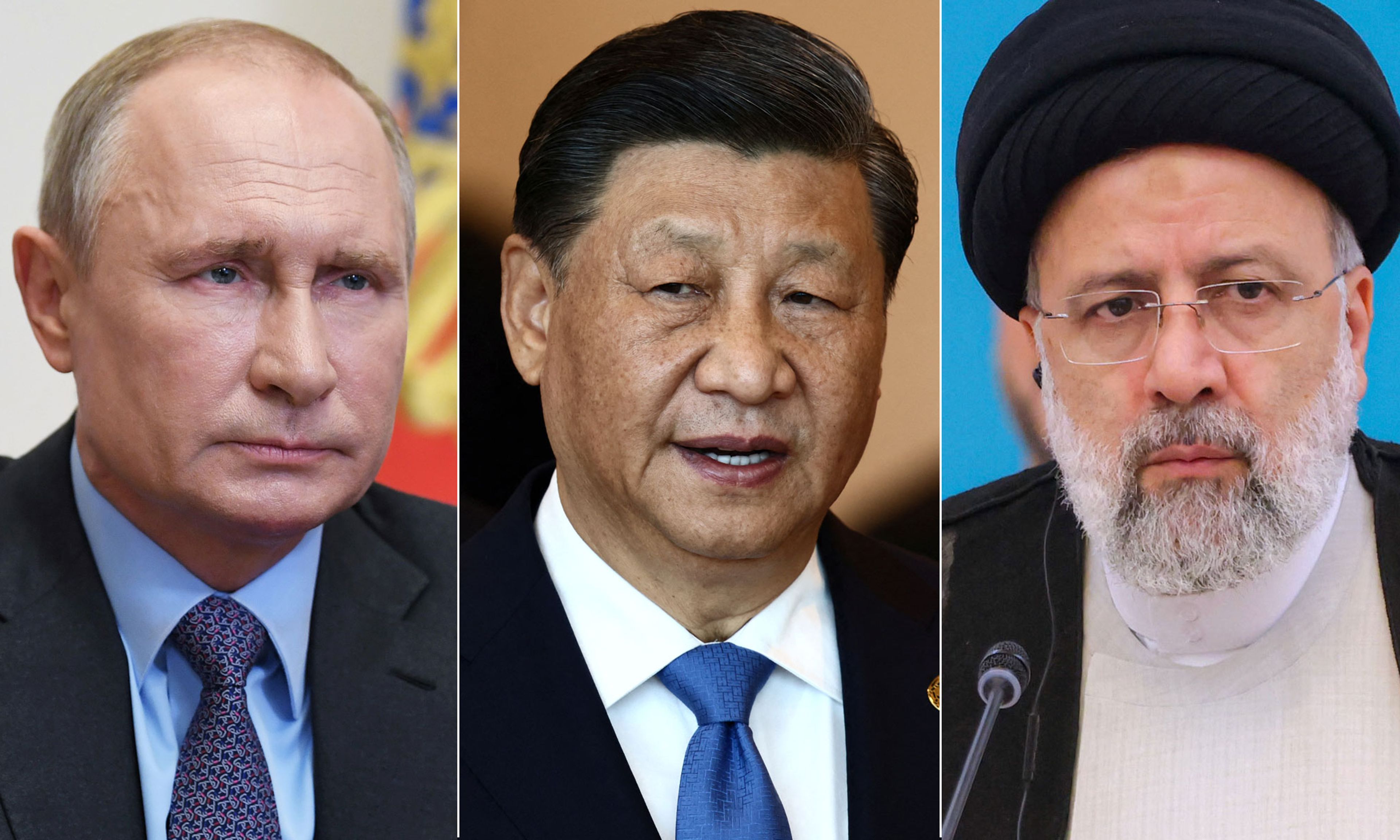
Today, the challenges to American hegemony and the Western-led world order have become obvious and direct. Still, China, Russia, Iran, and their second-tier proxies (Venezuela, North Korea, Syria, et al.) are often viewed as separate trials for the West to deal with. Each wishes to claim predominance in its own near abroad, and politicians and pundits tend to address them separately. The debates over prioritization have been fierce; some want a focus on the war in Ukraine; others, a shift of priorities to the Pacific. Differences over how to deal with Iran are just as stark, while some have failed to see it as a threat at all.
What these debates miss, however, is the very crux of the matter: These seemingly disparate challenges are inextricably bound together. They are all rooted in the same goal: the demolition of the American-led world order and its replacement with hard spheres of influence. Segmenting the challenges into regional siloes is tempting but fails to address their root cause and shared mission. It also ignores the reality of the situation, as these three powers — China, Russia, and Iran — have far more in common than base motivations.




Comments