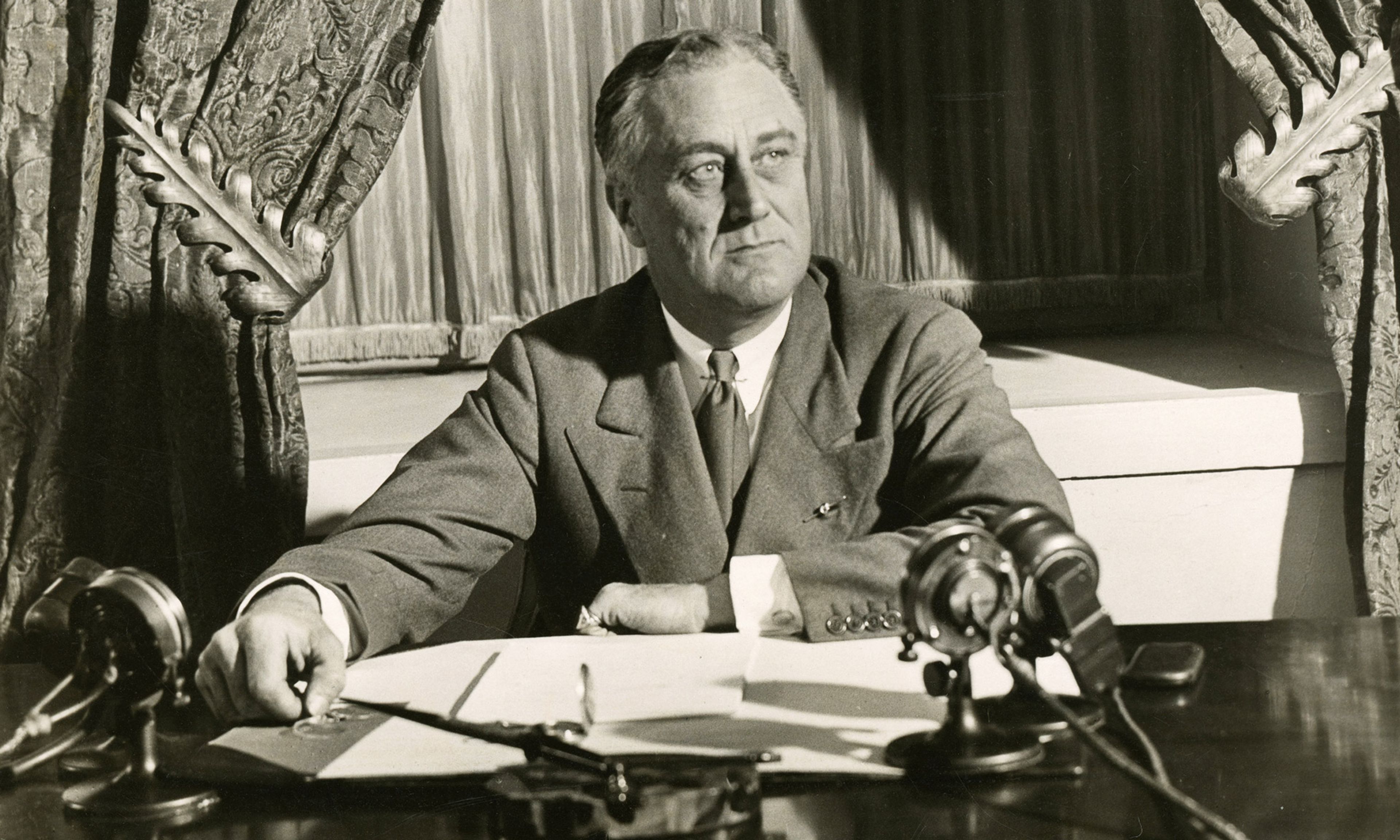
This is a rigorous and readable work by H. W. Brands, a very accomplished biographer. At 824 pages of text, it is not overlong for its complicated subject, but it is a bit eccentric about what is included and what is left out. Thus we have two pages on an obscure press conference about the applicability of the unconditional-surrender policy to post-Mussolini Italy (it was waived), and two pages about whether the U.S. would send troops to Malaya in 1942 (a mad idea that was not seriously considered).
Yet the reader scours the book in vain for a reference to Joseph P. Kennedy’s famous telephone call to William Randolph Hearst during the Democratic convention in 1932, to help clinch the nomination for Roosevelt; or to the careful calculations behind Roosevelt’s neutrality in the Spanish Civil War, where most Americans favored the Spanish Republicans, but most American Roman Catholics supported Roosevelt but also supported the Spanish Loyalists (a different course could have lost him the 1940 election). There is no mention of Federal Reserve chairman Marriner Eccles, and particularly not of his important Keynesian intervention to help reverse the economic relapse of 1938. Roosevelt’s prescient warning to Stalin in August 1939 that a non-aggression pact with Hitler would lead to a German attack on the USSR in two years isn’t recorded here.
The historical minuet with Japan prior to Pearl Harbor is sketchily covered. Japan imported 85 percent of its oil from the United States. Roosevelt imposed a virtual embargo on oil exports to Japan, as well as on scrap metal that was vital to the Japanese steel industry. When he and Churchill met in August 1941, Churchill asked for these embargoes to be made absolute; he wanted the U.S. to help protect Malaya and Hong Kong from the Japanese, and sought to provoke war between Japan and both Britain and the U.S., Hitler not having swallowed the bait of Roosevelt’s considerable provocations.
Roosevelt declined, saying he wished to retain some leverage to promote a more conciliatory Japanese attitude. He was unaware that his undersecretary of state for economic affairs, Dean Acheson, had rejected the Japanese request to buy American oil, and had effectively imposed his own embargo. FDR discovered this when he returned to Washington and looked into it, but he didn’t reverse Acheson’s “policy.” There is brief reference in this book to Roosevelt’s “modus operandi” of 1941, which would have partially lifted the embargo, but no analysis of why FDR withdrew it. Roosevelt weighed whether to press Japan so hard it would be likely to go to war, or whether to relent somewhat to enable the U.S. to continue its massive rearmament program in peace. His concern, then and subsequently, was whether Stalin would leave the German war, as Lenin and Trotsky had done in 1917.
As the Japanese leaders considered whether to attack to the south, to secure more oil (from what is now Indonesia), the Germans were swarming toward Moscow and Leningrad. When Japan did turn south and deployed its forces away from the Manchurian border with the USSR, Roosevelt advised Stalin, who was able to deploy 400,000 soldiers from the Far East to a last-ditch defense of the country’s two principal cities. Roosevelt concluded that it was worth the high risk of imminent war with Japan and probably Germany too, before the U.S. was fully prepared, to avoid the risk that Stalin might make peace and leave Hitler in unshakeable control of Europe.
Brands rightly criticizes the imprudence of Hitler’s invasion of the USSR, but Hitler knew that he couldn’t subdue Britain and was already at war with the U.S. by several criteria. If his relations with Roosevelt descended into outright hostilities, he could not rely on Stalin to avoid Anglo-American inducements to attack Germany.
These equations aren’t really addressed here. Brands describes the first meeting between Roosevelt and Stalin just before the start of the Tehran Conference in 1943, but does not refer to the main point of it: Roosevelt recruited Stalin to support the cross-Channel invasion of France over Churchill’s preferred operations in the Mediterranean and Adriatic, or even Norway. This was one of Roosevelt’s greatest successes: Stalin allegedly believed, as the chairman of the British general staff, Sir Alan Brooke, did, that Hitler would be helpfully distracted from the Eastern Front — but Stalin (and Brooke) also thought that Hitler would ultimately push the Western Allies out of France as he had at Dunkirk and Dieppe. Thus, Roosevelt recruited Stalin, the emerging chief future rival of the U.S., to override the caution of Churchill, America’s greatest and truest ally. (Brands is gratuitously critical of Churchill at times; he virtually accuses him of causing the Great Depression with his policies as chancellor of the exchequer in the 1920s.)
There is no mention here of the 1944 Warsaw Uprising, of the Morgenthau Plan for the pastoralization of Germany, or of the European Advisory Commission (which demarcated post-war German occupation zones). Nor is there reference to either Quebec Conference (or indeed Canada in any significant context, including that Canadians took one of the five beaches at Normandy).
Nonetheless, the author very accurately summarizes the strategic interests and actions of the Big Three, and steers admirably clear of the ancient and unutterably irritating Yalta Myth, i.e., that Roosevelt was swindled by Stalin into handing over Eastern Europe. The balancing act between atomic development and the desire to have the USSR take a large share of the casualties if an invasion of the Japanese home islands did prove necessary is also well and fairly presented.
Brands is overly indulgent of Roosevelt’s outrageous meddling in Britain’s relations with India. He accurately writes that Roosevelt believed India had been pillaged by Britain for two centuries, and that Roosevelt had some doubts about the fighting qualities of the British Indian army, but seems to have some sympathy for these mistaken, even ignorant, opinions. The British controlled the Indian Empire of 500 million people with never more than 100,000 resident British, about three-quarters of them military, and they did so with less bloodshed and brutality than the U.S. southern states inflicted on 10 million blacks over the same period. The Indian army of 3 million was a first-class fighting force and Brands is right, as well as insightful, to point out that this strategic asset was vital in allowing Britain to take its place at the high table with the Russians and Americans.
Churchill made short work of Roosevelt’s flippant comparisons of India to revolutionary America. Roosevelt’s posturings in support of Gandhi were also tiresome, as Churchill patiently suggested when he mentioned Gandhi’s desire to offer the Japanese free passage through India to join up with Germany in attacking Russia and the Middle East. (Unfortunately, he spared mention to FDR of Gandhi’s proposal to the European Jews to acquiesce in being genocidally liquidated to achieve historic admiration and eternal peace.) In other respects, Roosevelt’s concern about the potential flammability of colonial areas was well founded, and Brands is right to credit him for it. Less impressive is the author’s indulgence of Roosevelt’s fatuous courtship of Vichy France, and of his lengthy underestimation of de Gaulle (partly corrected in the last year of his life).
His handling of Roosevelt’s domestic record is consistently strong, but concedes more than it should to the conventional wisdom that the New Deal was fundamentally unsuccessful against the Depression. Brands correctly recognizes that Roosevelt’s greatest genius, apart from the political arts, was his talent at raising and sustaining public morale and inspiring the nation. But he follows the lead of other distinguished pro-Roosevelt historians, including William Leuchtenburg and Doris Kearns Goodwin, in accepting the assertion that U.S. unemployment levels were much higher through the Thirties than those in Germany, Britain, or France. To the extent there is any truth to this, it is because the people drafted into the armed forces or defense industries in huge numbers by those countries in the mid and late Thirties are accepted as employed, while Roosevelt’s millions of workfare participants are not. (Even if those in the New Deal workfare programs are considered unemployed, the New Deal brought unemployment down from 33 percent in 1933 to 12.5 percent in 1936, and to 1 percent in the summer of 1941.) The New Deal had its shortcomings, but it was a social, economic, and cultural success, as well as a popular success that assisted Roosevelt to three reelection victories with an average of over 55 percent of the vote.
Unfortunately missing from the chronicle of Roosevelt’s astounding political virtuosity is the disenfranchisement of almost all of the 13 million members of the armed forces outside their normal voting districts in 1944. The southern Democrats and conservative Republicans united to prevent, respectively, the blacks from acquiring the habit of voting, and the soldiers, sailors, and airmen from voting for their commander-in-chief. Only Roosevelt’s great popularity and unassailable record as war leader prevented a disgraceful theft of the 1944 election.
There are an inexplicable number of small errors in this book. John N. Garner had no interest in being vice president in 1932; Roosevelt wasn’t “haunted” by his pledge in 1940 not to send American youth into foreign wars; he did not regret giving the 1937 Quarantine speech; Henry Wallace wasn’t the vice president in September 1940; and the sinking of the British capital ships Prince of Wales and Repulse did not cause the fall of Singapore, which was attacked and overrun by land. There was no possibility that Churchill would come all the way to Washington on HMS Duke of York in December 1941, because the Potomac and its bridges are inhospitable to 40,000-ton battleships drawing 35 feet of water and looming 140 feet above the water. These errors and others are trivial, but they are distracting. There are 57 short chapters, which assists readability in some ways, but makes the book somewhat episodic and impedes a gripping narrative, which Roosevelt’s career can certainly incite.
The book is well written and has some light moments. Of FDR adviser Louis Howe, Brands writes: “He knew where Tammany had buried the bodies (metaphorically for the most part).” Stalin “didn’t shoot his subjects as often as he had during the 1930s, in part because the Germans were shooting so many that he couldn’t afford to waste the remainder.”
The author’s basic conclusions — on Roosevelt’s leadership qualities, physical courage, personal magnetism, political ingenuity, and moral authority — are well and eloquently made. His enumeration of his subject’s immense achievements, in redefining American government and integrating the country into a world desperately in need of American ideals and strength, is equally well and irrefutably argued. This is a slightly idiosyncratic book, but is not less interesting for that, and it is a valuable addition to the Roosevelt literature.





Comments