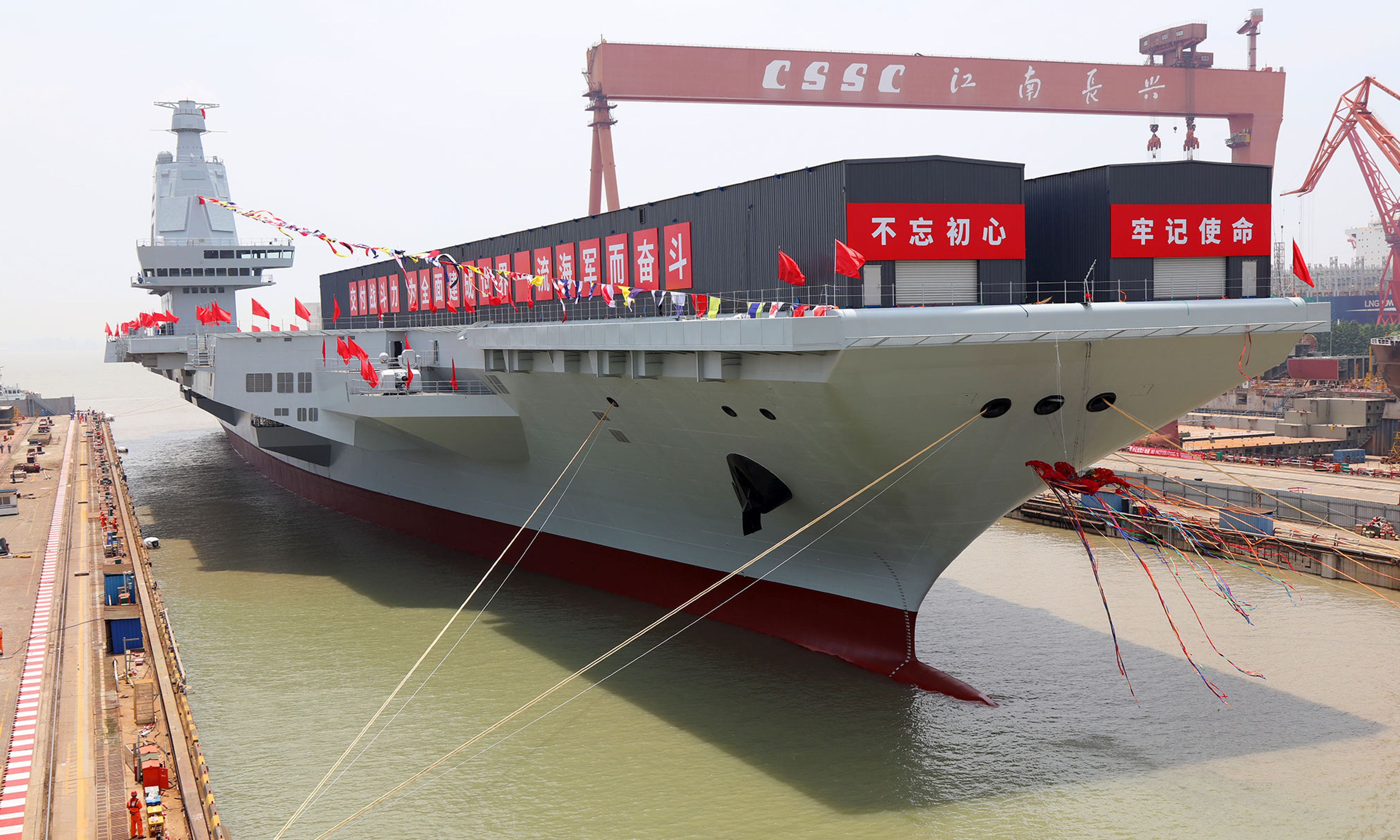
Two weeks ago, China launched the Type 003, 80,000-ton, “super” carrier Fujian, its first carrier capable of launching planes with catapults and catching them with arresting gear upon landing. While it has been operating two other aircraft carriers, the former Soviet Union–built 60,000-ton Liaoning and the indigenously built 70,000-ton Shandong, since 2012 and 2019 respectively, these two ships represent older, less technically challenging short takeoff but arrested recovery (STOBAR) designs. The Fujian is a thoroughly modern “CATOBAR” carrier design (Catapult Assisted Take-Off Barrier Arrested Recovery), truly a “supercarrier” equivalent in displacement to the now retired Forrestal-class U.S. Navy aircraft carriers that first entered service in the 1950s, but also incorporating advanced electromagnetic catapults that have only just entered service in the American fleet. Such a rapid design evolution and construction program suggests a substantial technological achievement that bridges the gap between the commissioning of the USS Langley a century ago and the commissioning of the electromagnetic-capable USS Ford in 2017. China has made a very significant strategic leap in the span of a decade.
This news should be taken with a note of caution. While it is true that the Fujian is in the water and beginning her sea-trial period, there is nothing to suggest that she is fully capable. As the ship was launched, large structures could be seen on her flight decks covering each of her three electromagnetic catapults. Just as it is true that the U.S. Navy’s newest carrier, the Ford, has not been operationally deployed yet due to technical difficulties with its catapults, arresting gear, and internal aircraft and weapons elevators, it is likely that it will be some time yet, perhaps even years, before the highly complex systems onboard China’s new carrier are properly tested and made operational.





Comments