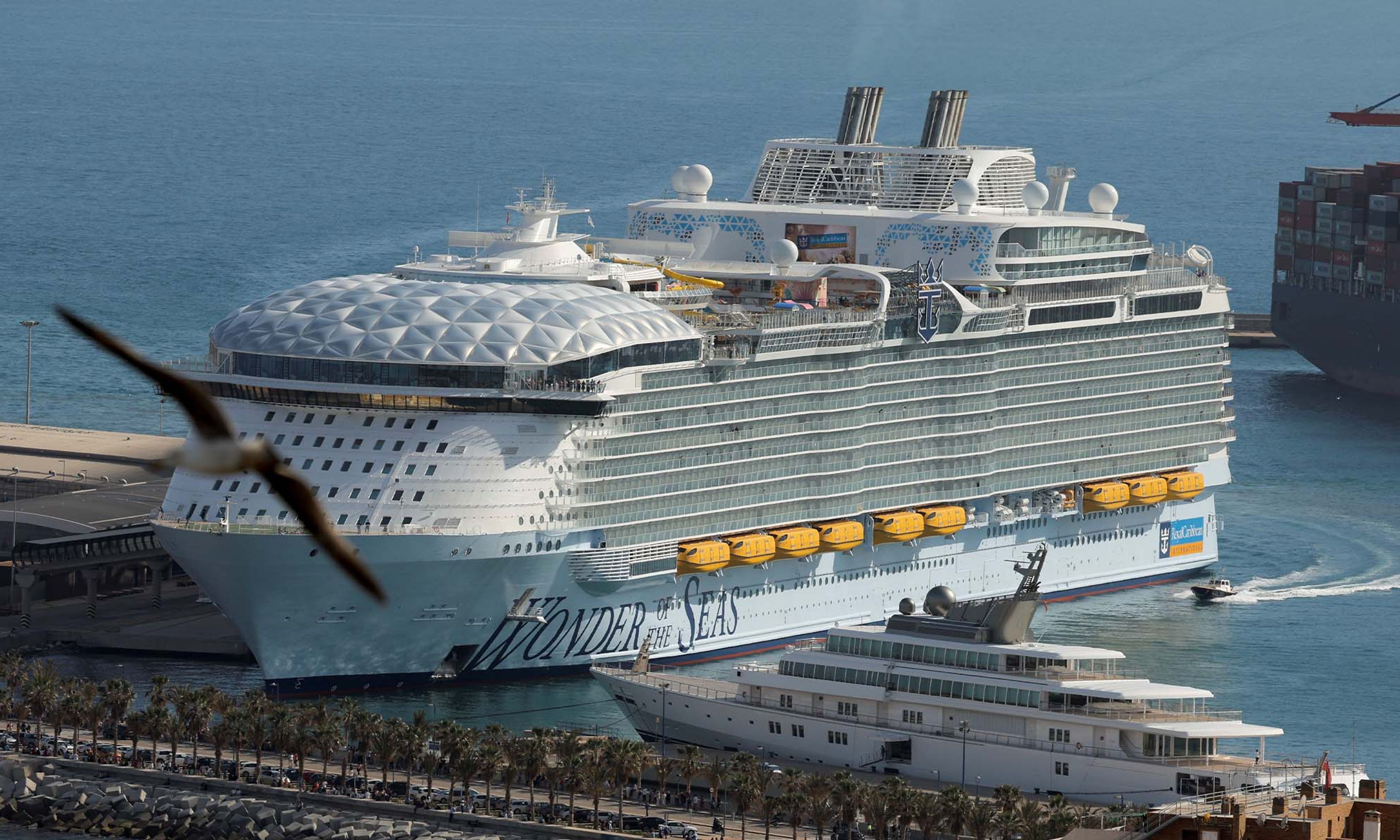
In the Atlantic Ocean — On the National Review Institute cruise to the Eastern Caribbean, it’s impossible not to notice how global the cruise industry is.
The boat on which we are traveling, the Sky Princess, was built in an Italian shipyard. She’s powered by Finnish engines. She’s flagged in Bermuda, captained by an Italian, and the roster of senior officers includes people from Croatia, the Netherlands, Spain, Slovakia, and Poland. Her roughly 3,700 guests are served by about 1,300 crew members, many of whom are from the Philippines. At this time of year, she sails the Caribbean, but in the summer, she sails in Europe, and in fall, she sails between New England and Atlantic Canada.
The cruise line, Princess Cruises, is an American subsidiary of Carnival Corporation & plc., a British-American joint venture. Carnival Corporation, the American half, is incorporated in Panama. It came about as a result of a series of mergers, including Dutch, German, British, and American corporations.
As a result of this feat of the international division of labor and capital, cruise lines are able to build floating cities that provide entertainment and leisure to people all over the planet. The engineering and creative possibilities that are unlocked by leveraging the resources and talents of the entire world are what make the modern cruise industry what it is.
Yet, the United States, which has more coastline than most other countries and millions of people willing and able to spend money on a cruise vacation, has largely excluded itself from cruises between its own ports.
It’s not the Jones Act, but the Passenger Vessel Services Act (PVSA) that is largely responsible for this outcome. Signed into law in 1886, the PVSA requires any vessel transporting passengers between two U.S. ports to have been constructed in the U.S., flagged in the U.S., and 75 percent owned and crewed by Americans.
As it is obvious to anyone on the Sky Princess, that’s not how the cruise industry operates in 2022. There is no single country that has all the resources and know-how required to successfully design, plan, and operate a modern cruise that Americans would want to go on. It’s a necessarily global undertaking.
So, hardly anyone in the United States undertakes it. Hardest hit is Hawaii, which ought to be a prime cruise destination for Americans from the 48 contiguous states. A 2020 report from the Grassroot Institute of Hawaii explains how the U.S. is made worse off by the PVSA.
The report says, “Foreign cruise liners are allowed to pick up passengers at a Hawaii port and cruise in Hawaii waters, but the passengers may not go ashore at any of the other Hawaii ports unless the vessel also stops at a foreign port.” That requirement essentially disqualifies most possible cruise itineraries because the nearest foreign port to Hawaii is 1,000 miles away.
Cruises beginning and ending at the same U.S. West Coast port can only serve Hawaii if they also stop at a foreign port, which has worked to enrich the Mexican port city of Ensenada, the report says. (The PVSA is also why Alaska cruises stop in Canada or begin in Vancouver, and Canadian interest groups lobby to keep the PVSA in place.)
Cruise lines shouldn’t have to play this government-contrived route-planning game to serve their customers. We know what can happen when government removes these strictures. In 1984, Congress exempted Puerto Rico from the PVSA, and the influx of cruisers contributed to the island territory’s booming tourism industry in the years that followed. The report says, “Congress stipulated that this exemption would remain so long as no PVSA-qualified line offered comparable service. To this day, none have.”
Many Americans would have a lot of fun on a cruise from Seattle to San Diego or Boston to Savannah. But the major cruise lines that actually exist today are largely prohibited from offering those options by the federal government.
There is only one large cruise ship currently in operation that satisfies the PVSA, the Pride of America — which was actually completed in Germany after the federally subsidized U.S. shipyard that started it failed to complete it. Every other cruise ship on the planet, including the Sky Princess that NRI cruisers are currently enjoying, is banned from operating a U.S. cruise. No cruise ship has been fully built in a U.S. shipyard in over 60 years. The PVSA is protecting an industry that does not exist.
Congress should repeal the PVSA and allow cruise lines to offer more options for Americans to relax and have fun without needing a passport. An NR cruise from Houston to Miami, with intermediate stops in New Orleans and Tampa, would be a blast.



Comments