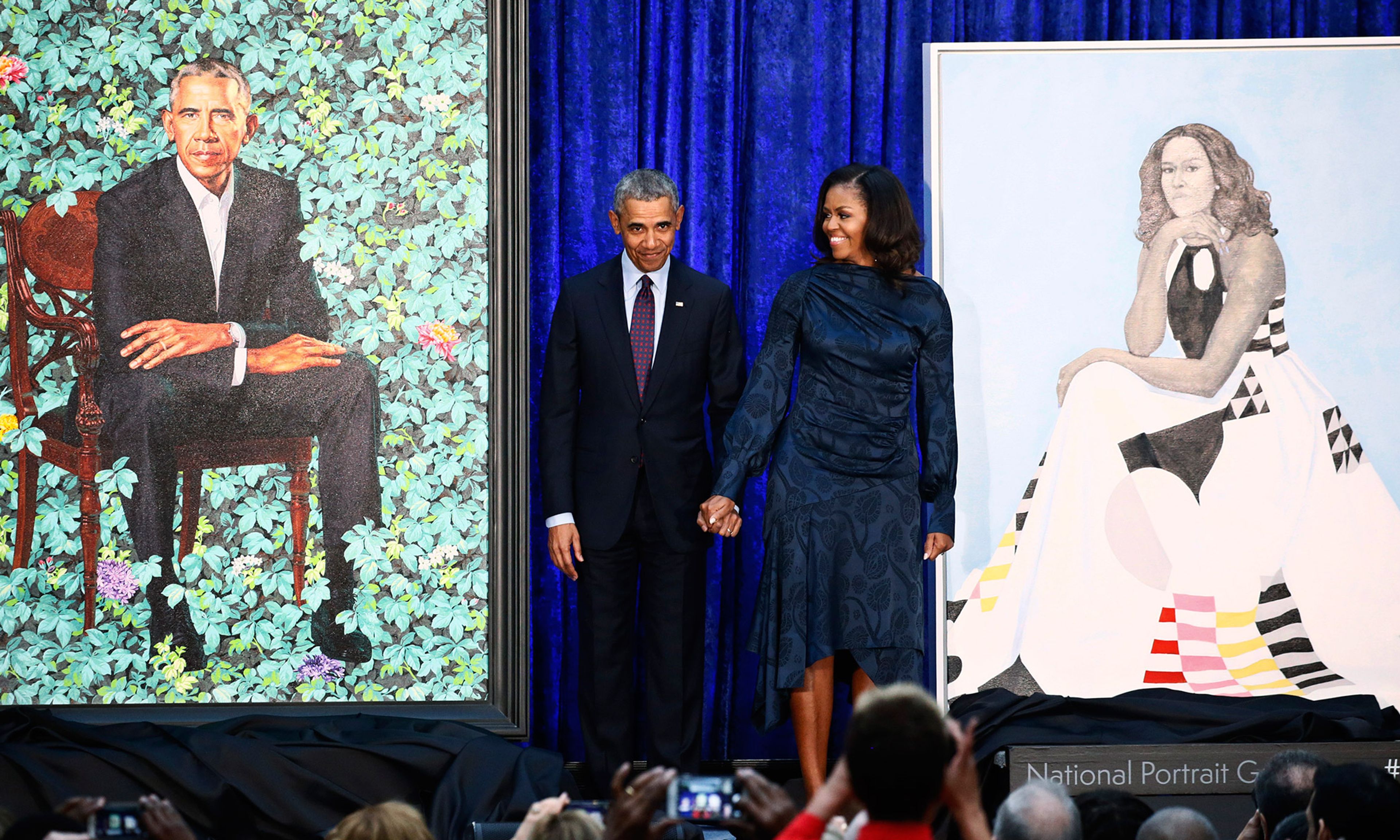
I’ve read plenty about the official portraits of Barack Obama, painted by Kehinde Wiley, and Amy Sherald’s Michelle Obama. I saw them at the National Portrait Gallery last week and like them both.
We Americans famously tossed a king out the door once, but, let’s face it, presidents today are secular royalty.
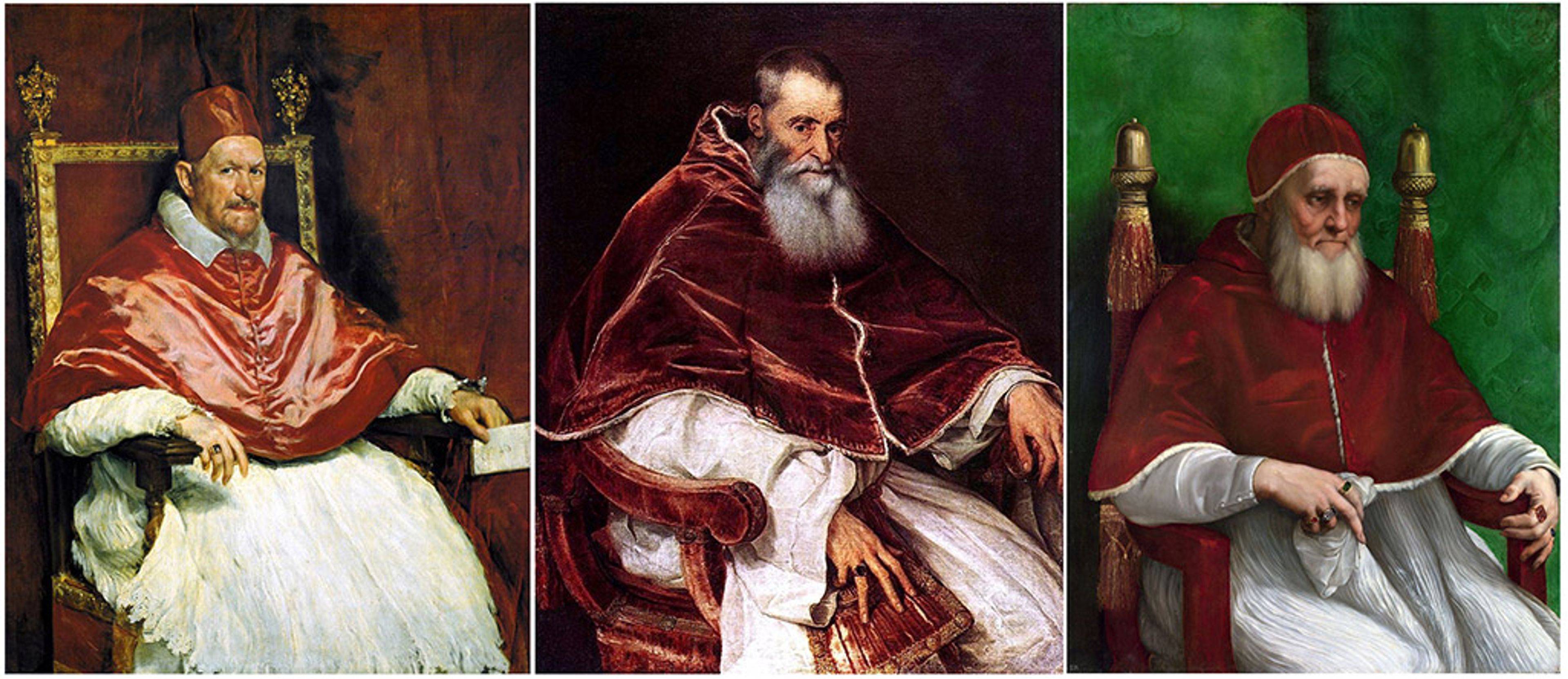
Obama supplements the allure of raw state power with celebrity, school credentials, media smarts, new money, and a cool, pop look. At this hub lies the zenith of style in today’s America. So, we should treat these pictures as we would portraits of kings, popes, and generals by Titian, Van Dyck, Velázquez, and others. Wiley evokes the best of them in authority and elegance. This is good. We need, at least officially, to exalt our presidents.
In looking at American portraits, I think about Thomas Eakins, too. His portraits of men normally show them in their work milieu because work, to him, was the key to character. Wiley doesn’t do this, strictly, though I suppose Obama sees himself in the thought business. Like Eakins when he paints scientists, doctors, and professors, Wiley gives Obama a big, splendid head. That’s where ideas happen. His hands and fingers are prominent and attenuated. Hands, after all, make thought tangible through craftsmanship or, in Obama’s case, writing.
Obama looks directly at us, as if he reads our minds and challenges our assumptions. It’s jarring but effective. He’s formal and familiar, both tense and loose. He leans toward the viewer. It’s not a position comfortably sustained. It’s not repose. It suggests imminent action. For Obama, this probably means he’s about to tell us, “That’s not who we are,” instructing us to question some near-universally held sentiment. Wiley builds the figure with straight lines and diagonals. His suit is dark. Aside from his wedding ring, he’s unornamented. Obama’s open collar softens the effect. It’s his trademark look but seems like a uniform. He’s a role model, so it works.
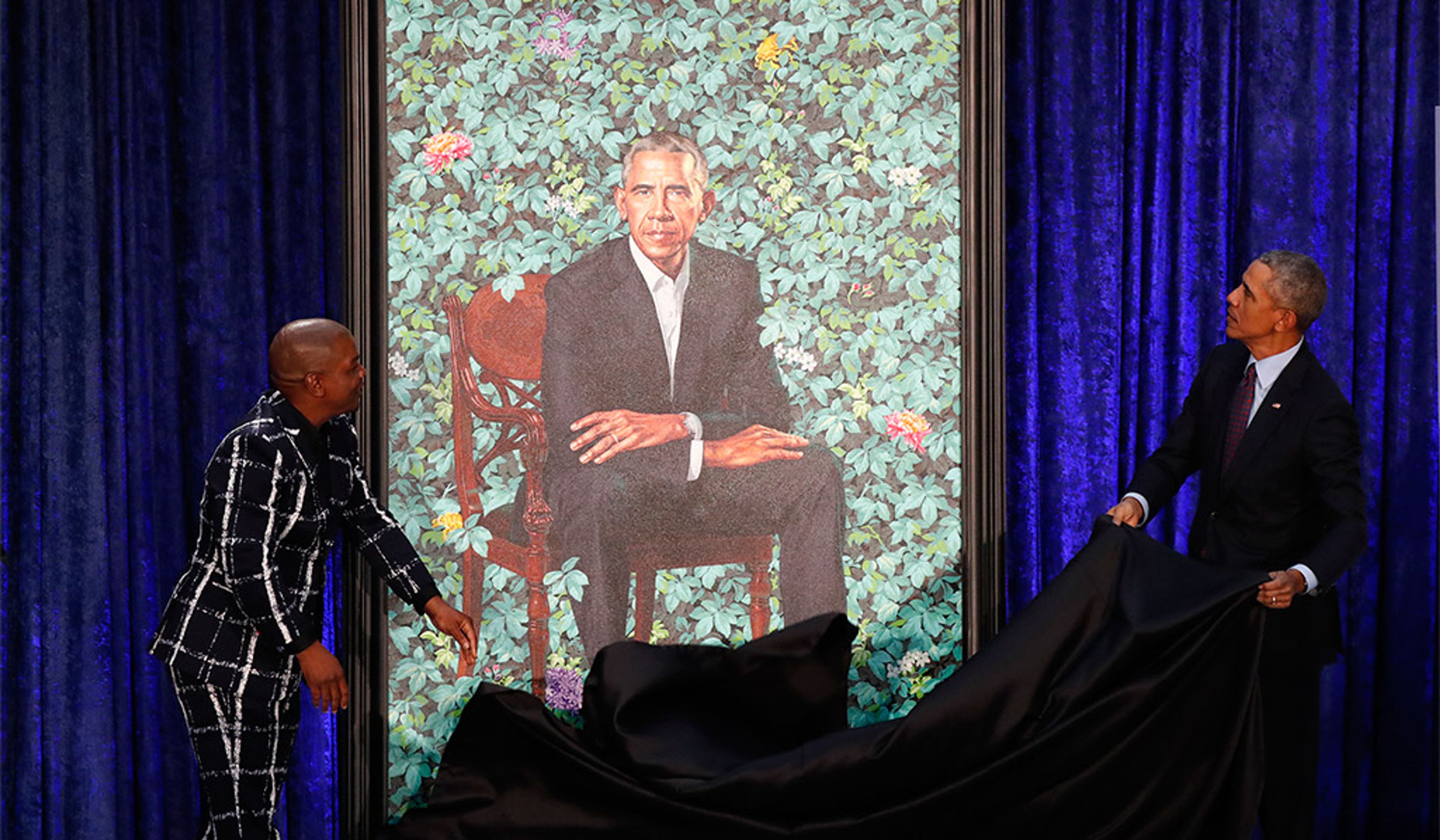
Wiley said he invented the chair. It relieves Obama’s austerity and mediates between the figure and the intricate background and its saturated colors. It’s part Queen Anne, part Chippendale, not much Sheraton, a dash of Hepplewhite. That makes it eclectic, and Obama is proud of breaking molds. It’s looks late Victorian. The late Victorians often had trouble editing themselves.
Wiley uses flat, bright, ornamental backgrounds in his portraits. He says they’re only decorative, like wallpaper. They eliminate the distraction of place. This isn’t the case here, since the flora reference specific places in Obama’s life: blue lilies from his father’s home in Kenya; jasmine from Hawaii; and chrysanthemums, the official flower of Chicago. It’s an iconographic trick with a pedigree. Most art related to Rome’s powerful Barberini family was laden with bees, the family’s symbol. Queen Elizabeth’s portraits and regalia often have thistles, roses, shamrocks, and Wales’s leeks or red dragons for the regional elements of the United Kingdom.
Floral backdrops are almost always reserved for portraits of women. Even in royal portraiture, they link women with nature and nurturing, but we never see them in portraits of queens and empresses who are boss ladies, not consorts along for the ride. Prud’hon’s full-length, seated portrait of Napoleon’s wife, Empress Josephine, from 1809 is a great example. In her forest setting, she evokes fertility and nature’s rule by timeless cycles like the seasons. Ancestral homes, armies, battleships, books, busts of ancient philosophers, or the trappings of work often set off powerful men. Traditionally, Wiley’s treatment would seem to feminize Obama. I don’t mind this bit of gender bending.
When I saw the Obama portrait, I thought of a picture I know well, John LaFarge’s Maua, One of Our Boat Crew, from 1891, at the Addison Gallery at Phillips Academy, where I was director for years.
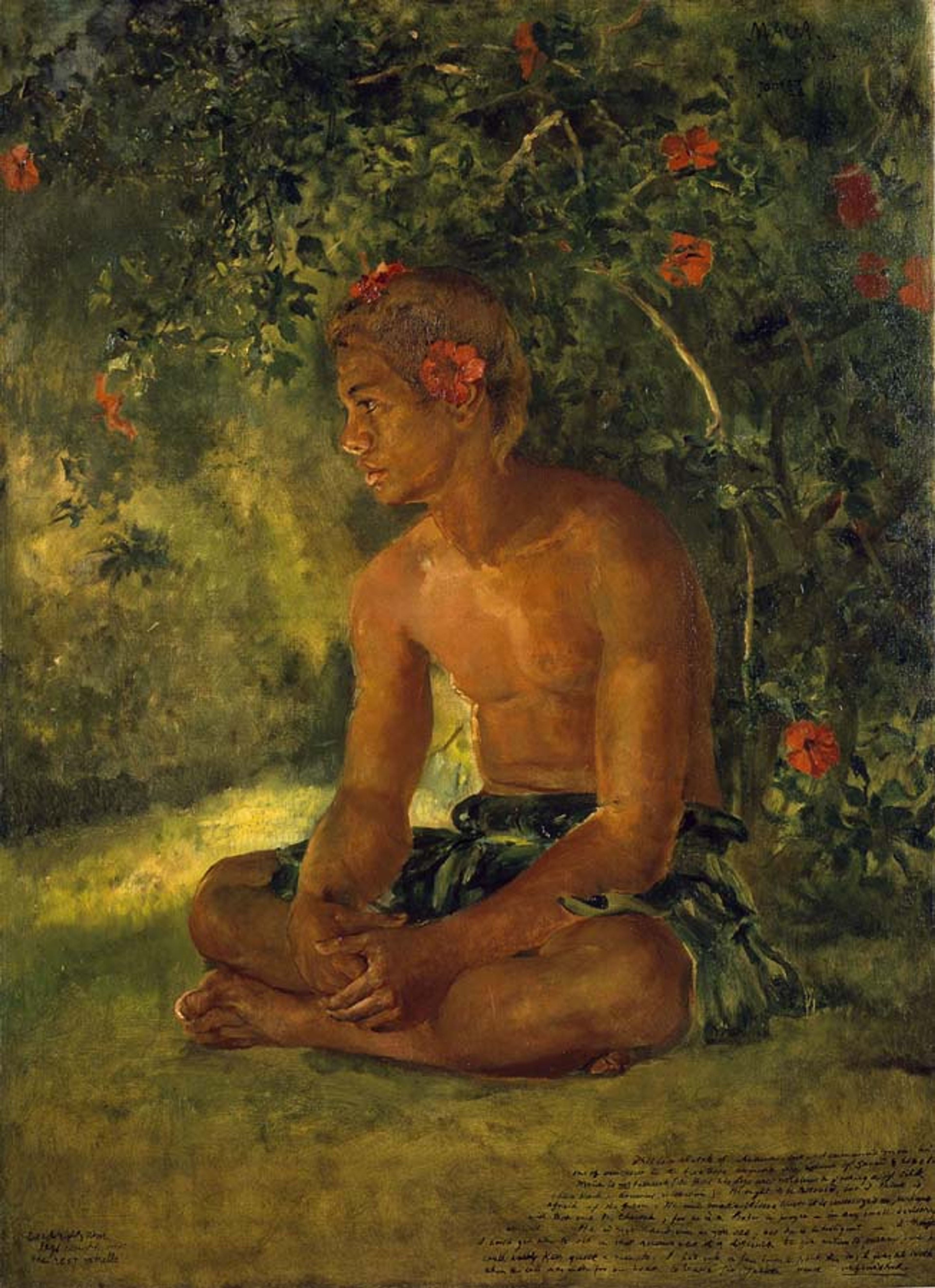
Maua, a Samoan teenager, is painted by the New Englander LaFarge as a creature of nature, imbedded in tropical foliage, signaling his otherness. His world is defined by nature, not machines, clock time, or logic. Obama situated himself in multiple worlds: Harvard and academia, Chicago, and Hawaii and Indonesia, the two places where he grew up. Exoticism is part of his brand. Wiley found an iconography that augments it.
Of Mrs. Obama’s portrait, journalist Chris Cillizza said, “This is a beautiful portrait. . . . It looks very little like Michelle Obama.” Pablo Picasso’s response when critics complained that his portrait of his muse Gertrude Stein looked nothing like her. “Everybody says it doesn’t look like her,” he responded, “but it will.” Today, a hundred years later, it’s the image of Stein we keep in our minds, stone faced and commanding, not her pudgy, gnomish reality. Though Mrs. Obama was our most photographed First Lady, Sherald’s portrait will have an edge in defining her.
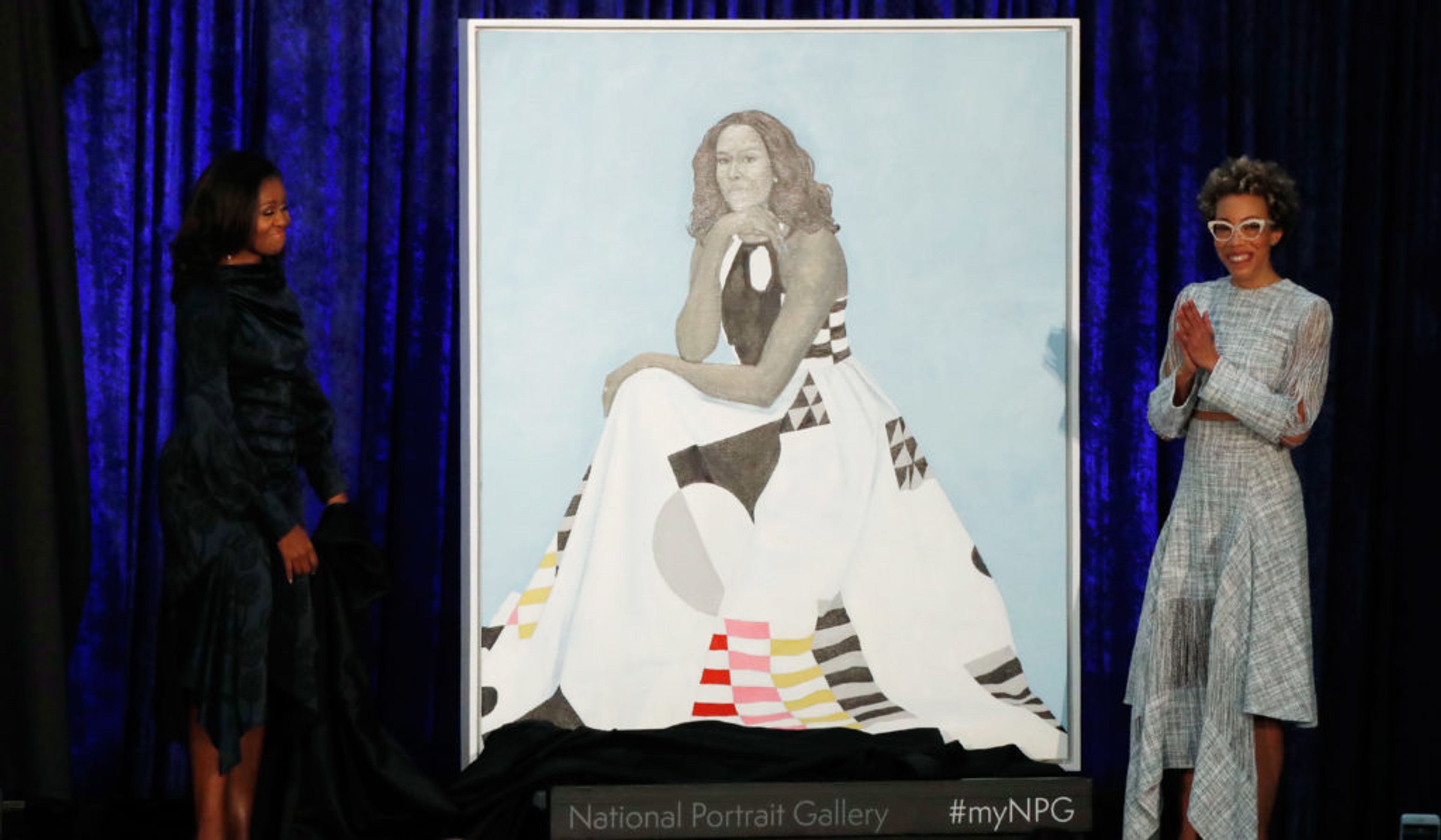
Mrs. Obama looks strong, unique, and independent. Her designer dress has simple, geometric patterns and bold colors. She is no creature of nature — there’s no green — and against a plain blue background, shaped as a pyramid, she is very much part of a built environment. Wiley uses paint lusciously, he gives us texture; while Sherald uses paint for a billboard effect, her surfaces are flat, with the paint applied thinly. If she uses glazes to soften and complicate her palette, they’re hard to see. Mrs. Obama becomes an ad for success via confidence and taste, good goals for everyone.
[pullquote align=”left”]Presidential portraits once showed what democracy served us, for better or worst. Our instinct aimed for common denominators, not divinities.[/pullquote]
Presidential portraiture is a markedly mediocre genre with few high points, among them now the Obama paintings. Gilbert Stuart’s portraits of our first five presidents at the National Gallery are full of gravity, wisdom, and subtle charisma. These Founding Fathers don’t look likely to find anything silly or transient. John Singer Sargent painted a majestic portrait of Theodore Roosevelt in 1903. Sargent bickered with him over lighting and seating, and complained that the president wouldn’t sit still long enough for him to complete a portrait. At one point, Sargent told Roosevelt that, as a subject, he didn’t know what he was doing. An indignant Roosevelt said, “Don’t I, you say.” Sargent responded, “Hold that pose.” And so a great portrait was born. Wiley said he used George Healy’s full-length, posthumous, 1869 painting of Lincoln as a model for President Obama’s portrait. Lincoln is seated, stooped, in profile, and deep in thought. It’s fine but dark and somber. It doesn’t have Obama’s animation.
The bar is moving up. Presidential portraits once showed what democracy served us, for better or worst. Our instinct aimed for common denominators, not divinities. Usually done on the cheap, they were safe, drab, and assiduously boring. Now these portraits are privately funded and expensive. Former presidents pick the best painters, who know how to steward an image. We’re getting better art and a nice boost for civic pride.






Comments