In our times, events echo one another, sometimes at nearly lightning speed. Globalization had made the world’s economy one and seems to have a similar effect on our politics. By exposing the political systems of many countries to the same external shocks, political phenomena resembling one another arise simultaneously: Hence Brexit, Trump, and Le Pen.
And hence, too, the ascent of the old-school socialist Jeremy Corbyn to the leadership of Britain’s Labour party and the strange resonance his views have had in the United Kingdom’s ongoing general-election campaign. Once hopelessly trailing in the polls, seemingly unable to close the 20-point gap with the Conservatives, he has done precisely that. One poll even found him only a point away from the competition. His candidacy has often appeared as a bolt from the blue, appealing to a social-democratic constituency nobody quite knew existed, at least not to the extent Corbyn’s polling numbers suggest.
The relevant comparison here, almost a hackneyed one by now, is to Bernie Sanders, who virtually endorsed Corbyn earlier this week in a move that delighted the burgeoning American far-Left. Corbyn has risen so far largely through the same tactics Sanders employed in his dynamic campaign for the presidential nomination last year: He inspired enthusiasm among young people and forged a seemingly personal connection with his fans by promising a better, simpler, fairer, more just country.
The similarities do not end there, of course, and they are not all rosy: Both men come from that unpleasant portion of the Left whose political development ceased at some point in 1968. They have apologized for the crimes of Stalinism and display a worrying coziness with dictators of all stripes so long as they can plausibly fall under the category of “anti-imperialist freedom fighter.”
If Corbyn is Sanders, then, what does that make Theresa May, the increasingly embattled prime minister? Well, Hillary Clinton, of course.
Like the former Democratic nominee for the presidency, May has suffered from unexpected opposition. The Clinton camp, the field already cleared by the Democratic elites, believed that the primaries would be a steamrolling affair: She would face no serious challenges and inevitably win the nomination. As we all know, the opposite occurred. Sanders dogged Clinton throughout the spring of 2016, racking up unanticipated victories in various states and, for a period, looking as if he had a real, though narrow, chance of blocking Clinton’s ascendance.
Much the same has occurred with Theresa May. She called the general election in April with Labour at its polling nadir. She expected, and the punditocracy predicted, a massive victory on the scale of Margaret Thatcher’s famous 1983 victory. Her polling lead held for a time but has since collapsed as the deficiencies of her own candidacy have been exposed and as Corbyn has displayed his considerable gifts in the art of campaigning: a human touch and the ability to form an emotional connection with his supporters, talents that are sorely lacking on the other side of the aisle. From May’s perspective, what once seemed assured now hangs in the balance and her hubris looks very foolish indeed.
So the situation in which May now finds herself resembles what befell Hillary Clinton at crucial points in her race against Sanders and Trump: The candidate that should have walked the golden path to victory is finding a few more potholes than she would have liked. But the parallels between the two candidates run much deeper, revealing some shared personality traits as well as some strategic moves they both employed.
Many pundits have suggested that the root cause of Clinton’s close call against Sanders and eventual defeat against Trump was her inability to articulate a strong, compelling case for her candidacy. Why Clinton? What could she bring to the office that no other candidate could? Her campaign never reached a satisfactory answer to this question, and to many members of the public, it seemed that Clinton’s justification for her candidacy revolved around personal aggrandizement. It was her turn, and she had come to claim her birthright, rudely denied to her in 2008.
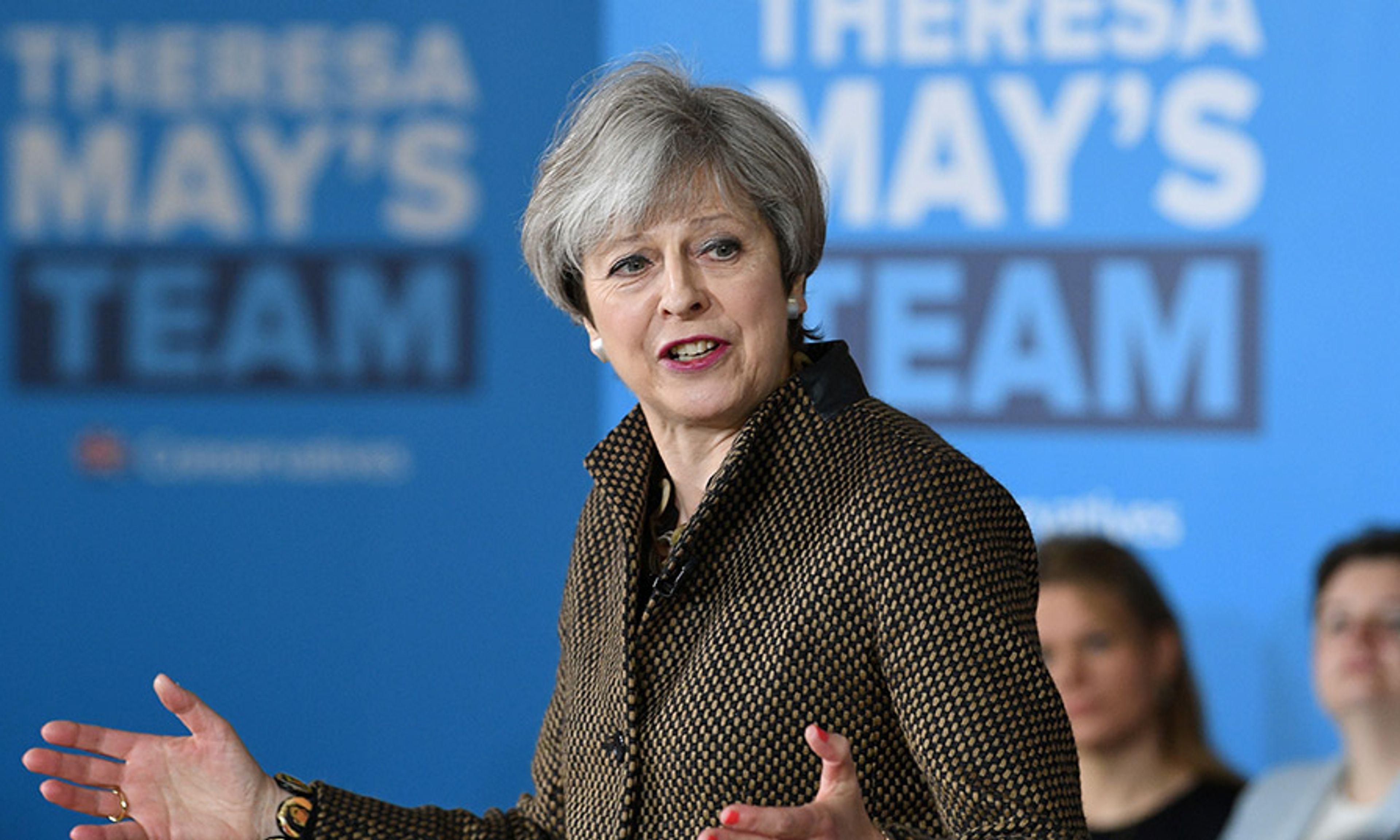
With May, the story is much the same. For months she denied plans to call a general election. Then she reneged on that vow, seemingly out of sheer opportunism: Labour looked like easy pickings, and a grand victory could guarantee her a place in the history books. But voters do not much like opportunists, nor do they particularly warm to a candidate who takes the long and storied tradition of the Conservative party and distills it into “Theresa May’s Team.”
And both women exhibit a chameleon-like public persona, appearing to have no heartfelt convictions, happy to change their mind to meet whatever the public favors at a given time. Clinton’s flexibility on policy positions is legendary, an integral part of her presence in American politics. She opposed gay marriage when the country opposed it and supports it now that the country supports it; notably, she declared herself pro–gay marriage only after Joe Biden and other high-profile Democrats announced their support.
Without any discernible policy convictions, and without putting forth any clear justification for their respective candidacies, Clinton and May have instead relied on instilling fear.
May is subject to the same pitfall. She campaigned, tepidly, for Remain during the run-up to the Brexit referendum but has now embraced a hard Brexit centered on regaining absolute sovereignty and control over immigration, economic costs be damned. Her most public campaign flap thus far involved a flip-flop on her party’s proposals for the funding of social welfare for the elderly: The Tory manifesto, normally a sacrosanct document in British politics, imposed a floor rather than a cap on individuals’ contributions to their own care when elderly; once the public cried foul, denouncing her proposal as a hard-hearted “dementia tax,” May immediately reneged on the policy.
Without any discernible policy convictions, and without putting forth any clear justification for their respective candidacies, Clinton and May have instead relied on instilling fear that the other candidate might win. In both cases, these are justified fears. Jeremy Corbyn at the helm of the U.K. would probably be nothing less than a catastrophe, just as many Trump critics condemn his presidency, not yet five months in, as a disaster.
Fear, however, will take a campaign only so far. People do not like being told they should fear things: Trump’s election and Brexit prove that. A strong candidacy is one that makes an affirmative case for itself, that roots itself in a compelling quasi-mythical narrative about the country and its people, that recognizes that the right to rule must be earned. Clinton could not live up to the task. We’ll soon find out whether Prime Minister May can.
— Noah Daponte-Smith is a student of modern history and politics at Yale University and an editorial intern at National Review.






Comments