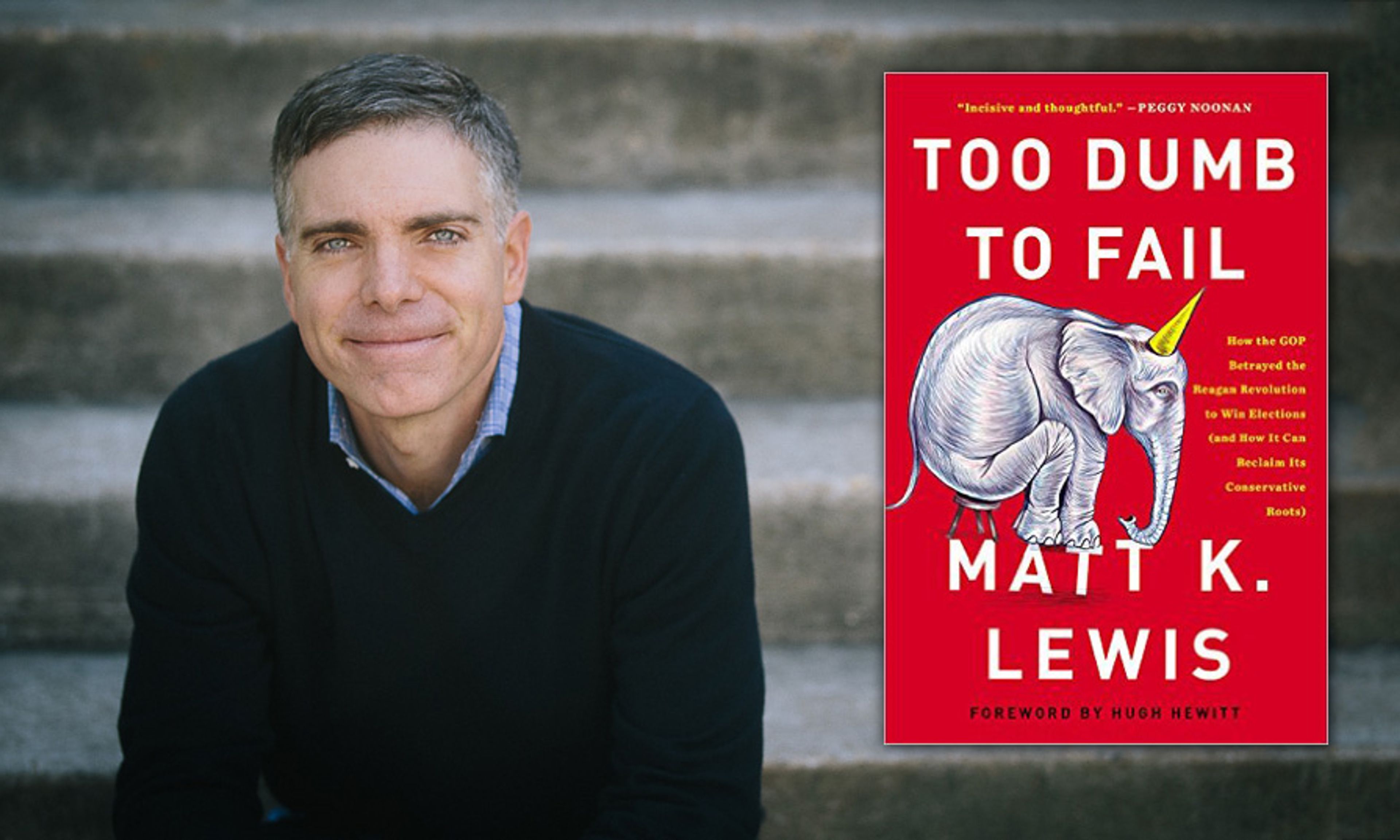
This is the year when nothing has seemed predictable in politics. But Matt K. Lewis is author of the particularly well-timed book Too Dumb to Fail: How the GOP Betrayed the Reagan Revolution to Win Elections (and How It can Reclaim Its Conservative Roots). As people wonder how we got here, the book provides a constructive reflection. Lewis answers some questions about where we are and where we could be going. – KJL
Kathryn Jean Lopez: Perhaps my favorite title of a chapter in your book is “What a Mess.” Are you feeling prophetic?
Matt K. Lewis: I started writing this book because I saw some trends on the right that didn’t comport with the brand of conservatism I grew up with. I started seeing a rise of what I would call a populist or nationalist strain of politics. Republicans were playing identity politics and the politics of victimhood. I saw the storm clouds gathering, but when I started writing this book, Donald Trump wasn’t even a candidate. I do feel a bit like Cassandra, and I do find myself wishing that I hadn’t been so right.
Lopez: Is titling a book about the Republican party “Too Dumb to Fail” asking for a Democratic-party victory in the presidential race? More pile-on?
Lewis: It is true that I have focused more in my career on covering and critiquing the Right, but that’s because I’m more invested in conservatism’s future. The lover of classic cars does not ignore a pinging sound in his 1965 Mustang. Instead, he looks under the hood immediately.
I should confess that I was, indeed, worried that some of my conservative friends would see this book as “concern trolling” instead of a sincere effort to provide constructive criticism. But I have been pleasantly surprised by the warm reception it’s had. The Weekly Standard wrote a terrific book review about it, I spoke at the Leadership Institute and it was very well received, and folks such as conservative commentators Hugh Hewitt (who penned the foreword) and Erick Erickson have had kind things to say about this book.
Lopez: Is the GOP worth saving? At this point, can it be, anyway?
Lewis: I think it’s very possible we could be on the cusp of an unraveling, or, at least, a reordering. You could potentially have the GOP split in half, with a populist or nationalist party in the vein of Donald Trump, and then a more solutions-oriented conservative party that would be represented by folks such as Ben Sasse, Nikki Haley, Marco Rubio, et al.
It would be in everyone’s best interest to preserve this party and this movement.
The reason this is so tenuous is that there are at least two ways the breakup could occur. First, if Trump wins the nomination, you could have a lot of conservatives who would fear he would redefine what it means to be a conservative, and that they cannot in good conscience remain in a party that he heads. To do so would violate their moral code. On the other hand, if it is perceived that the election is “stolen” from Trump at a convention, you could easily see his faction bolting the party.
I don’t think any of us should hope for that. It would be in everyone’s best interest to preserve this party and this movement. In the immortal words of Al Green: Let’s stay together.
Lopez: What is “conservatism’s current incoherence”? Is it on display with Donald Trump
Lewis: The contrast between people such as Donald Trump and Jeff Sessions on one hand, and Marco Rubio, Tim Scott, and Nikki Haley on the other, couldn’t be starker. This is partly a policy schism (protectionism vs. free trade, immigration hardliners vs. compassionate conservatives, etc.) but it also speaks to differences in style, culture, and class. At some point it’s worth asking whether this disparate coalition has all that much in common anymore.
#share#
Lopez: You write: “This is the dirty little secret of the conservative movement in America today: everyone knows that it has lost its intellectual bearings. Empty-headed talking point reciters, rookie politicians who’ve never managed anything in their lives, media clowns such as Donald Trump, dim bulbs in tight pants or short skirts, professionally outraged shout-fest talking heads, and total political neophytes dominate conservative airwaves and the Right’s political discourse.” Tell us what you really think! Are all those people conservatives? Who is the gatekeeper? Should there be one? Have you appointed yourself to the job?
Lewis: I wrote this book at least partly out of a moral obligation. However, I suffer no illusions that I have the gravitas to dramatically change things. To paraphrase Tom Stoppard, the best a writer can hope for is to “nudge the world” a little bit. The good news is that I’ve heard from some prominent conservatives and elected officials that have read the book and agree with much of it. But the fact that I was tasked with this role is indicative of a larger problem, which is the fact that there are few gatekeepers or adults who have the moral authority (or courage) to call out the charlatans and self-promoters who are harming the conservative movement, while personally profiting.
There are no Bill Buckleys who can cast anyone out of the movement. There are numerous reasons for this. The barriers of entry have been lowered. Party bosses have lost their statutory authority to reward or punish. We are less humble and self-sacrificing (or willing to police our own behavior), and more apt to respond to perverse incentives (pundits who say or do controversial things sell more books, get more ratings and buzz, etc., all while harming the movement). And the few conservative leaders who might have had the moral authority to do something have largely abdicated that responsibility, choosing instead to pander to their followers and talk-radio listeners.
Lopez: What’s wrong with Duck Dynasty and how are you going to break it to Ted Cruz
Lewis: I actually went on TV and defended Phil Robertson when he was suspended by A&E for saying some controversial remarks. I didn’t necessarily agree with what he said (and certainly not with the way he said it), but I am increasingly worried about how people who hold conservative viewpoints are being punished for expressing them. This could obviously have a chilling effect on free speech. But having said that, I also find it ridiculous that these guys are trotted out on cable TV to offer political punditry. This is part of the dumbing down of our political discourse and the coarsening of our political rhetoric. I mean, compare the intellectual quality of the guests that Bill Buckley debated on Firing Line to the trend of having NASCAR drivers — or Chuck Norris — or Phil Robertson — or Kid Rock — go on TV and discuss public policy.
Lopez: What do you mean when you say that “the average Evangelical has the same intellectual horizon as the nonbeliever who’s obsessed with American Idol”?
Lewis: In some cases I think we have dumbed down religion the same way we have dumbed down politics and entertainment. The average Evangelical might watch the aforementioned Duck Dynasty instead of Keeping up with the Kardashians, but it’s still vapid. And I think it has political consequences. This is another area where I think I was ahead of my time. I wrote this before it became clear that Donald Trump would, in many cases, win the Evangelical vote. Unfortunately, I don’t think there’s much of a distinction between the ways that Evangelicals vote or live and the way that anyone else does. My guess is that this is partly because people who self-describe as “Evangelical” might not actually be regular church attendees.
Lopez: You point out that “while conservatives were abandoning popular culture and academia, they were flocking to politics. The problem is that, in democracy, once you’ve lost the cultural institutions, all political victories are temporary.” What should we do and support on these fronts? Homeschooling in catacombs?
Lewis: This is one of the areas that is much easier to diagnose than to treat. I would encourage some young conservatives to consider eschewing overt political participation, in favor of a career in academia, media, or the arts. We don’t need “conservative” comics or music or movies, but instead, people making great art that happen to have a conservative worldview. In order for this to happen, I would suggest that some political donors would be more likely to affect the culture and long-term politics by becoming patrons, rather than merely donors.
Lopez: Some — Trump supporters, perhaps — might wonder if we have the luxury of being happy warriors today. Why would you insist on it when things seem dire to many?
Lewis: I think it’s important to be a happy warrior for two reasons. First, while passion is important, we don’t make smart or rational decisions out of fear or anger. Second, I think it’s really important for anyone who wants to be effective in the long-run to guard their heart. Liberals believe that politics can bring about utopia, but conservatives shouldn’t put all their stock in princes of this world. There are other things — faith, family, work, hobbies — that those of us who enter in the political arena must have to keep us balanced and sane.
Lopez: Could prudence be a luxury right now?
Lewis: Some see prudence as being overly cautious, but its synonyms are wisdom and judgment. Some people might say you can’t afford to exercise prudence. I’d say we can’t afford not to.
Lopez: Have we made an idol of Ronald Reagan on the Right?
Lewis: Absolutely. We should respect and revere him, but he was also a human. The danger is that we are looking backwards instead of forward, which — ironically — is an un-Reaganesque thing to do.
#share#
Lopez: Is there anything you discovered about Bill Buckley in writing Too Dumb to Fail or that you’ve learned along the way that you’re especially grateful for?
Lewis: I was reminded of a couple of the important things he did that haven’t gotten as much attention. For example, one of the side benefits of starting NR was simply providing a job for conservative writers and intellectuals. This is no small thing. Additionally, he did a lot to help young conservatives.
There was something else I stumbled upon that struck me as interesting, and revealing, in terms of how Buckley’s Catholic faith informed his politics. In his book The Maker of a Movement, Lee Edwards notes that Buckley “adamantly opposed Communism all his life not just because it was a tyranny, but also because it was a heresy.” We sometimes hear about how the Cold War served as the glue that held the three legs of the conservative coalition together (each wing had their own special reason to hate Communism), but here we see the embodiment of this in one man.
Lopez: Why do you like Eric Metaxas and Russell Moore so much?
Lewis: I think they both combine some interesting elements. They are devout believers who do not come across as stereotypical Christian conservatives. And both have the ability to win converts, not just preach to the choir.
Lopez: “[W]hat shall it profit a man if he should win the election but lose his soul” — is that more of a danger this year than others?
Lewis: Politics is seductive, but it’s important to maintain a healthy perspective. Haley Barbour has this great saying: “The main thing is to keep the main thing the main thing.” These are wise words. As important as politics is — and I do believe we have a responsibility to preserve freedom and opportunity for our children — there’s no election more important than your eternal soul.
Lopez: Where would you focus conservative minds primarily, to start rebuilding?
Lewis: I think we need to do two things simultaneously. First, we need to reacquaint ourselves with the conservative intellectual tradition. So many of the things we are clinging to really have nothing to do with a conservative worldview — they are, instead, cultural signals and stereotypes. Second, we need to look forward. The good news is that some of what is happening technologically are actually skewing our direction. In my book, I talk about Uber, so I’ll skip that here. Instead, I’ll talk about the Ultrasound here. It’s impossible to see one and not realize it’s a baby, not a “fetus.” What is more, people now post these pictures on Facebook. Conservatives can win the future, but that’s what makes the rise of Donald Trump so frustrating.
Lopez: What’s your hope for this presidential election? For conservatism beyond, come what may?
Lewis: I think there’s an opportunity to “modernize, but not moderate” — and to win over 21st-century Americans who don’t know they’re conservative, yet. If you saw that scene in South Carolina recently, where an Indian-American female Republican governor named Nikki Haley and an African-American Republican U.S. Senator named Tim Scott endorsed Marco Rubio, the son of immigrants, for president, then you know the possibilities. All three of them are bona fide conservatives, and I suspect that all three of them have the potential to sell conservatism to a more diverse cross section of Americans.
— Kathryn Jean Lopez is a senior fellow at the National Review Institute and editor-at-large of National Review Online. She is co-author of the updated How to Defend the Faith without Raising Your Voice.





Comments