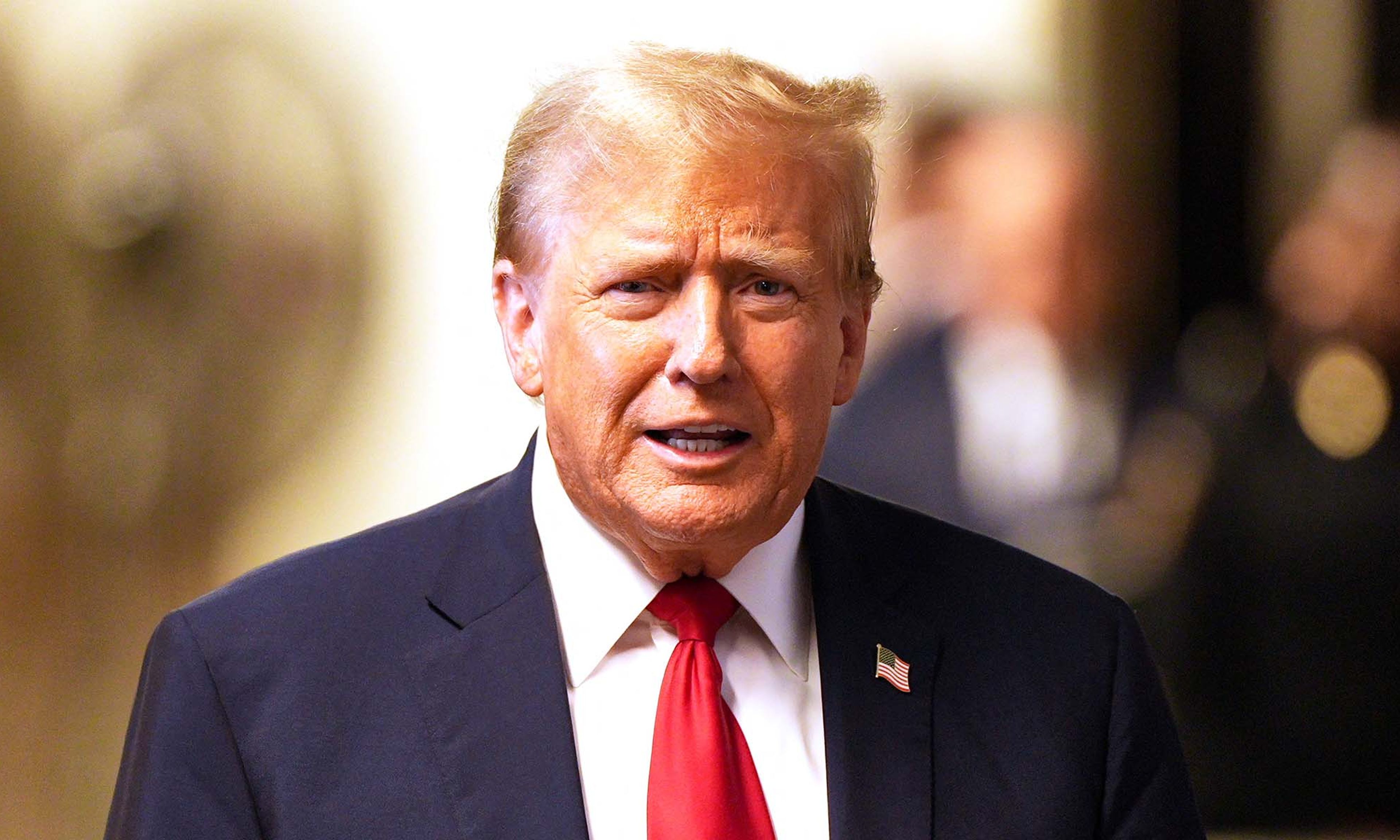
It is fitting, perhaps, that a man who launched his reelection campaign by transmuting himself into a series of gaudy nonfungible tokens would eventually be transformed into an avatar. Donald Trump has long served as a Rorschach Test, but, as he heads undeterred into his third bid for the presidency, he has become something more protean besides. At this stage, there are thousands of Trumps, each tailored to the predilections of the observer. Trump is a myth, an archetype, an emblem. How can it be that a country full of people who speak the same language cannot agree on the elementary facts that attach to the man? Simple: Because each involved in the debate has pulled a different trading card from an increasingly extensive pack.
Take the question of Trump’s involvement in the recent bill that provided $60 billion in military aid to Ukraine. There, the plain details are these: Rather than emphatically oppose further funding for Ukraine, Donald Trump submitted that “Ukrainian survival and strength . . . is also important to us”; rather than attempt to sink it behind the scenes, Trump contrived the idea that the aid should be cast as a “loan” — an idea that was adopted, and that proved crucial to its passage; rather than criticize Speaker Mike Johnson for his role in shepherding the package through the House, Trump said publicly that Johnson is a “good person” and “a good man,” who is “trying very hard.” Given his previous rhetoric, it is unclear precisely why Trump did and said these things, but do and say them he most decidedly, indisputably, unequivocally did.





Comments