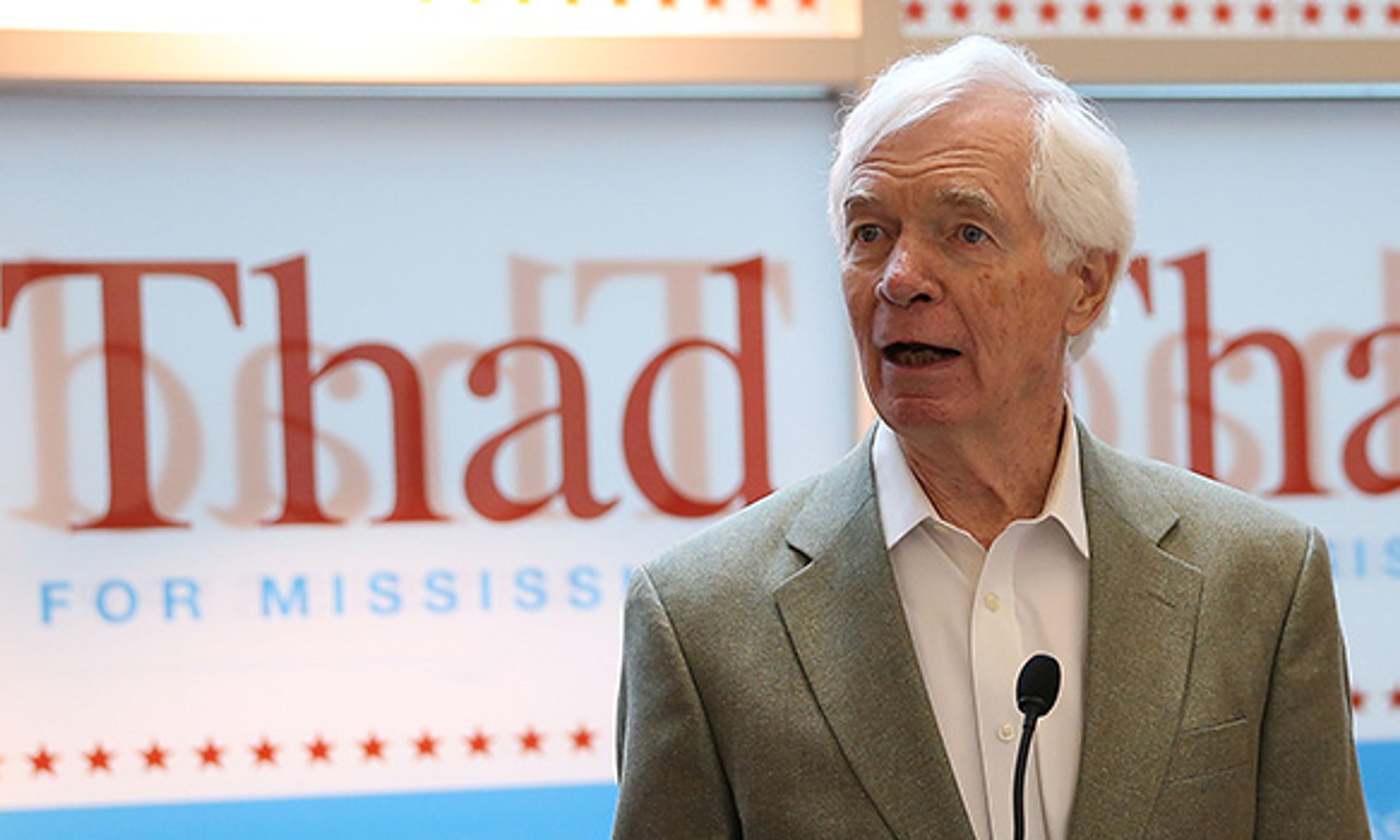
Just two days before the Mississippi runoff, an African-American state senator from the state’s 13th district, Willie Simmons, sent a letter to his constituents. Simmons himself, according to a report by the Associated Press, had voted in the state’s June 3 Democratic primary and was therefore prohibited from voting in Tuesday’s Republican runoff, but he wrote to urge his constituents to cast their ballots for Republican senator Thad Cochran in Tuesday’s runoff. He touted the “millions of dollars” in appropriations Cochran had secured for Mississippi’s Head Start programs and his support for “Food Stamps programs.”
A mailer distributed in heavily African-American precincts struck similar notes, advertising Cochran’s support for Mississippi’s public schools and his tea-party opponent’s opposition to food-stamps programs. The headline: “The Tea Party intends to prevent blacks from voting.”
“I don’t know who put it out,” former Mississippi governor Haley Barbour says of the fliers. “I can’t imagine the Cochran campaign did that.” Barbour says that support for Cochran among Democrats bubbled up organically and that the six-term senator, who first won a seat in Congress in 1972, has always had bipartisan appeal. “Within a week of the first primary some black churches in Hattiesburg started running ads on the radio in Hattiesburg by raising the money themselves,” he says.
But Cochran’s opponent, state senator Chris McDaniel, and many of his supporters smell a rat. In the midst of the non-concession speech McDaniel delivered Tuesday evening, he argued, “There is something a bit unusual about a Republican primary that’s decided by liberal Democrats.” In Hattiesburg, where a crowd of McDaniel supporters had gathered for what most expected to be his victory party, the candidate was seething, not celebrating: “So much for principle,” he said from the podium.
Less than 24 hours after Cochran seized victory by a little more than one percentage point, his campaign’s decision to woo Democrats is exacerbating the intra-Republican battle between the grassroots and the establishment.
Chris Chocola, the president of the Club for Growth, which spent over $3 million in its attempt to oust Cochran, came out swinging against the powers that be in the GOP. “They say they believe in pro-growth policy,” he says, “but when it comes time to take action, here it’s revealed, probably more powerfully than it’s ever been, that they care more about the preservation of political power and the status quo.”
In Mississippi, Chocola says, the establishment fought for a candidate whose message was “Vote for me and I’ll give you more government.” Throughout the primary and the runoff, Cochran campaigned on his ability to funnel federal dollars to Mississippi, a poor state that has long depended on Washington’s largesse.
“The challenger was saying, ‘Vote for me and I’ll give you more freedom,’” Chocola says. “What’s more reflective of the Republican position? I always thought it was the freedom thing.”
On June 4, the day after the hotly contested and bitterly personal primary election was sent into a runoff, the Cochran campaign determined to expand the electorate by any means possible. Scott Reed, the political strategist of the U.S. Chamber of Commerce, which was spending $100,000 a day on Cochran’s behalf in the week leading up to the runoff, puts it bluntly: “Our Mississippi runoff strategy was to grow the electorate: base GOPers, independents, and Reagan Democrats.”
For Cochran, that meant burnishing his conservative credentials before Republican audiences. But he also publicized his support for government programs to centrists and Democrats. Austin Barbour, a Cochran campaign hand and Haley Barbour’s nephew, told the New York Times, “We’ve spent a lot of time bringing a conservative message to black voters, as well as to white voters, the old and young, men and women.”
Well, not quite. Though Cochran had throughout the primary campaigned on his ability to deliver pork to Mississippi, he broadened that message during the run-off. The Jackson Free Press noted Cochran’s “stepped-up ad campaign” in newspapers that cater largely to African-American and Democratic communities. The ads touted Cochran’s support for historically black colleges and for food stamps. At the same time, the Free Press said, Cochran campaigners left doorknob hangers on homes in whiter neighborhoods that highlighted Cochran’s support for the National Rifle Association and his opposition to abortion and Obamacare.
Reed and Barbour also say Cochran’s message on education helped tip the scales. Cochran hammered McDaniel for an April interview he gave to the Associated Press in which he said the Department of Education is unconstitutional.
“The word ‘education’ is not in the Constitution. Because the word is not in the Constitution, it’s none of their business,” McDaniel said. “The Department of Education is not constitutional.” The Cochran camp began telling voters that if the approximately $1.5 billion Mississippi receives in federal education aid were cut off, their taxes would skyrocket.
“That started getting some energy in this campaign because people were really concerned about the idea that there should be no federal money for education,” Barbour says. “A lot of people who don’t give a flip about anything else, about government, will fight over their schools.”
While hardly a conservative message, it does seem to have appealed to Mississippi voters. The Club for Growth’s Chocola doesn’t deny that the Cochran campaign strategy worked. “From just a mechanics standpoint, it was effective,” he says. “They did what they needed to do.” The party establishment “hasn’t always been effective at winning elections, but they were here. So it’s interesting to see what gets [the establishment] riled up, and it’s not the [Republican] party platform. That’s the disappointment.”
With the Mississippi race decided — Cochran is considered a lock to defeat his Democratic opponent, former representative Travis Childers, in November — both the Tea Party and the establishment are looking forward. But their visions of the future contrast starkly.
“This now allows us to close this chapter, unite the coalition, and focus on the general elections,” says Reed.
Chocola is thinking along different lines, looking back to 2004, when Pennsylvania senator Arlen Specter narrowly defeated challenger Pat Toomey, the Club’s former president. Six years later, Toomey drove Specter out of the Republican party, and today he is the state’s junior senator. If history follows that pattern, much to the chagrin of establishment Republicans, we haven’t heard the last from state senator Chris McDaniel.
— Eliana Johnson is a national reporter for National Review Online.





Comments