Inflation-phobic Germany just hit 7.3 percent annually. The United Kingdom inflation’s rate is at 7.0 percent. Even Japan has reversed from deflation to inflation.
Some contend that U.S. deficit policies ought not be blamed for rising inflation, given the presently high rates across the globe. To be sure, some European economies have spurred their own inflation with an ill-judged energy “transition.” Yet it is undeniably true that the U.S. dollar’s role as the world’s reference currency — with which over 40 percent of international payments are made and over 60 percent of international reserves are held — has served as a transmission mechanism for exporting U.S. inflation to the world.
Borrowing for the American Rescue Plan tipped inflation from a normal cyclical bounce to its current unacceptable pace. The initial recovery stimulus in March 2020 was record-setting in its own right and began to affect prices just as the Biden administration’s plan took deficits and inflation to a new level, in early 2021. This borrowing was eye-opening, even compared with that of advanced economies in the OECD. The chart below depicts changes in U.S. federal debt relative to the GDP of all long-term OECD member economies:
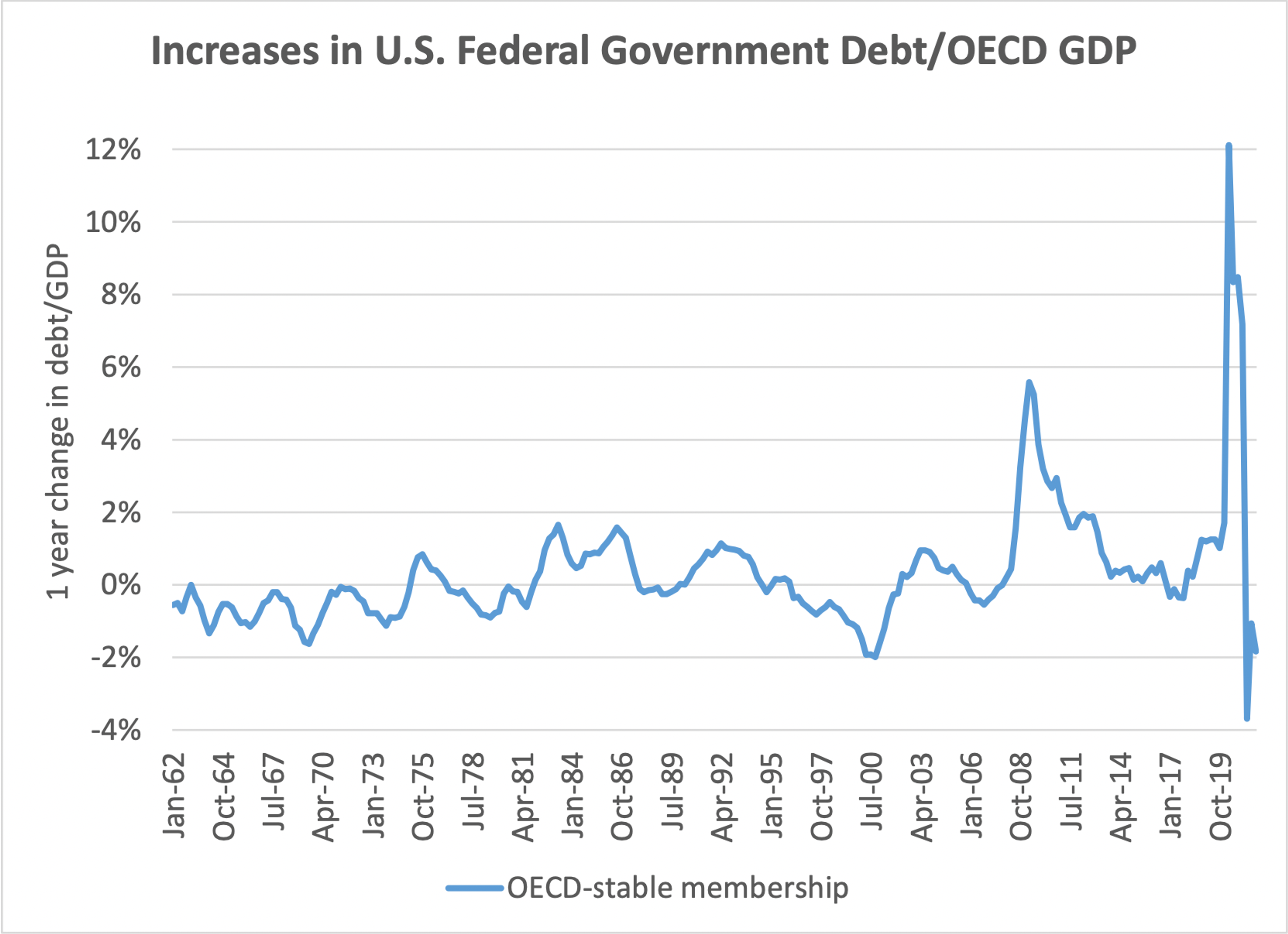
The combined deficit packages took a huge, unprecedented chunk out of the collective advanced economies, dwarfing the prior peak in 2008.
It didn’t take long for the enormous borrowing to affect inflation. The chart below compares the monthly inflation rate with the federal government’s monthly borrowing:
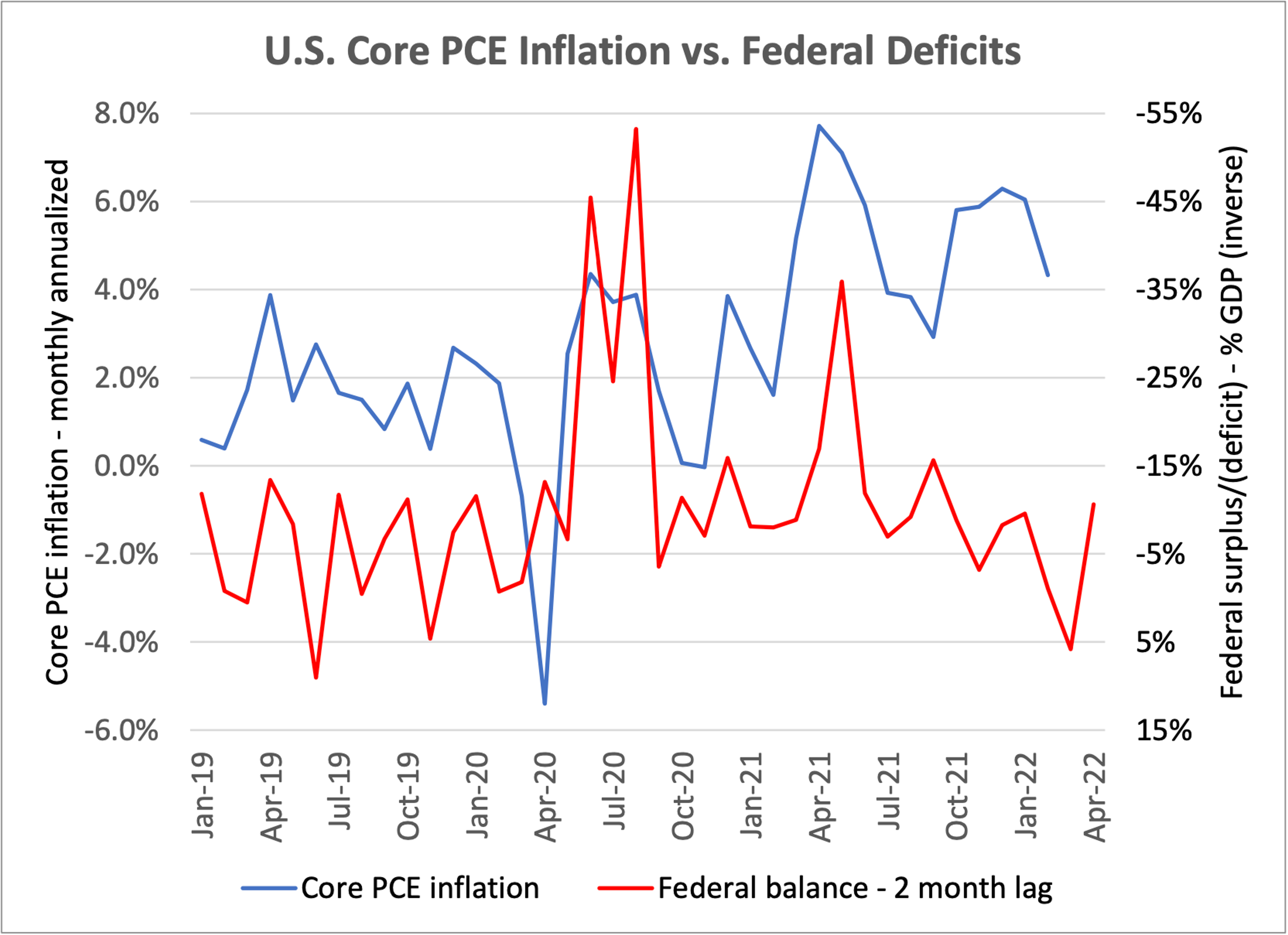
Two months after each deficit-spending eruption, inflation spiked and then filtered through the economy to ever higher levels.
The deficit packages spurred consumption and restrained investment, particularly higher-frequency inventory investment. The pandemic exacerbated the effect with its shift to goods from services consumption. The following chart compares inflation with the ratio of goods consumption to inventories:
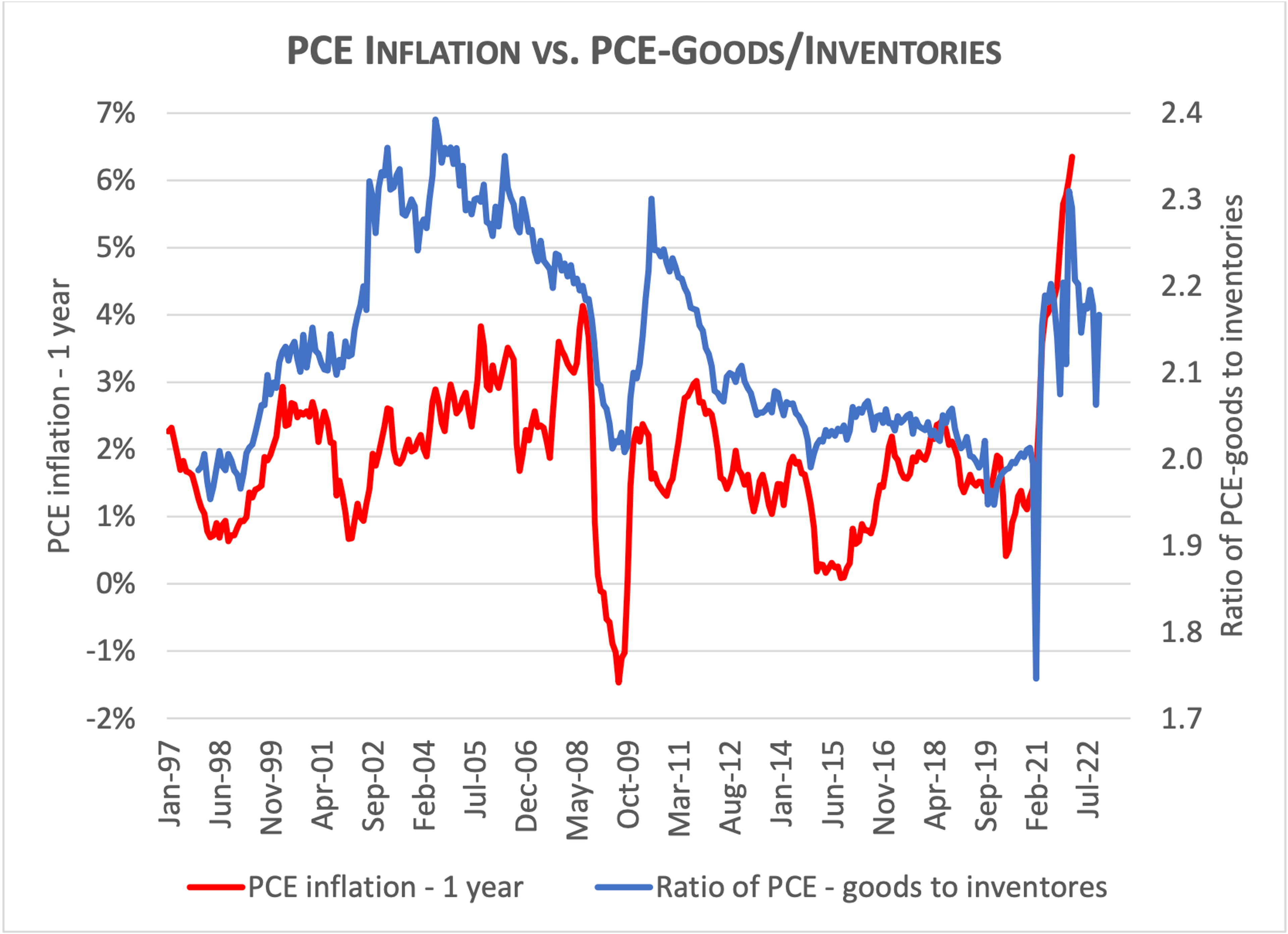
If this relationship holds, the U.S. may be near an inflation peak, though it would likely remain at elevated levels with no signs of returning to the Fed’s targeted 2 percent neighborhood.
Another textbook consequence of government deficits has been lower trade surpluses (or increased trade deficits). This is especially true for America thanks to the dollar’s wide acceptance as a repository for foreign-trade surpluses. The next chart displays the relationship between federal and trade deficits:
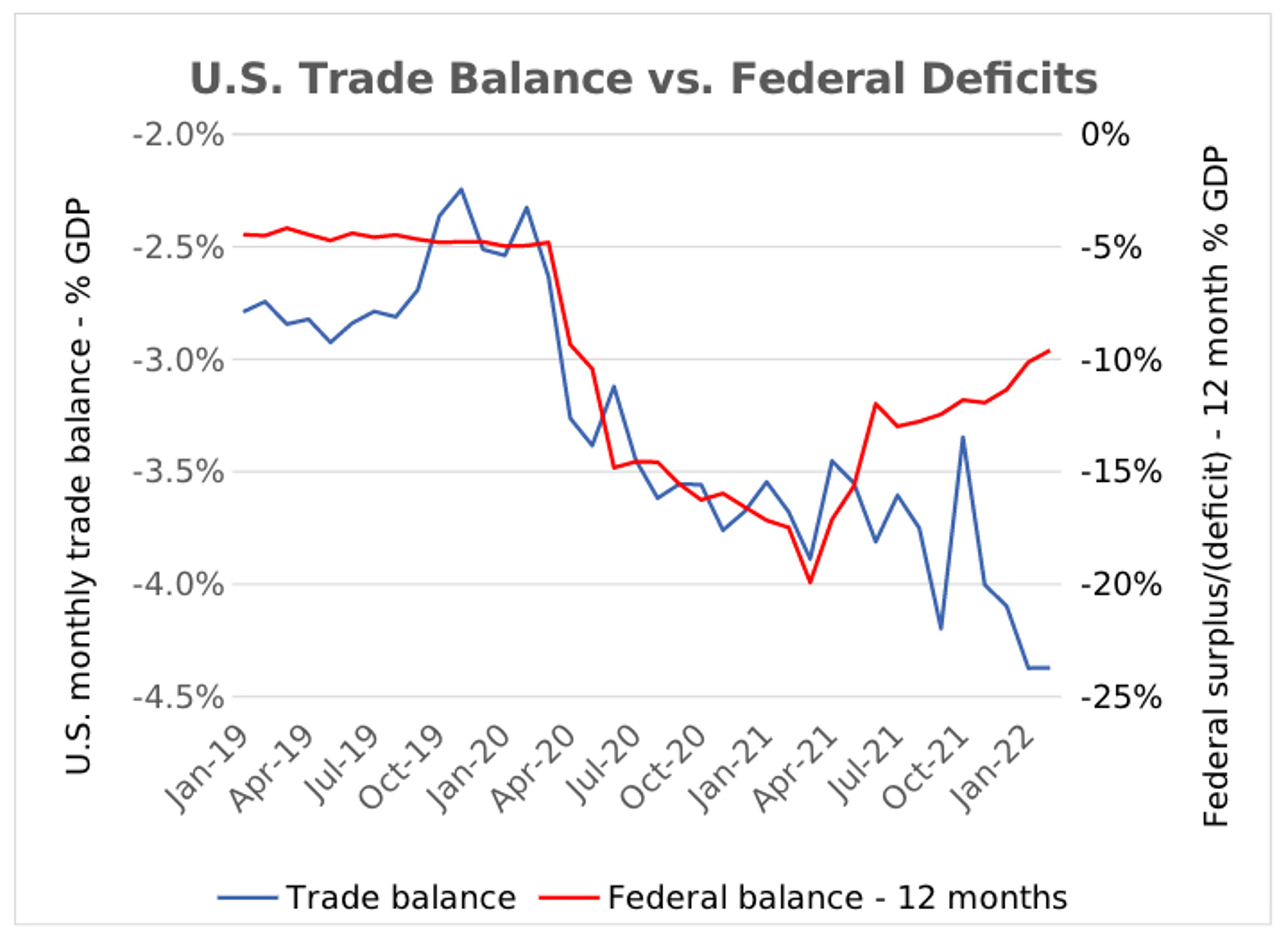
So, U.S. demand drew in products from other countries as their own economies recovered, boosting prices, particularly in the durable-goods sector. The Bank of England found that the U.S. accounted for over 80 percent of durables-consumption growth among major economies.
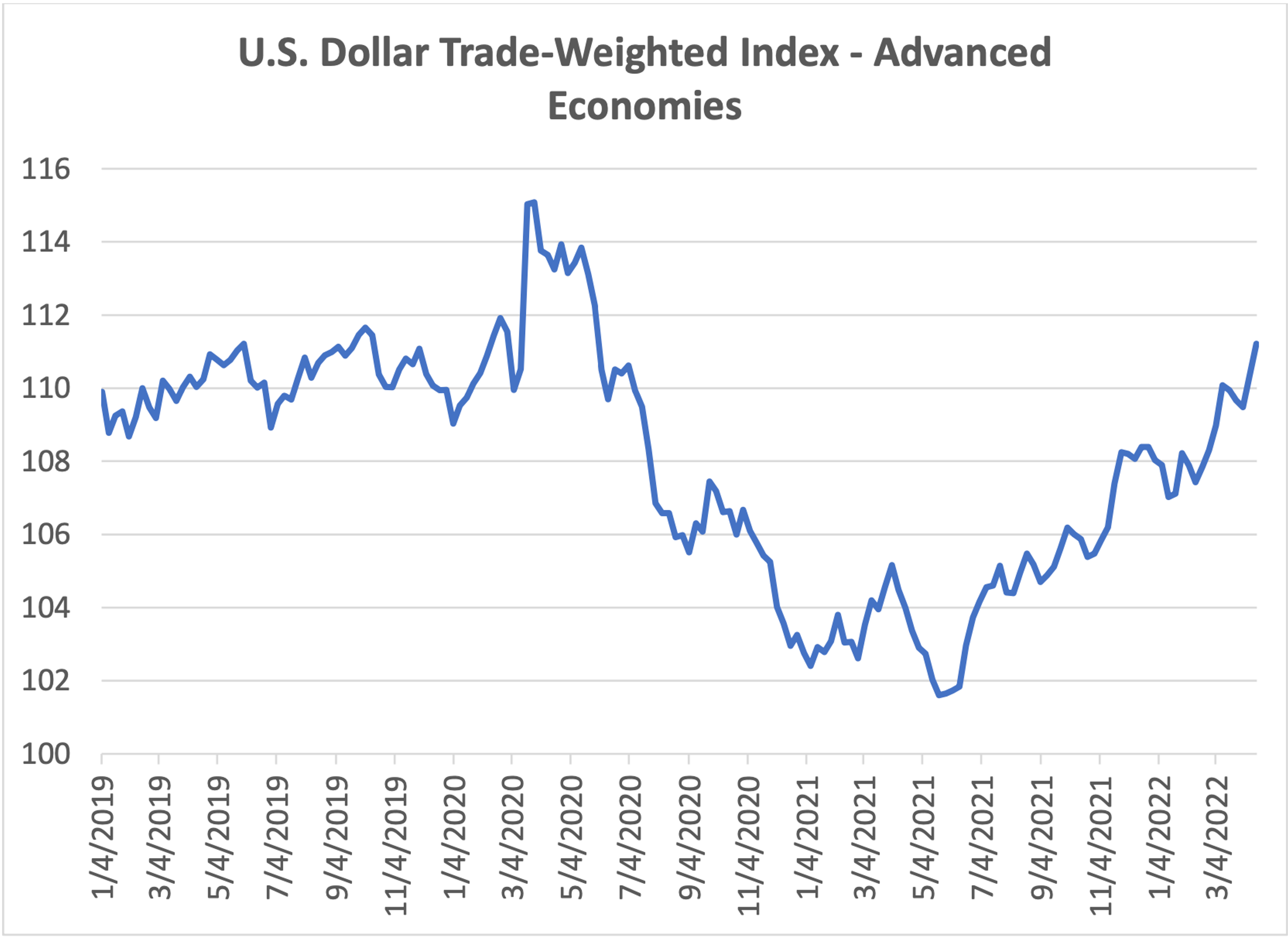
Compounding the problem beyond U.S. borders are fluctuations in the dollar’s value. After relative stability through 2019, the dollar jumped on a pandemic-related flight to safety, then sank as the Powell Fed jammed the stimulus throttle wide open. The dollar bottomed in mid 2021 as markets recognized that the reviving U.S. economy would require the Fed to hit the brakes.
The timing was unfortunate for foreign economies, where inflation was just rearing its head. Given the fact that commodities were priced in dollars, too, the stronger greenback made the effects worse yet. The following chart sketches the dollar’s erratic path:
With the U.S. economy scarfing up goods — especially durables — and with the dollar jacking up effective prices in other currencies, inflation has broken out abroad. Below are inflation rates for some major economies:
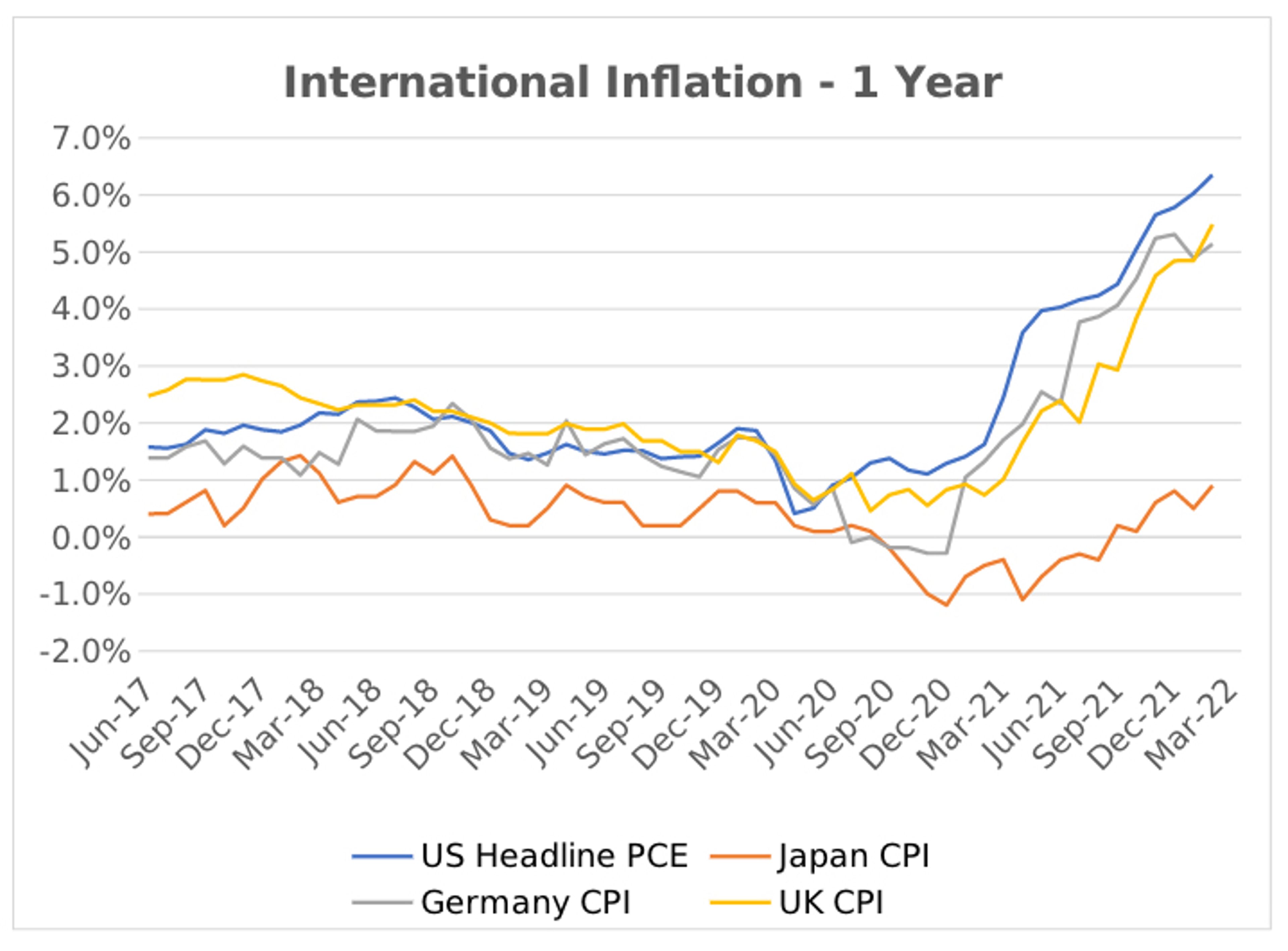
U.S. inflation bottomed at 0.4 percent in April 2020. The U.K. rate bottomed in August, and Germany and Japan bottomed out in December. The U.S. rate has risen the farthest and the fastest.
As a ballooning trade deficit shows, the U.S. isn’t doing too well when it comes to exporting its products — except for one, which is spreading like wildfire. Sadly, it’s inflation.




Comments