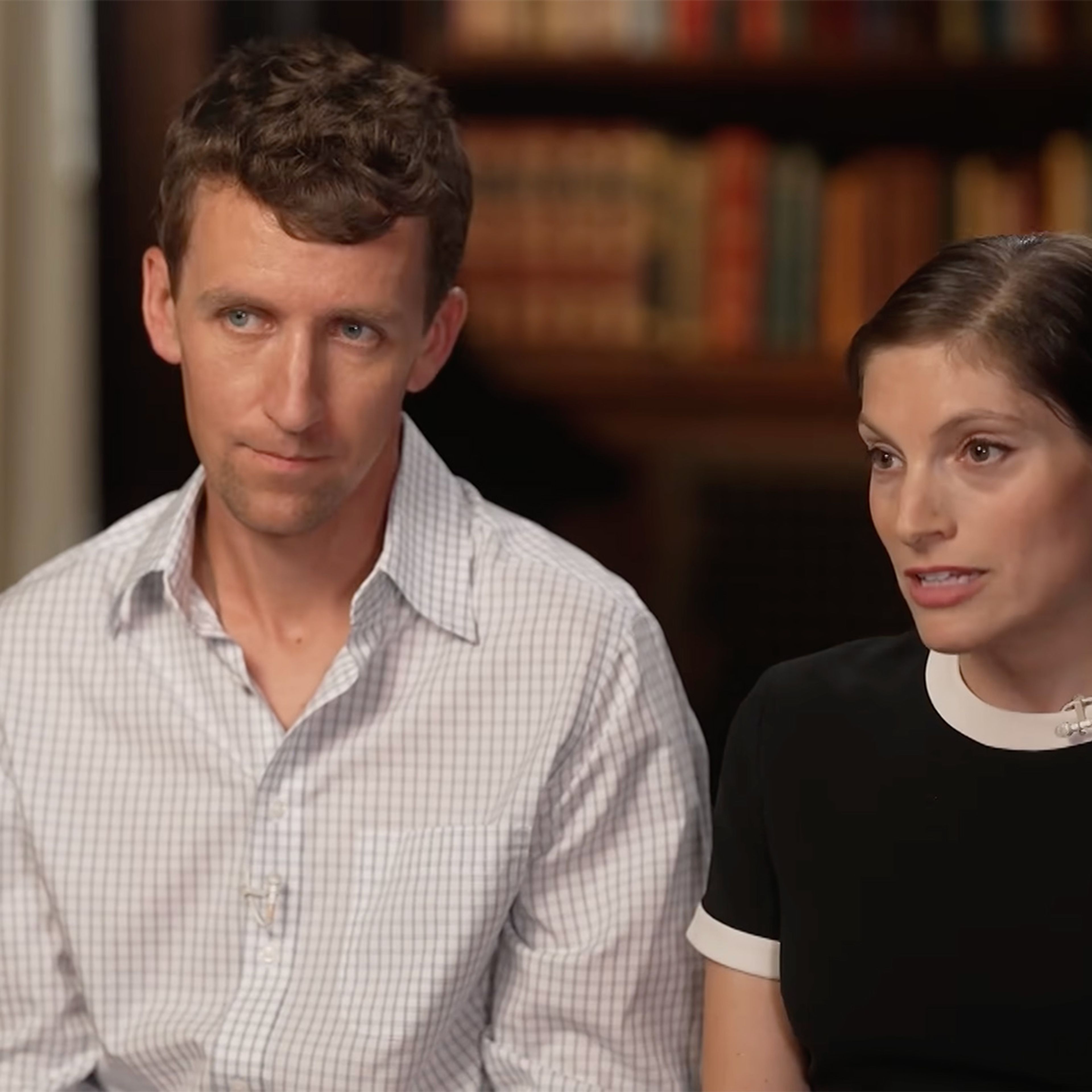
Kiev — A Ukrainian military officer named Dmitry sits solemnly, hands folded. He was based in Crimea when Russia invaded, and, like many unsettled by unfolding events in Ukraine, he tells me I can use only his first name. Beside him sits his wife, a pretty blond. Their child sleeps on her lap, and there are no assurances that her husband won’t be back in battle in East Ukraine soon.
“Without military help from the [West], it would be very difficult for Ukraine to protect its independence in a war like this one,” Dmitry tells me through a translator, adding that he has no way to predict the level of bloodshed.
We talk for an hour, but much of the time we are silent as Dmitry ponders answers he doesn’t seem to want to give voice to. I see him smile briefly when I enter his home in an old Soviet building in Kiev, where he is now stationed; he doesn’t smile again until I leave.
That’s because we’re discussing a grim fact: If the conflict with Russia comes to blows, Ukraine stands at a significant disadvantage. Russia has four times as many soldiers, and its military budget is more than 48 times bigger than Ukraine’s.
“The Ukrainian military is not in a good state when it comes to trying to face Russia in any sort of armed confrontation,” says Paul Floyd, a military analyst with the global-intelligence firm Stratfor. “The Ukraine military as we see it today is relatively weak compared [with Russia’s]. It’s fairly underfunded, and a lot of its equipment is basically mothballed. It’s just not been a national priority until very recently. . . . [Russia has] an overwhelming amount of firepower compared to what Ukraine can muster.”
As Floyd also notes, the loyalty of Ukraine’s police and military forces is also in question. Some were appointed by the now-deposed president Viktor Yanukovych, who was Vladmir Putin’s puppet, and others began their careers during Ukraine’s Soviet days. The Russian media reported that at least 5,500 Ukrainian soldiers defected in Crimea during the Russian invasion. That number is likely inflated, but there are confirmed instances of Ukrainian soldiers’ switching sides in Crimea.
Dmitry shrugs away suggestions that the Ukrainian armed forces have questionable loyalty. “The people I was with [in Crimea] were ready to defend their country,” he says, adding that “I’ve met a lot of people in the military, and all of them are ready to defend. We’re not in panic.”
“The situation in Ukraine,” as it is ubiquitously and unspecifically known, remains complicated, Dmitry notes. He says that while military prognoses are generally easy to make, conflict with Russia is tough to gauge because Putin, “the person who initiated this war, is one whose mind is very unpredictable.”
Furthermore, Dmitry says, there’s no guarantee that the Ukrainian military’s experience in Crimea will have useful applications in East Ukraine. “Of course, every experience can help you in the future, but to talk about the experience in Crimea — it was a very new experience,” he says. “I never experienced or studied [this sort of warfare] in the Ukrainian army, and I’m not sure it was [taught]. . . . These are terrorists.”
Later that afternoon, I talk with Eugene Levchenko, a man in his early 20s who is part of Ukraine’s reserve forces. Over Belgian beers in a European-style pub near the Olympic stadium, he tells me that his two-week training gave him some practice with guns, but it didn’t address the psychological aspects of warfare, and he expects that will be a problem.
Russian troops also have recent experience in combat (in Georgia and Chechnya, for example), but “our country didn’t have any war [in recent years], any conflict,” Levchenko says. “Most of our soldiers don’t know how to shoot men, and that’s a major disadvantage for our country at war. But in peace, it’s not a disadvantage for our country.”
Levchenko says he’s ready to fight for Ukraine — “we can’t look into our girls’ eyes, our wife’s, our children’s eyes, and not be ready” — and that the Maidan revolution showed how ready his countrymen are to defend their freedom.
If armed conflict with Russia occurs, the Ukrainian military will probably need significant civilian support. The demonstrations in Maidan Nezalezhnosti taught many Ukrainian civilians combat skills, but while those capabilities would be useful for undermining established Russian control, they may be less effective in staving off an invader to begin with.
The Ukrainians I spoke with seem to both understand the importance of a military defense and comprehend the weaknesses of their armed forces.
Since Russia invaded Crimea, large numbers of young men have been voluntarily enlisting in the Ukrainian army. In Kiev, I could not find one man who was not ready to fight if needed. And then there’s been the success of a crowd-sourcing campaign launched by the Ukrainian military to help fund its efforts: When Ukrainians text 565, it sends about 50 cents to pay “logistics or military support.” In the first five days of the campaign alone, it raised more than $2.3 million. That’s impressive in a country of 45 million where the per capita gross domestic product is only $3,867.
Still, as Levchenko notes, what’s really needed is international support.
“I regret that Ukraine gave up our military weapons,” Levchenko says. “We should not have done this. Several countries — the United States, the United Kingdom, Russia — said that if we gave up our nuclear weapons, they’d guarantee our safety. As we can see, it’s not [the case]. Russia just took a part of our country and wants to take more parts. . . . I’m scared now that Ukraine will [face] on its own Russia, that Europe, the United States won’t help us in this fighting.”
— Jillian Kay Melchior writes for National Review as a Thomas L. Rhodes Fellow for the Franklin Center. She is also a senior fellow at the Independent Women’s Forum.



Comments