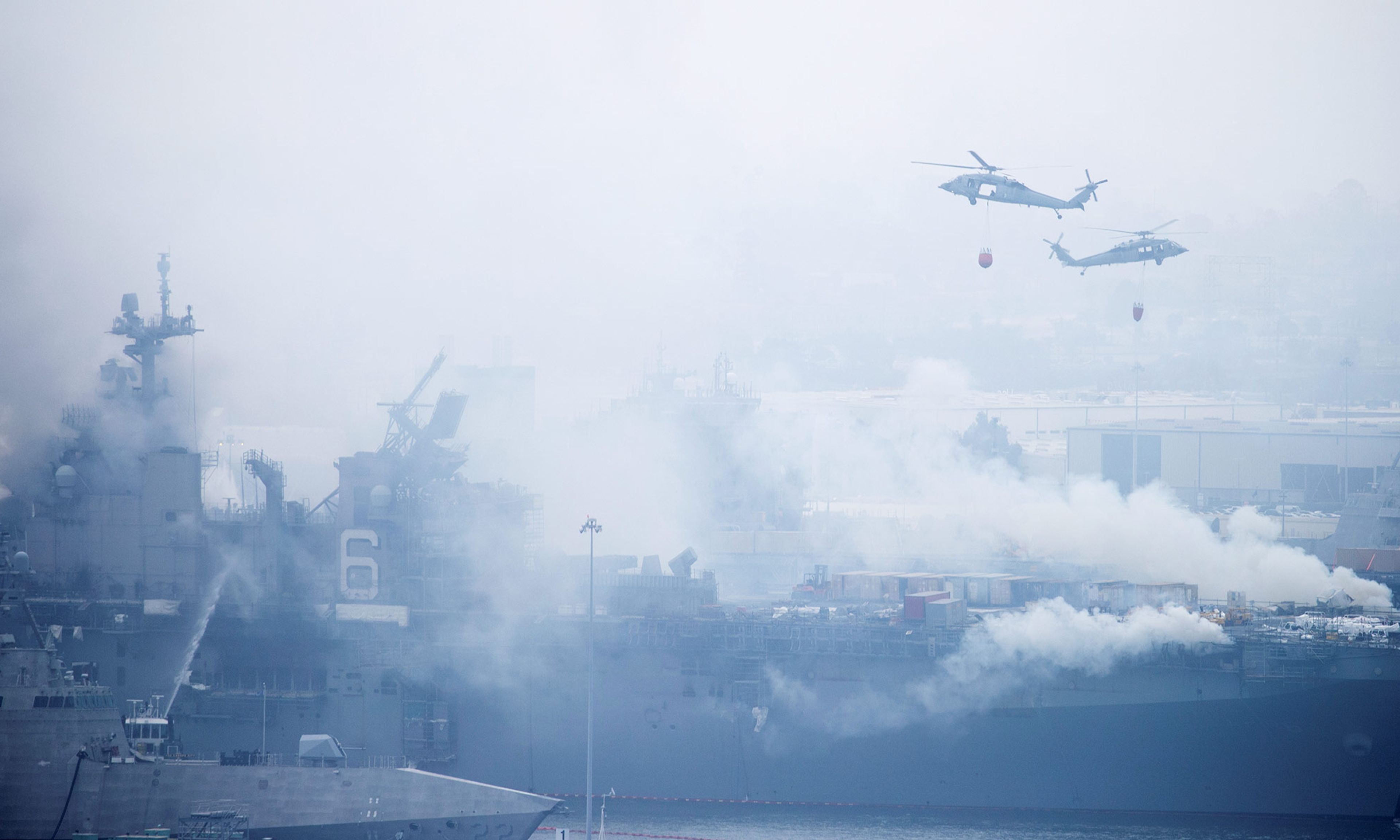
The Navy suffered yet another cruel blow this past weekend when a fire broke out onboard the light amphibious carrier USS Bonhomme Richard, one of the oldest and most revered names in U.S. naval history, and then grew to massive proportions and spread throughout the ship. At one point the ship was entirely evacuated, firefighting tugboats pulled back, and the two destroyers that were tied up across the pier from the burning ship got under way as quickly as possible to escape the soaring temperatures and thick smoke. Local fire officials momentarily speculated that the ship might have to be left to burn “to the water line,” an outcome difficult to imagine for a steel-hulled vessel but not so difficult for those firefighters attempting to work in close proximity to the ship’s internal 1,000-degree Fahrenheit temperatures. The flames have raged for days, and firefighting efforts finally appear to be gaining control of the situation. The ship’s aluminum island has melted and her radar masts have collapsed, while Navy and local San Diego officials worried what would happen if the flames reached the ship’s fuel tanks, located just above her keel, well below the waterline, but containing 1 million gallons of the Navy’s special blend of diesel fuel.
For those who have served onboard Navy ships, the chain of events that led to the conflagration was not difficult to understand. The ship, a light amphibious carrier displacing some 45,000 tons, had been forward deployed to Japan beginning in 2012, and had returned to San Diego in 2018 to begin a major maintenance overhaul that would upgrade all of her major systems and prepare her flight deck for the embarkation of new Marine F-35B short-takeoff, vertical-landing fighters. This maintenance period was coming to an end and the many contractors onboard were finishing their repairs and gathering up their debris. Initial reports, which may be incorrect, suggest that “hotwork” was being done in the ship’s lower-well deck area, near a storage space where large amounts of rags, cardboard, and other flammable materials were gathered. The type of materials and the type of hotwork (the term alludes to welding or cutting torches or any number of operations involving ignition sources) have not been established, but what came next has been. At 0850 Pacific time, a fire was observed and the ship’s internal speakers ranged out with the dreaded “Fire-Fire-Fire. Fire in space . . .” followed by a description of the fire’s location onboard using the complex language of ships that every sailor learns upon joining the Navy. Following this initial statement, instructions followed for a firefighting party to gather at a equipment locker near the fire to suit up and advance in an organized manner toward the flames.





Comments