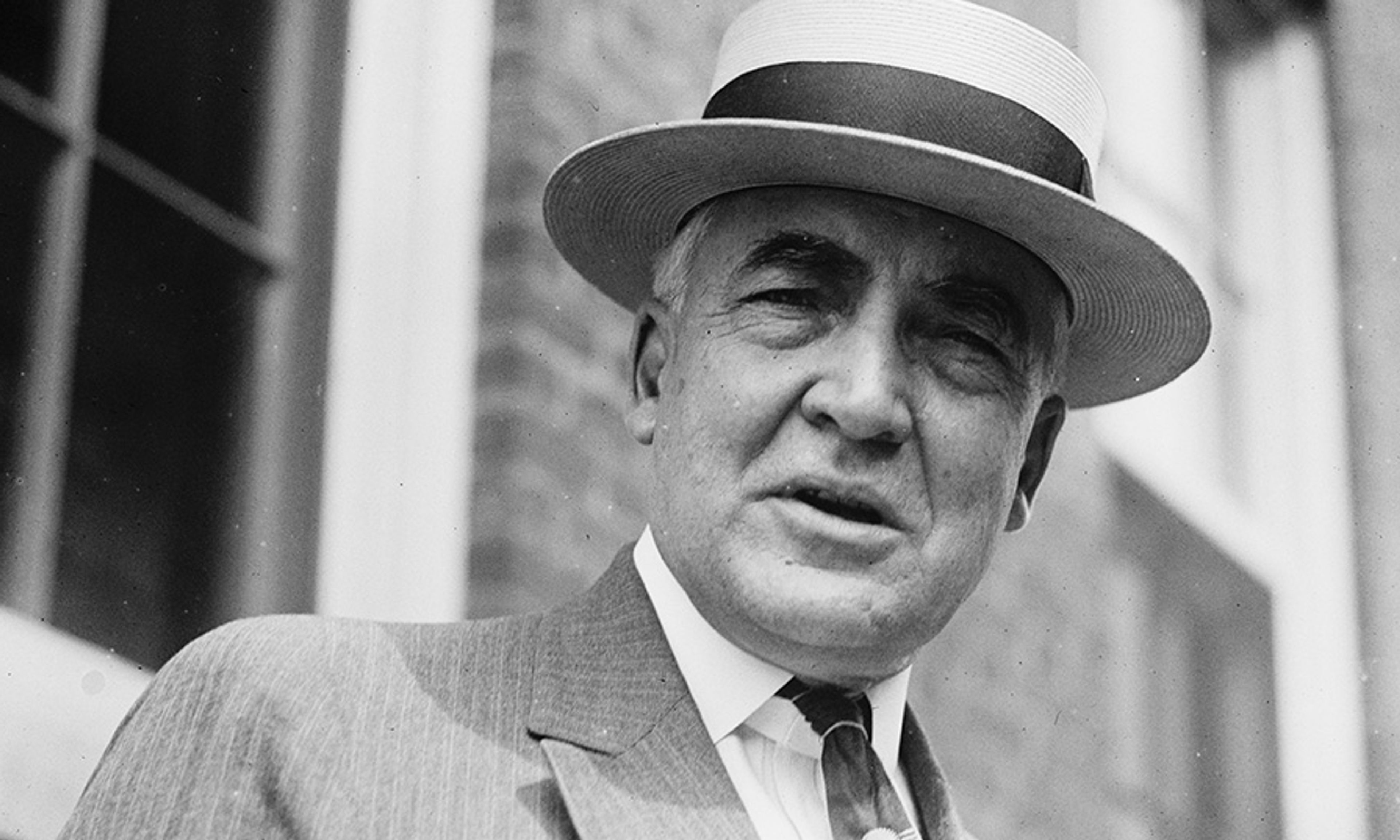
Poor Harding — he can’t get a break.
The story that the married Warren Harding fathered a child with Nan Britton, 31 years his junior, became part of the lore of both the Roaring Twenties and his battered presidency (1921–23). Teapot Dome, and a cutie on the side — no Mount Rushmore for this guy.
In recent years, while Harding’s affair with the age-appropriate Carrie Phillips was universally accepted (there are hundreds of letters to prove it), Britton’s story had fallen into disrepute — Paul Johnson in Modern Times was only one of many who dismissed it. But now a DNA test of Harding’s and Britton’s relatives shows that Nan’s child was indeed Harding’s.
More interesting to me, the DNA also showed that Harding had no black blood. This was a stubborn rumor in his lifetime, fomented by Democrats who were coming off the presidency of racist Woodrow Wilson. It was a stubborn rumor after Harding’s death. I remember appearing on C-SPAN in the 1984 election cycle, where I said, of Jesse Jackson, that he was the first serious black presidential candidate. A few days later I got a postcard asking, first, why had I concealed the fact that Harding was a Negro, and second, why had I concealed the fact that I was a Jew? My correspondent was wrong on both counts.
The Harding sex stories are more than voyeurism: They are plot points in the narrative of Democratic court historians (such as Arthur Schlesinger Jr.) to portray almost all non-Democrats as ciphers, rascals, or wrongheaded. The narrative begins with Federalist Alexander Hamilton (about to be downgraded on the ten-dollar bill, by order of Jack Lew); it blackens Grant and all his bearded Republican successors, then marches on through the 20th century. The narrative has to accept Lincoln (purged of his Whig past), and makes nods to Theodore Roosevelt, but Harding is mere road kill.
Harding died, age 57, just past the midpoint of his lone presidential term. Had he lived, cleaned house, and won reelection, his reputation might look different. What did he accomplish even so? He rode out a post-war depression without taking any measures that might have prolonged it. He let the socialist Eugene V. Debs out of jail.
His most problematic achievement was the Washington Naval Conference of 1921–22. This froze battleship ratios among the major naval powers (the U.S., Britain, and Japan). It spared the first two from an expensive ’20s–’30s arms race, and probably spared them from accumulating vessels whose usefulness would be curtailed by air power. On the other hand, it allowed Japan to build up to its capacity. Japan never had the industrial power overtake an alarmed United States, but as Admiral Yamamoto said, it could have six good months.
The Washington Conference reflected a very old American belief, going back to Thomas Jefferson, that wars are caused by weapons, and a related belief that treaties can effectively limit weapons. Another strain of American diplomatic thinking was expressed by John Jay, as he was negotiating the Treaty of Paris: No treaty has ever signified “any thing since the World began.” We are still turning that dilemma over today.






Comments