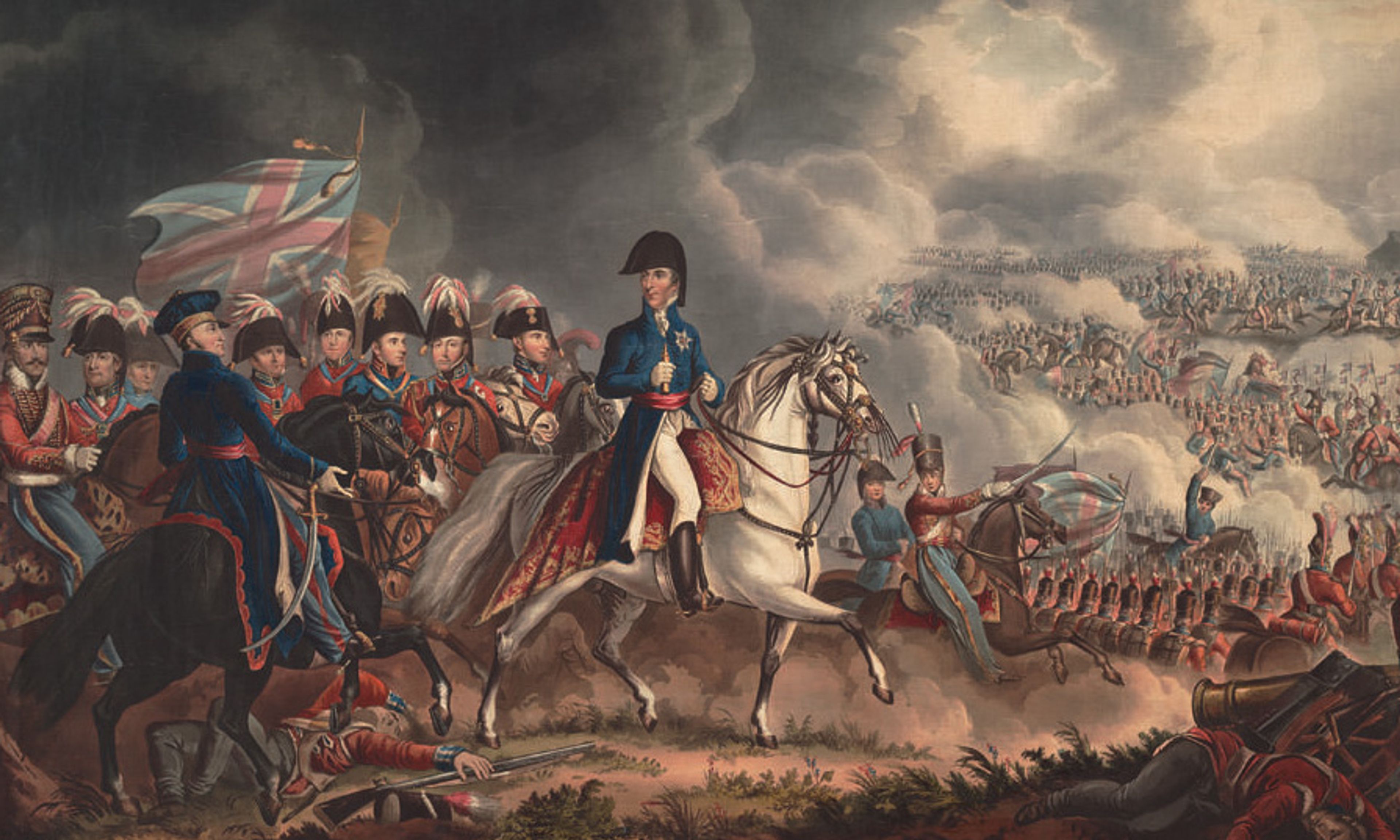
Two hundred years ago today, in a field at Waterloo, Napoleon Bonaparte was finally defeated. In the many celebrations that the anniversary of that battle has yielded, the historical significance of the fight itself has been a touch overstated. The importance of the changeover that it marked, however, has not. In hindsight, Waterloo served as the key moment of the nineteenth century, recording for posterity the precise day on which the French claim to be the world’s “top nation” came crashing ignominiously down, and the promise of renewed British power, which had been fermenting quietly since the Battle of Yorktown, came finally to fruition.
That the British emerged from the fighting as the new world leader should not in truth be surprising. Since 1780, London had demonstrated in no uncertain terms that it was not to be trifled with at home, abroad, or on the high seas. At Trafalgar in 1805, the sheer depth of British naval superiority had been made readily apparent, that decisive battle having illustrated for all and sundry both that Britain would prove impossible to invade and that its capacity to project power around the wider world was unmatched. At home, meanwhile, the country’s burgeoning population and explosive industrial and economic growth had all but guaranteed its future strength. Wellington may well have been correct when he noted that the Battle of Waterloo had been “the nearest run thing you ever saw in your life,” but the tides of history had been turning long before French troops hit the allied post at Hougoumont. A victory for the French would have changed the course of history a touch, yes. But for how long?
SLIDESHOW: Battle of Waterloo
When Napoleon had returned to France in early 1815, thereby bringing to a whimpering end the First Restoration of Louis XVIII, he had taken over a country that was in gradual decline. Despite the lofty rhetoric of the revolutionaries of 1789, by the turn of the 19th century the French had fallen behind in the industrial arms race, had been exhausted by near-constant warfare, and, perhaps most crucially, had suffered a dangerous population slowdown that left it unable to compete in the long term with nearby Prussia. Worst of all, Napoleon’s unexpected revival had queered the French among their neighbors. During times of celebration and national pride, modern Frenchmen make much hay of the fact that the majority of the fighters in the victorious Seventh Coalition were not British but Prussian, Dutch, Hanoverian, Brunswickian, and Nassaun. This is a fair and deserved tweak — especially in the face of romanticized English claims that the battle was “won on the playing fields of Eton.” And yet it misses a crucial point: namely, that it was precisely the ease with which Britain recruited a committed coalition of discontents to its side that did France in. Put simply: If Napoleon hadn’t been undone by Wellington, he would have been undone by somebody else.
PODCAST: Author Bernard Cornwell on the Battle of Waterloo
The allies’ victory defined and shaped the contours of the modern world, bringing an end to seven centuries of Anglo-French hostilities and setting the stage for a long period of peace, prosperity, and progress that would not be interrupted in earnest until, a century later, German “hyper-nationalism” sought to replicate Napoleon’s gains. Just as, if not more important, it ushered in what has now been 200 years of unbroken global Anglo-American hegemony. It is tempting for human beings to presume that what is currently so will always be so. At present we live in a world in which trade, travel, information, and the commercial use of the seas are as uninterrupted as is practically possible, and in which the world’s liberal democracies are capable of projecting force at a moment’s notice — often, if not always, in defense of individual liberty. It should be remembered on this day that this is not the natural state of affairs — the “way things are,” in modern parlance — but the direct result of those nations that developed and codified classical liberalism having won the day. Between 1815 and 1945, the role of global underwriter was played by the post-slave-trade British Empire; between 1945 and today, it has been played by the United States. We are entering the third century in which the champions of freedom are in a position of unmatched international strength. That trend began at Waterloo, and we should all be thankful for it.
— Charles C. W. Cooke is a staff writer at National Review.
Editors note: This post has been updated.





Comments