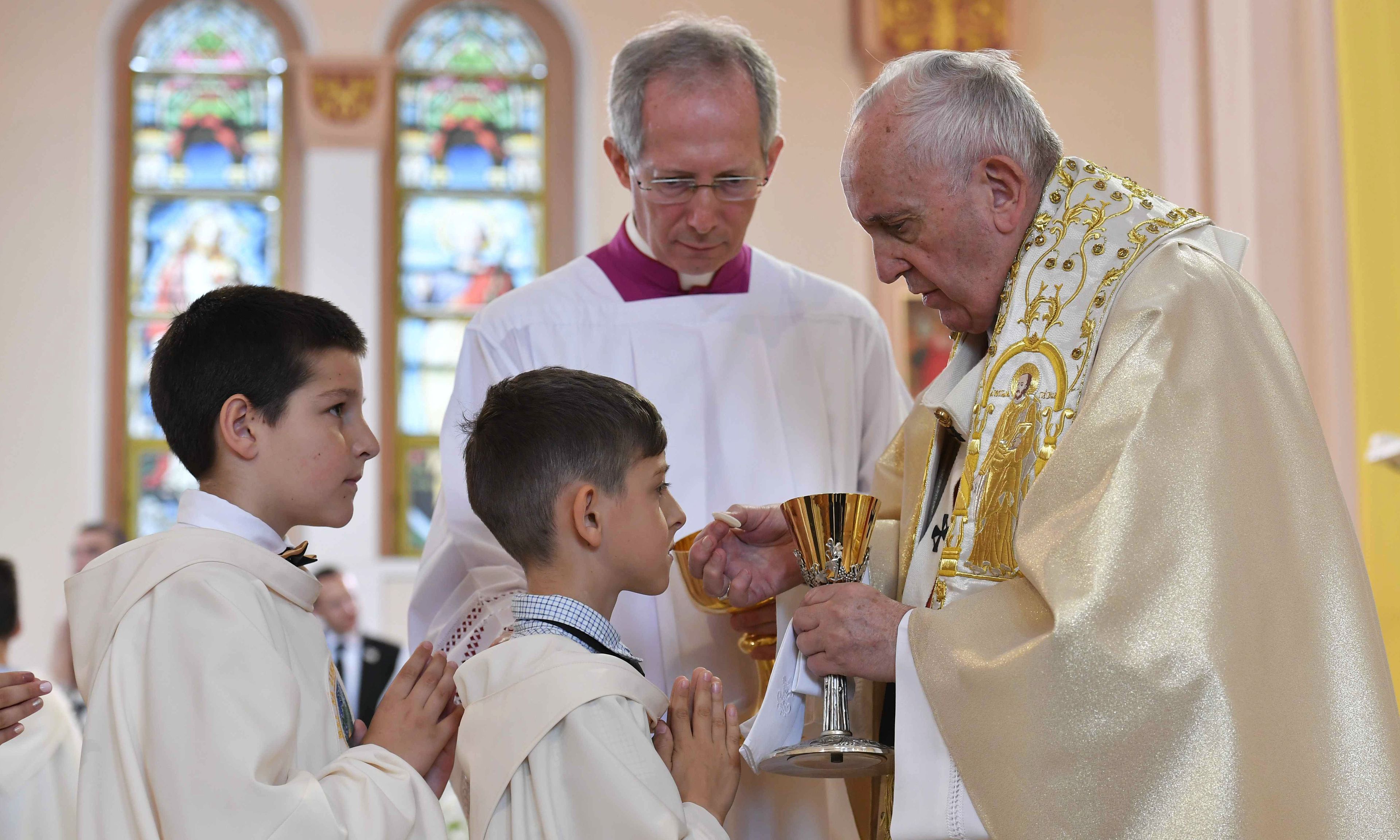
On the plane ride back from his trip to Romania, Pope Francis told reporters that since “there is already Christian unity,” there is no need for the faithful to “wait for the theologians to come to agreement on the Eucharist.” Some progressive Catholics have considered this to be evidence that the pope may be open to granting full Eucharistic communion to non-Catholics. If that is indeed what Francis meant — what else could he have meant? — then he is forcing the Church to address a series of rather difficult and uncomfortable questions.
Not least among them: What is the Eucharist? Is it a tool to be used to facilitate a “Christian unity” that the pope insists “already” exists? Or is it an expression of full communion with the Roman Catholic Church? If the Church reverses herself and contradicts her unbroken Magisterium on the admission of schismatics and dissenters to the sacraments, what happens to her dogmatic integrity on other settled questions of faith and morals? Is the entire canon perpetually subject to the modish preferences of the current and future occupants of the Petrine chair? Most astounding, why is she unwilling to “wait for the theologians to come to agreement” before making a change of such gravity?
Theology, in St. Anselm’s classic formula, is fides quaerens intellectum — faith seeking understanding. If the pope’s goal is to formulate a discipline wherein faith is joined to right reason, there is nothing to fear in allowing rightly disposed “theologians to come to agreement on the Eucharist.” If his goal is to unshackle the Church from her bimillennial moorings, that is another project altogether, one that might not be aided by waiting for a consensus of theological opinion.
As the liberal priest Father Thomas Reese suggests, dissolving the statutory boundaries that surround reception of the Eucharist is part of Pope Francis’s broader insistence that “facts are more important than ideas.” What this triumph of “facts” over “ideas” is supposed to mean for a Church that communes with an invisible God and a cautiously preserved deposit of faith is unclear.
What “facts” conceivably justify reversing the Magisterial opposition to unregulated intercommunion with schismatics? More to the point — are there any “facts” in the Catholic imaginary that can be wholly separated from the Church’s “ideas” about God? And which of these free-floating “facts” are more important than the “ideas” that make them intelligible? What, for instance, is more important — the “fact” that Jesus of Nazareth was executed by Roman authorities in the first century, or the “idea” that His crucifixion was an atoning sacrifice for the sins of mankind? If it’s the former, why do Catholics go to Mass?
If Catholic life is a series of brute “facts” with no broader intellectual coherence (“ideas”), then the entire practice of faith is a futile exercise. That intellectual novelty can be used to justify almost any change in the Church’s Magisterium, while those who insist on the preservation of the “ideas” that buttress Catholic faith are presumed to be angry scholastics and reactionaries thwarting the springtime of Vatican II. If “facts” and the Catholic intellectual frame (“ideas”) are at odds, then the entire Catholic understanding of the natural law and the broader philosophical project of the Church are a laughable sham.
This type of suggestive imprecision is not unusual for Francis. He has made a habit of using airplane press events to make what often amount to freewheeling, controversial claims about matters of Catholic faith and morality. The press corps will latch on to one or more of the pope’s remarks that appear to suggest a papal willingness to change a particular Church teaching, even though the pope has never explicitly said so. These statements, inasmuch as they appear to challenge settled matters of Church teaching, have left the faithful to wrestle with a recurring series of questions about the integrity of dogma and the difference between discipline and doctrine, and existential questions about inerrancy.
The first and most fundamental such question is this: Why does the Church believe what she does about the Eucharist? For centuries the Church has held to the doctrine of transubstantiation, whereby the “accidents” of bread and wine are changed into the literal Body and Blood of Christ when they are consecrated at the altar. And, lex credendi, lex orandi, Catholic liturgical practices demonstrate the Church’s belief in the reality of Christ’s Eucharistic immanence. The gathered faithful kneel in unison, prostrating before what appear to be ordinary bread and wine, as the piercing toll of bells and the rising smoke of incense mark the presence of Christ at the consecration. In an even more explicit sign of this belief, before the controversial liturgical reforms that came in the wake of the Second Vatican Council, members of the Church received the Eucharist on their knees as an ordained minister placed the Host on their tongues.
Belief in transubstantiation has both scriptural and patristic bases. It was one of Christ’s most polarizing teachings while on earth. Consider His words in Saint John’s Gospel:
Then Jesus said to them: Amen, amen I say unto you: Except you eat the flesh of the Son of man, and drink his blood, you shall not have life in you.
He that eateth my flesh, and drinketh my blood, hath everlasting life: and I will raise him up in the last day.
For my flesh is meat indeed: and my blood is drink indeed.
He that eateth my flesh, and drinketh my blood, abideth in me, and I in him.
As the living Father hath sent me, and I live by the Father; so he that eateth me, the same also shall live by me.
Christ’s followers were (understandably) shaken by these words, which seemed to insist upon cannibalizing Jesus’ own Flesh and Blood. They responded in disbelief: “This saying is hard, and who can hear it?” Who can hear it indeed?
The Church Fathers themselves attest to the mystery of the bread and wine becoming the Body and Blood. Saint Irenaeus of Lyons, writing in a.d. 180, insisted that Christ “has declared the cup, a part of creation, to be his own Blood, from which he causes our blood to flow; and the bread, a part of creation, he has established as his own Body, from which he gives increase to our bodies.” Saints Justin Martyr, Clement of Rome, and the Didache (The Teaching of the Twelve Apostles) all attest to this ancient belief of the Church well before the third century a.d.
Given the unique and divisive teaching about the substantive nature of the consecrated bread and wine, Saint Paul’s exhortation to the Corinthians provided what would become the scriptural grounds for selective admission to the sacrament. Paul told the Corinthian church that those who received the Eucharist “unworthily” would be counted as “guilty of the body and of the blood of the Lord,” a bold and forceful instruction that established a scriptural basis for future Church guidelines on admission to the sacrament.
The early Church took Saint Paul’s instruction and sought to outline criteria for admission to the Eucharist. Saint Justin Martyr (c. 100–165), for instance, insisted that the Eucharist be open only to those who believe “that the things we teach are true, and has received the washing for forgiveness of sins and for rebirth, and who lives as Christ handed down to us.” The Eucharist was always considered to be an expression of unity with the Church, not a tool to display ecumenical zeal or a means to “break down barriers” among the masses.
Popes throughout the centuries were undivided in their opinion on the subject. Particularly before the Second Vatican Council, popes were stark in their indiscriminate opposition to intercommunion, considering it a profanation and an abject evil to be avoided. Pope Pius IX put it rather precisely in his encyclical Amantissimus (1862), where he proclaimed that “whoever eats of the Lamb and is not a member of the Church has profaned.”
Such precision is of little import to the “innovators” that Pope Pius XII warned the faithful about. Give the “innovators” of the post-conciliar Church enough time and they will wiggle their way out of even the Church’s most unambiguous statements of antiquity.
Allowing any and all schismatic or heretical Christians to receive the Eucharist in non-extraordinary circumstances (circumstantial exceptions which, as it happens, are the product of doctrinal changes wrought by Vatican II) forces the Church to answer difficult existential questions, not altogether unlike others raised during Francis’s pontificate. To what degree can any pope change quod ubique, quod semper, quod ab omnibus creditum est — that which has been believed always, everywhere, and by everyone?
What is a legitimate development of doctrine? Can dogma even “develop” at all?
Questions about the extent of papal authority and the ability of dogma to “develop” would seem to have been settled by the First Vatican Council, convoked in June 1868 by Pope Pius IX. It provided the following concise explanation (emphasis mine):
For the Holy Spirit was not promised to the Successors of Peter that by His revelation they might disclose new doctrine, but that by His help they might guard the revelation transmitted through the apostles and the deposit of faith, and might faithfully set it forth. . . . Hence, also, that understanding of [the Church’s] sacred dogmas must be perpetually maintained, which Holy Mother Church has once declared; there must never be a recession from that meaning under the pretext of a deeper understanding.
It isn’t, in other words, within the papal domain to change what is revealed in sacred scripture or in the unbroken Tradition that proceeds from the first apostles. The notion that individual pontiffs are given unchecked license to enact sweeping reforms of ancient dogmas and disciplines “under the pretext of deeper understanding” is an abuse that the prelates of Vatican Council I explicitly forbade.
This would be not only a change in discipline, which may be “modified or even abandoned under the guidance of the Church’s Magisterium,” according to the Catechism of the Catholic Church, but would amount to a bona fide change in doctrine. It would codify a view of the Eucharist that would be utterly foreign to the dogmatic constitution of the faith, and its proponents admit as much. Father Thomas Reese, in his article praising the pope’s remarks, ultimately conceded that this move would be a genuine reversal of doctrine, noting that operating with a receive-now-ask-questions-later attitude toward the Eucharist inevitably means viewing “the Eucharist as a unifying sacrament rather than a celebration of unity.” What that distinction means in practice — the “facts,” if you like — is that the Church would adopt a view of sacramental life radically different from the vision it has held for over 2,000 years.
To echo the lament of Pope Pius X, “Far, far from the clergy be the love of novelty!”





Comments