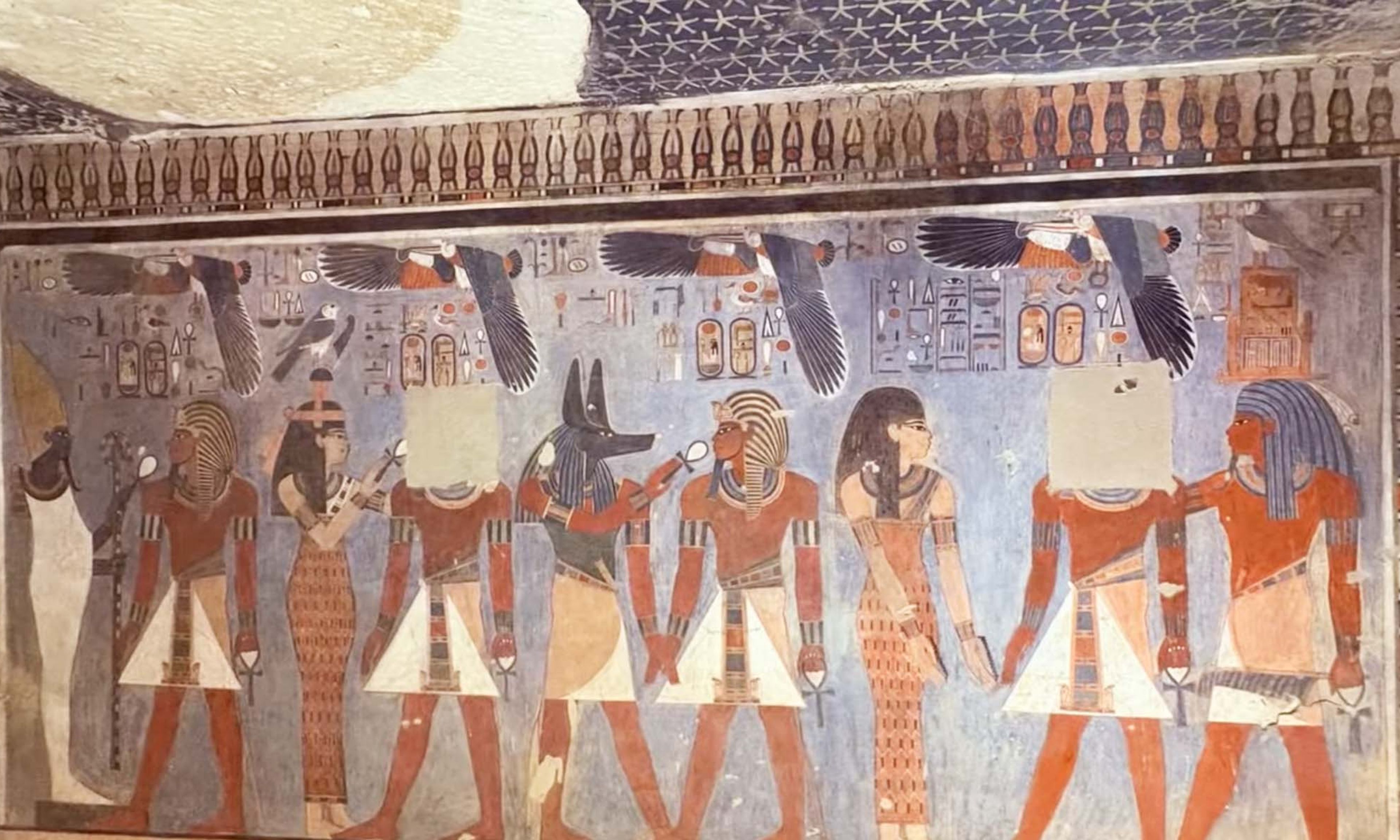
I’m always chipper around Christmas and New Year’s, times of gift giving, snow, revelation, reflection, and renewal. Revelation isn’t just about prophets channeling God. I follow Biblical archaeology but also Greek and Roman discoveries, believing that there’s so much we don’t know, plus technology has advanced so much. AI, ground penetrating radar, drones, magnetology, and DNA science are a few of the new ways to marry technology to the human eye and touch and the scholarly mind and to read what’s underground. Egypt’s Valley of the Kings has been combed for hundreds of years, thousands counting tomb raiders, but just a few months ago archaeologists there confirmed they’d found the tomb of Thutmose II, who ruled during, we think, the 1480s b.c. It’s the last missing tomb of an Eighteenth Dynasty pharaoh and the first discovered since King Tut’s tomb in 1922. The dynasty ran from around 1550 to 1292 b.c. and was ancient Egypt’s golden age.
The evidence? The neighborhood’s right but the proof starts in the paint — a patch of ceiling painted blue with gold stars. The color and design are reserved for royal tombs. Scenes from the Book of the Dead reserved for pharaonic tombs had disintegrated into bits on the floor, though small passages are still on the walls. Good puzzle skills and AI reassembled them. An inscription on a fragment of an alabaster pot salutes “the Son of Re, Thut,” but the rest hasn’t been found. There were several Thutmose pharaohs, but a fragment from another pot links the tomb to the husband of Hatshepsut, possibly the ruling queen in her own right, possibly any ninth Hatshepsut but we know of all the capo di capi called Thutmose, only Thutmose II had a wife named Hatshepsut. Thutmose’s daughter or granddaughter might have been the princess who discovered baby Moses in a basket, but a clique of Egyptologists and Biblical archaeologists think Thutmose II might have been Pharaoh during the Exodus. Timelines are sometimes set in sand, not stone.





Comments