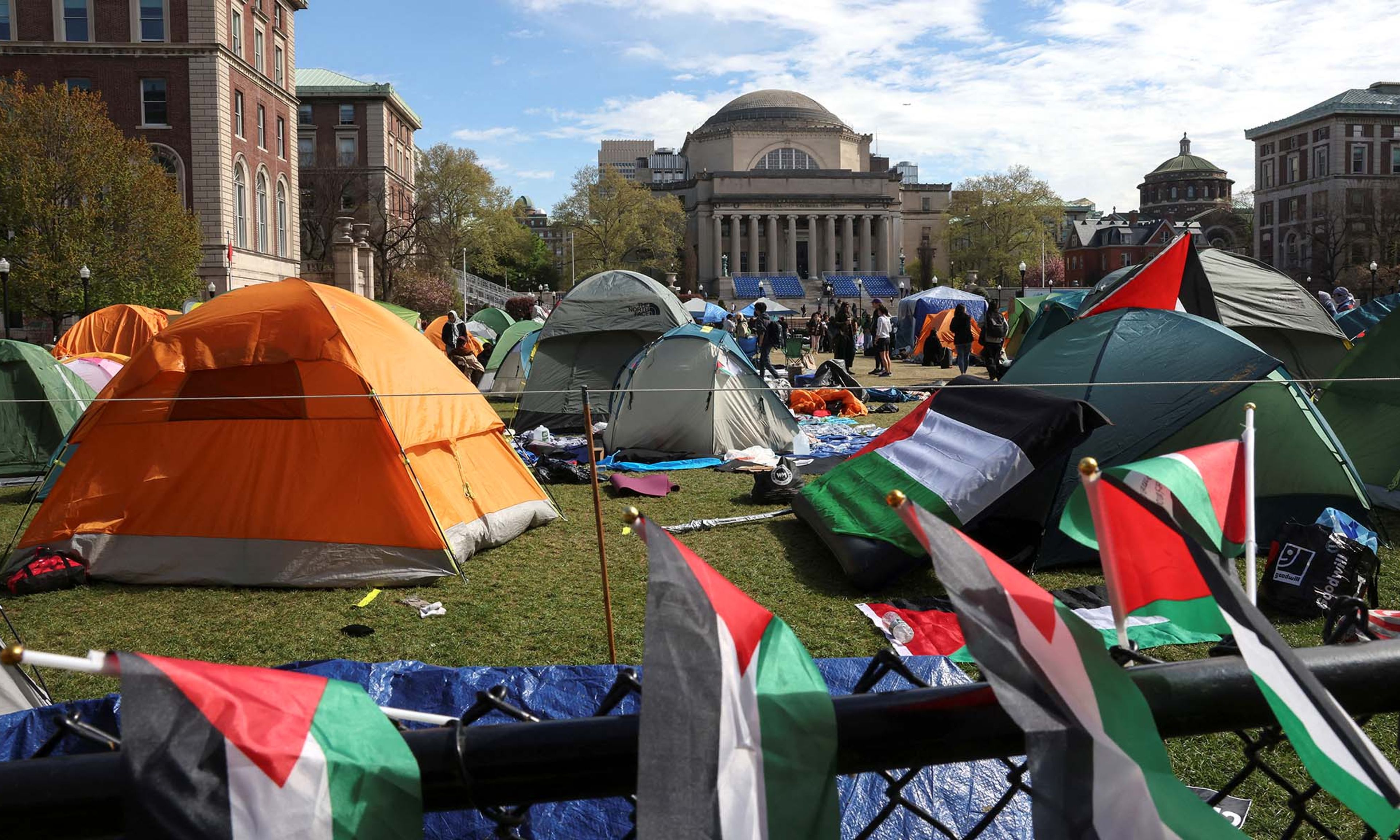
Herewith, I shall risk the sultry wrath of the perpetually politically indignant and submit for the record that it might altogether be a good thing if there were fewer angry protests on America’s college campuses and a more fastidious culture of reading important books. I am not alone, I suspect, in having noticed that the intellectual quality of those who are currently shouting the odds at Columbia and elsewhere is rather embarrassingly low. It is said that, when Patrick Henry sat down after an oration, the audience was stunned into silence. At Columbia, by contrast, I have been habitually stunned into indifference — or, if the speaker tries particularly hard, into mild bemusement. Which has made me wonder: Why, exactly, are these protests happening at all?
By this, I don’t mean, “What is it that the protesters are saying?” I know that. By this, I mean, “Why is it that they are saying it where they are saying it?” The tone of the coverage suggests that campus protests are simply assumed to be an important part of the college experience — like lectures or athletics or trying marijuana. But it’s not at all clear to me why this is the case. For a start, there is no obvious connection between the war between Israel and Hamas and Columbia University in New York. Against whom, exactly, are the students lodging their complaints? The faculty at Columbia is not in charge of Israel or the Israeli military; it does not set American foreign policy; and it did not contrive any of the historical or geopolitical questions that underpin the broader fight. I daresay that there are students at Columbia who, for whatever reason, are vexed by the state of the world, but to take this out on their fellow students and the staff at their school makes no more sense than to take it out on the staff at Pedro’s Deli. The two things do not, in any meaningful way, even come close to intersecting.





Comments