The big story of Chicago’s mayoral race last month was that voters sent incumbent Lori Lightfoot packing over her abject failure to keep residents safe and improve unfathomably low academic proficiency among the city’s schoolkids.
An overlooked part of the story is what the race says about the influence of unions and the depths to which they will go to hold on to power as their membership slides to an all-time low of 10.1 percent of workers.
Illinois’s neighbors to the north — Wisconsin and Michigan — can also attest to blatant power grabs for unions over the last month, making the Midwest a barometer for how the political winds may blow next year if the unions keep up their current tactics.
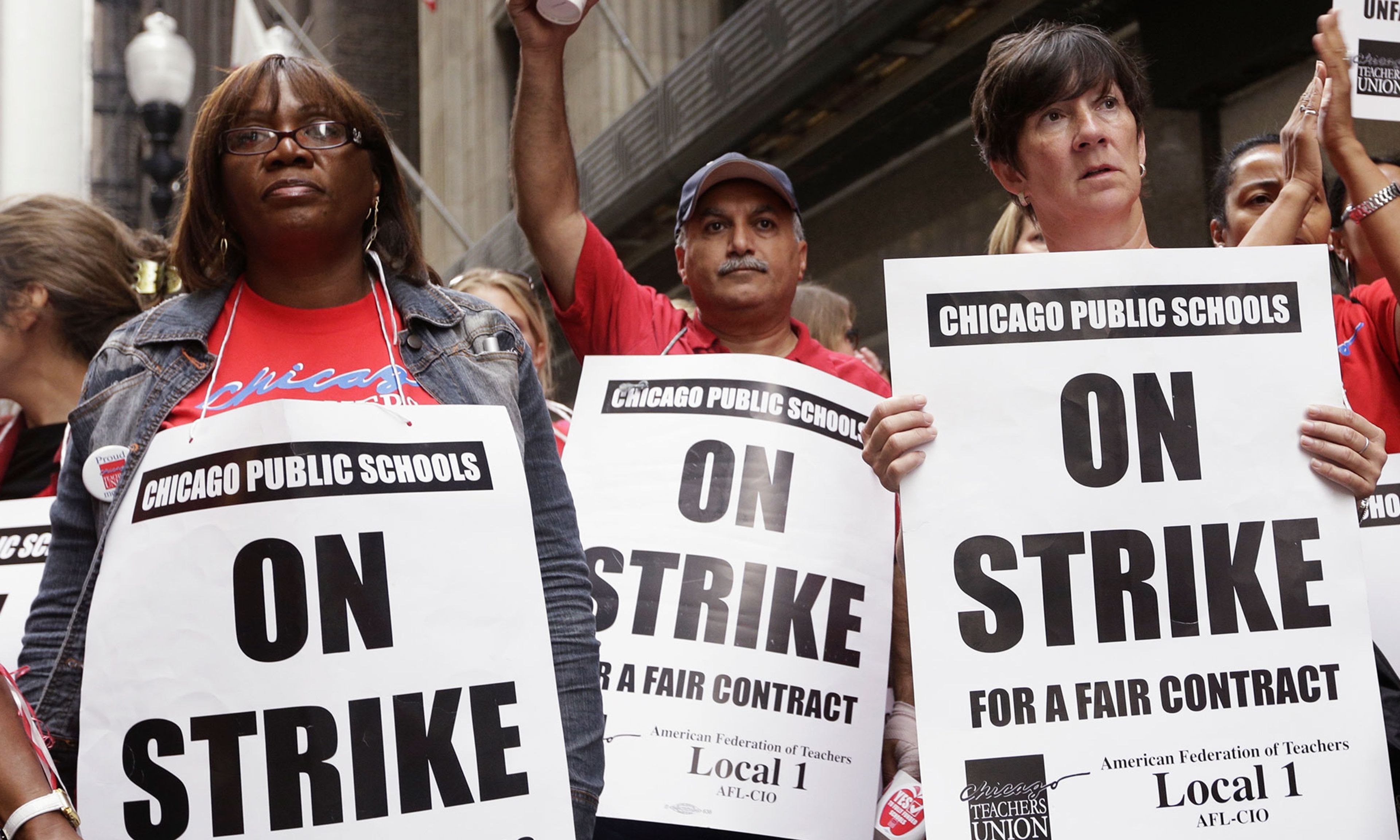
The Windy City is known for its political shenanigans, and the antics of the Chicago Teachers Union (CTU) leading up to the April 4 mayoral runoff only solidify that reputation. According to the Illinois State Board of Elections, CTU and its PAC have doled out almost $2.3 million to candidate Brandon Johnson, one of the union’s very own employees. The amount is triple what they spent in the last mayor’s race.
CTU made the move despite dissension within its ranks. Considering that crime in Chicago spiked by 41 percent from 2021 to 2002, some CTU members preferred Johnson’s opponent, who is more supportive of law enforcement. They were understandably outraged upon learning that CTU loaned its PAC $415,000 from dues to support Johnson, without taking a member vote on the transfer.
Further, CTU is spending $8 of dues per member per month through June to support Johnson, a move that some members said also lacked transparency. CTU did this despite its own handbook’s stating that no dues money would be spent on politics.
In a news interview, one CTU delegate said the union is composed of “Republicans, Democrats, progressives, libertarians, and Green Party,” and that “every one of those people have a right to be heard, and they aren’t.”
If Johnson wins, he may as well hand CTU leadership the keys to the city. Johnson will rubber-stamp every demand of his union bosses who put him in office. When asked during a candidate forum to name an issue on which he disagrees with the union, his response said a lot about how he would lead.
“If you’re asking me if I do not believe in public education, what kind of question is that?” Johnson said.
Unfortunately for families and the country, the more powerful the teachers’ unions become, the more poorly public schools perform. Since a radical group of teachers took control of the CTU in 2010, Chicago Public Schools’ reading and math scores plummeted, and 47,000 students left the system.
April 4 is also a pivotal election day just over Illinois’s northern border, when Wisconsin voters will decide whether a conservative or a progressive will fill a vacancy on the state supreme court. With a current 4–3 conservative majority, the outcome will very likely affect abortion, redistricting, school choice, voting laws, right-to-work, and government-union collective bargaining in a swing state just before the 2024 election.
With so much at stake, the temptation to influence the outcome is considerable.
Perhaps it should be no surprise, then, that earlier this month, a Milwaukee radio host found that the Milwaukee Public Schools system (MPS) had ordered its administrators to generate a list of students who will be eligible to vote in the spring election and add the information to a voter-registration document. MPS college and career advisers were also asked to work with the League of Women Voters, a left-leaning activist group, to set up a voter-registration event.
While this was an MPS-driven edict, there is little daylight between MPS and the Milwaukee Teachers’ Education Association (MTEA). For the first time in recent city history, every MPS board member is supported by the MTEA, giving the union ample room to wield its influence on policies and actions that ultimately benefit it. As the local paper of record noted, the MPS teachers’ union “appears poised for a new era of political influence.”
MPS’s actions not only violated its own policies on student information, political activity, and use of school equipment, the district probably violated federal law on how student information can be used.
That same week, unions in another Midwest state proved that the law will not stand in their path to government control. In a nod toward the unions, both Democrat-controlled chambers of Michigan’s legislature passed a bill to repeal the state’s long-standing right-to-work law. With a Democratic governor, it stands a good chance of passage.
If it does pass, both public- and private-sector unions will be able to require nonunion members to pay dues if they are covered by collective bargaining.
Voters won’t have a say in the matter either, owing to a savvy move by the Democrats, who attached an appropriation to the bill. Michigan law prevents referendums on legislation that contains appropriations.
In a historically union state that is important politically, the impact could be monumental.
According to a 2018 study, the passage of a right-to-work law reduced the Democratic Party’s vote share by about three percentage points on average. Repealing one would probably reverse that effect.
Yet even Democrats have acknowledged that a repeal is contrary to the U.S. Supreme Court’s decision in Janus v. AFSME, in which the Court ruled that public-sector unions cannot require workers to pay dues, because it’s a violation of the First Amendment.
With unions experiencing declining membership, and with the great awakening among parents who’ve seen the detrimental impact that teachers’ unions have had on schools, it’s no wonder they’re grasping for every tool in their tool kit — even if it’s against the law.
The time to push back is now, or we will all pay the price. Workers will be required to pay for political views with which they don’t agree. Kids in urban public schools, whose test scores are already at indefensible levels, will fall irretrievably behind. And taxpayers will be forced to pay for the increased cost of a government that is already broken and underwater in debt.




Comments