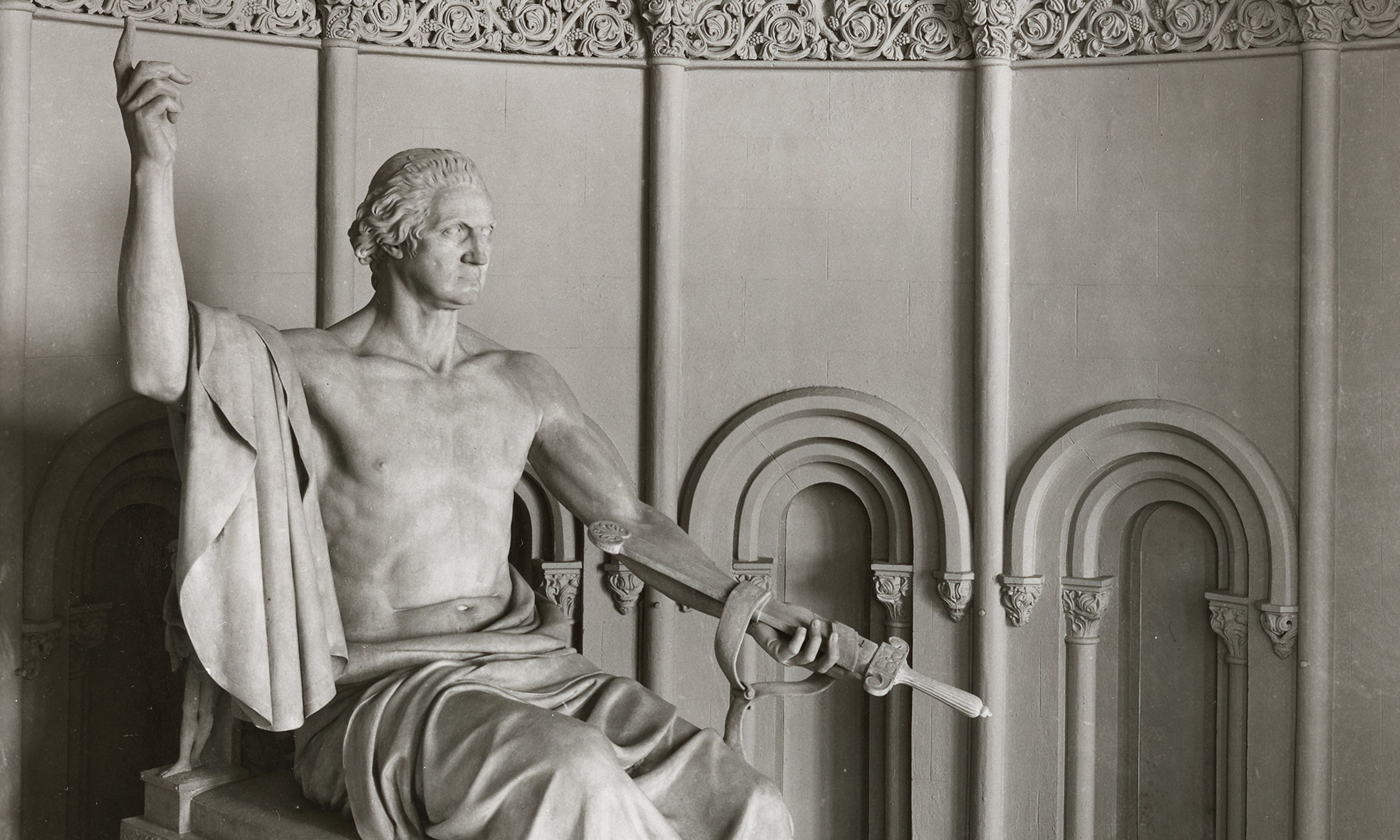
On July 14, 1832, the United States Congress commissioned a marble statue of George Washington to be sculpted in celebration of the centennial of his birth. The sculptor Horatio Greenough completed the work in 1840, and his Enthroned Washington is still on display today at the National Museum of American History.
From a strict historical perspective, the sculpture is something of an anachronism. The bare-chested Washington is draped in a Roman toga and clad in Roman sandals. Seated on an ornately carved chair (again, crafted according to the regnant style of Greco-Roman antiquity), he points the index finger of his right hand upward toward Heaven and in his left holds out a sheathed sword, offering the hilt of the blade to his onlookers. We can be certain that at no point during his earthly sojourn did the great general ever don such garments as these. Moreover, Greenough could easily have chiseled America’s indispensable man arrayed in an 18th-century military uniform without sacrificing a great deal of grandeur in his portrayal. Why the classical garb?





Comments