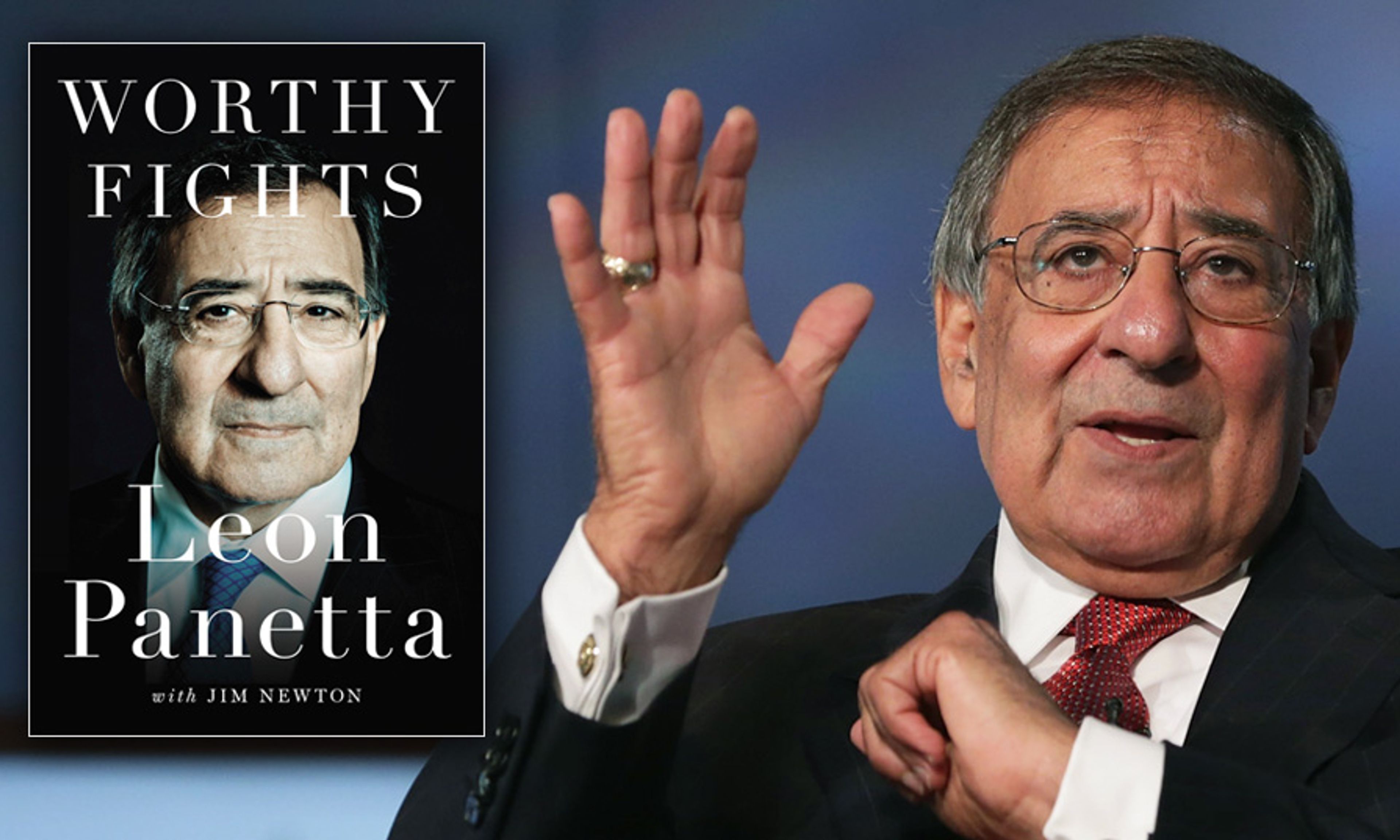
In his memoir, Worthy Fights (Penguin, 512 pp., $36), Leon Panetta happily reviews his upbringing and his career. He is a man at peace with himself and the path he has chosen in life. His sense of loyalty and patriotism is so deeply ingrained that the reader instinctively likes him.
Panetta asserts that all politics is personal. On that score, he connects with Mr. Clinton, adores Mrs. Clinton, and expresses loathing for Mr. Newt Gingrich. Without apology or analysis, he toes the Democratic ideological line throughout his book. He takes unabashed credit for admitting gays openly into the military and expanding combat missions for women.
A cheerful Democratic partisan and career politician, he projects a friendly spirit of competitive competence. When he writes that, at day’s end, as a garrulous, unabashed Italian American, he would share a glass of Scotch with his chief of staff, Jeremy Bash, and his military assistant, Marine general John Kelly, an outgoing Irish American, you know the conversations were frank, profane, hilarious, and insightful.
His book is mostly a straightforward account of his decades in government. Only in the last hundred pages does he relate his personal philosophy to affairs of state. In his view, it is the responsibility of elected officials to lead America in the direction of a better, more secure life for the next generation.
That banality seems anodyne enough — until he notes its absence in the decisions of the commander-in-chief. He writes that President Obama declared that the use of chemical weapons by the Assad regime in Syria constituted a “red line” — but then he could not bring himself to launch a retaliatory strike.
“Obama vacillated,” Panetta writes. “The result was a blow to American credibility. . . . It sent the wrong message to the world.”
Worse, he accuses Mr. Obama of ignoring the strong advice of the Pentagon, military and civilian, in his haste to withdraw all U.S. forces from Iraq — and recounts a similar rejection in 2012 of a consensus recommendation to arm the moderate Sunni opposition in Syria.
Panetta was appalled that both Congress and the president took no action to prevent the so-called sequester cuts from slashing the defense budget. He explains that the administration’s new “Pacific strategy” would shift 28 Navy ships from the Atlantic to the Pacific. Unfortunately, this tilt will probably not be noticed by the Chinese. And even that small quantitative shift may not take place, because a carrier battle group has been diverted to the bombing campaign in Iraq and Syria.
In his own memoir, former secretary of defense Robert Gates exhibited curiosity, introspection, and intellectual rigor. The extrovert Leon Panetta accepts his surroundings as they appear. He seeks to manage what the staff brings to him in the present; Gates tried to anticipate future events. Both left the Pentagon with grave reservations about the resolve of their commander-in-chief.
“A president,” Mr. Panetta said a few days ago, “needs the heart of a warrior.”
Regrettably, Panetta was wistfully speaking of a need rather than an existing condition. A warrior goes to battle to kill his enemies and to win. Such heartfelt determination is not an objective description of Mr. Obama.
Plainly distressed by the indecisiveness of the White House, Panetta concludes his book on an ambiguous note. “Without leadership,” he writes,” there is crisis.” But he is not convinced the crises will abate. “Leadership will require sacrifice and compromise, steadiness of purpose and a willingness to listen — all of which are somewhat forgotten virtues in today’s Washington. . . . Those who serve must learn again to subordinate their self-interest to the larger national interest. In so doing, they will preserve democracy itself. That’s a worthy fight.”
Worthy fight indeed. Unfortunately, it will be two more years before we will see whether the forgotten virtue of steadiness of purpose can be remembered.
— Bing West has written six books about the wars in Iraq and Afghanistan. His latest is One Million Steps: A Marine Platoon at War.






Comments