
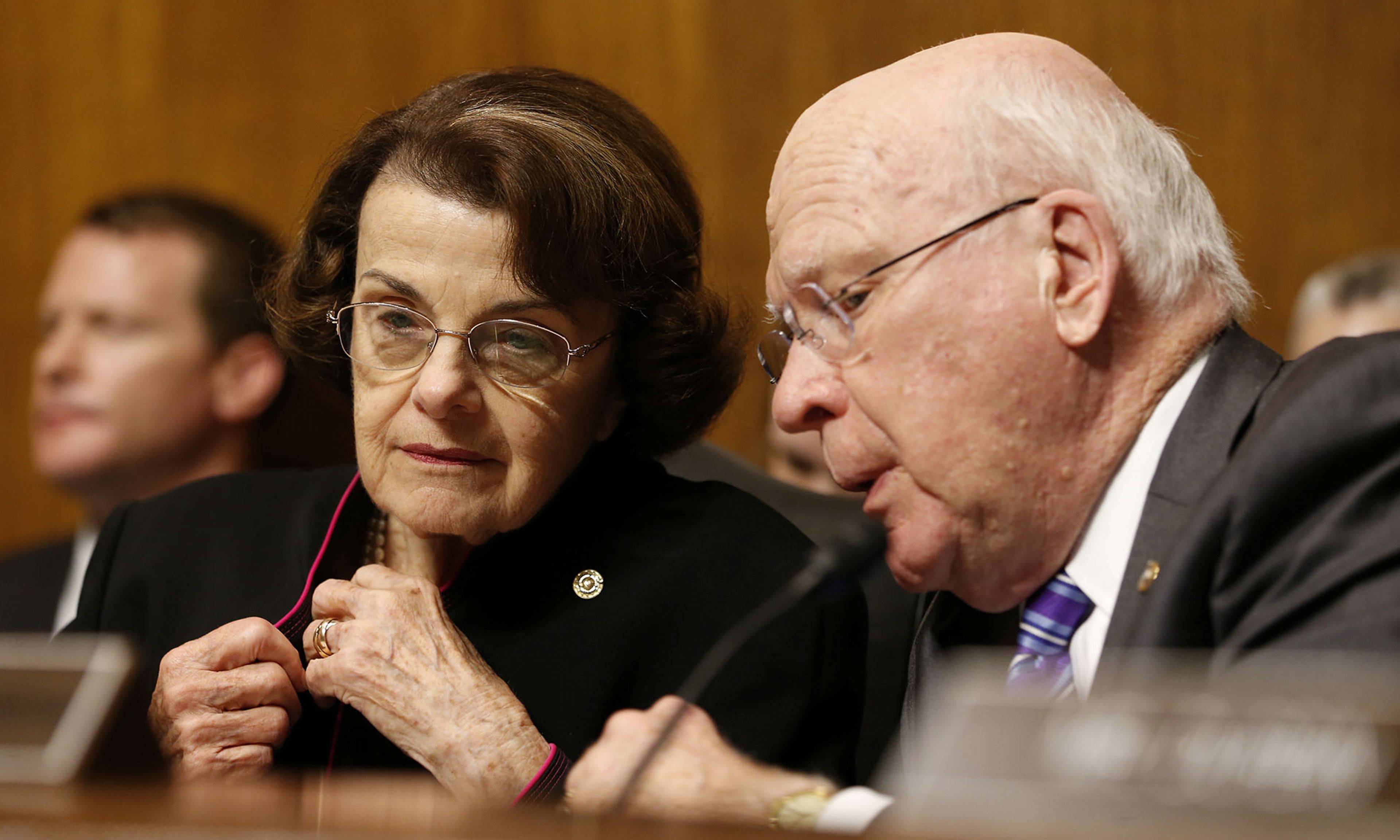
When it comes to judicial confirmation obstruction, blame flies over which party did what first, or more often, or with more negative consequences. Our fellow citizens still need to know, and have a reliable way to evaluate, what their government is doing. One way to approach this is to apply criteria or standards of the other party to the confirmation process. Democrats have frequently said how the process should work, at least with a Democrat in the White House. How does it measure up today?
On September 18, 2014, for example, then–Judiciary Committee Chairman Patrick Leahy (D., Vt.) complained that judicial vacancies “remain high.” Vacancies are 97 percent higher today.
On March 27, 2014, Leahy observed that “we are once again spending unnecessary floor time overcoming a procedural obstacle so we can move to an up-or-down vote on a judicial nomination.” That procedural obstacle was a time-consuming separate vote to end debate, a step that typically was accomplished easily by informal agreement between the party leaders.
At that point, 62 months into the Barack Obama administration, the Senate had taken 38 such votes. The Heritage Foundation’s Judicial Appointment Tracker shows that today, 29 months into the Donald Trump administration, the Senate has taken 87 votes to end debate on judicial nominations. Leahy voted against ending debate and to block a final up-or-down votes for almost all of them.
On January 9, 2014, Leahy charged that “Republicans, for the first time ever, refused to allow any currently pending judicial nominees to be held over so that they would be ready for immediate action this year. . . . Senate Republicans are forcing us to duplicate work this year that already completed [last year].” With Leahy’s support, Democrats did exactly that between 2017 and 2018, forcing Trump to renominate dozens of judicial picks and the Senate to start all over again.
On June 13, 2013, Leahy noted that “we are not even keeping up with attrition.” Today, despite a Senate controlled by the president’s party, judicial vacancies are still 11 percent higher than when Trump took office.
On March 13, 2012, Leahy charged that Obama’s nominees to the U.S. District Court “have already received more than five times as many ‘no’ votes in three years as President Bush’s district nominees did in his eight years.” At that point, 18 percent of Obama’s confirmed district court nominees had received at least one negative vote. Today, 55 percent of Trump’s confirmed district court nominees have received negative votes.
On March 4, 2013, Leahy criticized Republicans for “depart[ing] dramatically from well-established Senate practices . . . in their efforts to delay and obstruct [President Obama’s] judicial nominations.” At this point, 84 percent of Obama’s judges were confirmed without opposition, compared to 31 percent since Trump took office.
On February 27, 2012, Leahy claimed that Obama’s nominees “are being treated differently than those of any President, Democratic or Republican, before him.” Leahy’s evidence was that five of the six nominees to the U.S. District Court reported from the Judiciary Committee “by party-line vote” since 1945 had been Obama nominees.
Let’s accept as true Leahy’s claim that only six nominees in 66 years were reported by the Judiciary Committee on a straight party-line vote. This Congress alone, in less than 18 months and with Leahy’s participation, the Judiciary Committee has done that more than two dozen times.
There’s more where these came from, but no matter which way you cut it, Senate Democrats have done an about-face from the way they demanded that Democratic judicial nominee be handled.




Comments