
Japan’s new prime minister, Shinzo Abe, campaigned last year on policies that he said would bring the country strong economic growth — and he seems to be succeeding. Today, the Japanese government announced that the country’s economy grew by a handsome 4.1 percent annualized rate in the first quarter, revised up from 3.5 percent at the initial announcement. Consumer confidence hit an optimistic note, too, reaching its highest level since May 2007. This solid economic growth figure (the fourth-quarter growth number was 1.2 percent) can be seen as a vindication of prime minister Shinzo Abe’s policies (known as “Abenomics”) and are expected to give him the political capital to push for more of his “growth agenda” this summer. So far, those policies have amounted to basically one thing: waging war on deflation and seeking a 2 percent inflation target with an extremely active central bank, run by his appointee, Haruhiko Kuroda.
One of the most obvious ways that’s worked so far is by pretty much lighting the Japanese stock market on fire: While other equities indices have seen strong performances since the beginning of the year, the Nikkei rose about 50 percent this year, and though it’s tumbled since, it remains up about 30 percent:
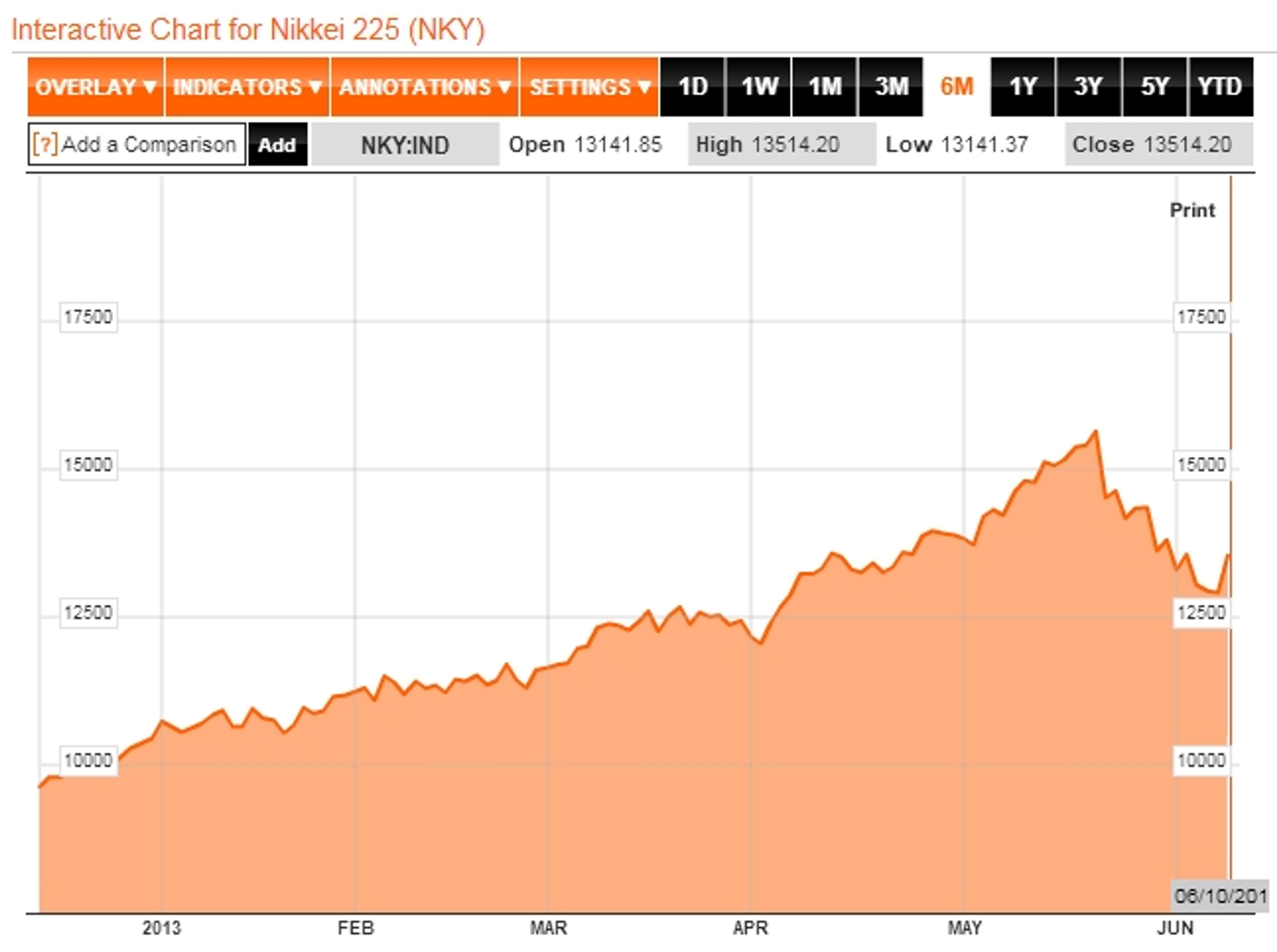
This boom carries with it a number of risks — prompting some Japanese to push for new restrictions to restrain volatility in bond markets — but it also seems to be working to revive Japan’s moribund economy.
Jim Pethokoukis’s NRO column today touches on a related topic, arguing that a more active monetary policy is what has made the difference between the U.S.’s merely weak recovery and Europe’s non-existent one The difference in the two policies, I think, has less to do with the fact that European Central Bank economists don’t share the U.S. Fed’s views and more to do with the fact that the European central bank serves a continent of countries with conflicting interests and prerogratives (see, for instance, the fact that the German supreme court this week has another real chance to strike down that country’s participation in some of the ECB’s monetary interventions). And there are a lot of other issues making the U.S. a more lively recovery candidate than almost any place in Europe. But Jim’s point is a very good one, and the signs of life in Japan’s economy after their new monetary-policy commitments strengthen it. Just today, in fact, the OECD’s latest monthly economic forecast gives just two wealthy members solidly positive long-term outlooks (reinforcing their semi-annual report from May): Japan and the U.S.






Comments