
John Updike was the one who coined the famous witticism that “America is a vast conspiracy to make you happy.” But while the phrasing was uniquely Updike’s, the insight was not: We as a nation have long prided ourselves on our optimism, our cheerfulness — an attitude based in a sense that we are not prisoners of the past but are instead creating a novus ordo seclorum, something new in human history. Some have even suspected that this “American exceptionalism” is the sunny flip side of a darkly hubristic Pelagianism, a conviction that we, alone among nations, are exempt from the human condition. Surely, a country with this kind of attitude is riding for a fall?
Well, we haven’t fallen quite yet, and I think the people who don’t like us still have a fair bit of waiting to do before their hoped-for American collapse happens. And I think, more fundamentally, that we’re on to something. There’s a movie coming out this week that embraces sexual fantasies of a sort that have been considered by most people throughout history as not just morally suspect but emotionally terrifying. Yet our culture, with its golden-hearted Midas touch . . . turns it into nothing more than an opportunity for a joke. I got an e-mail today from the publicist for a windows-and-roofing company in Kansas, offering “The Best 50 Shades of Grey for a Home Exterior.”
Even more pointedly, on Facebook, some friends of mine are talking about a Fifty Shades of Grey teddy bear you can buy from a company in Vermont.
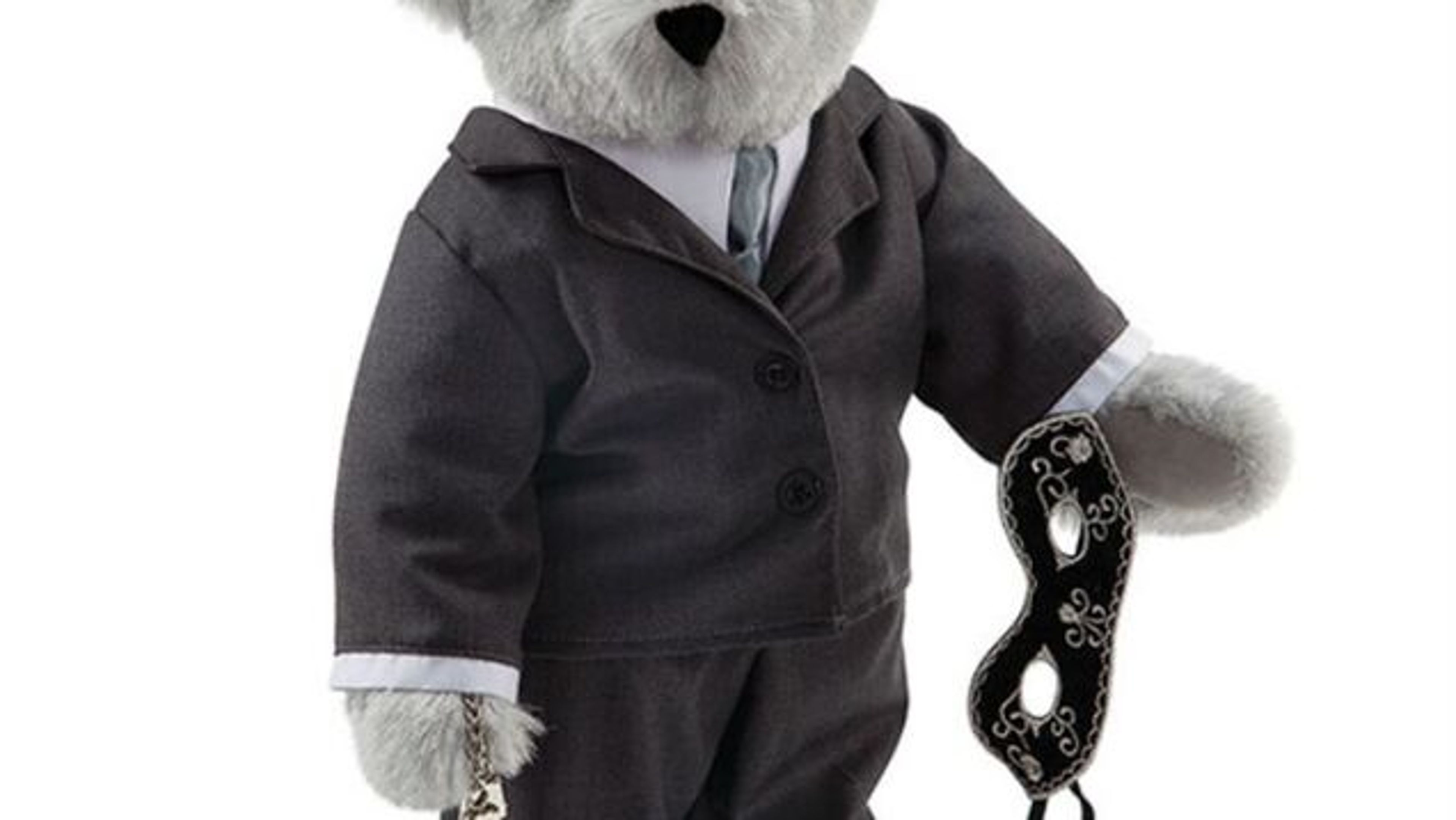
Now, this is an even more perfect metaphor for the American genius. A teddy bear, after all, is the domestication of a terrifying wild animal into an adorable children’s toy. The world can be a scary place, sure — but not after Walt Disney’s done with it.
A lot of people — and not just snobbish European bien-pensant intellectuals — are suspicious about this aspect of the American character. (A dislike of Walt Disney, in some circles, stands as shorthand for a dislike of America.) Allan Bloom, in a book beloved by many conservatives, noted how we transmuted the Brecht-Weill villain “Mackie Messer” into Louis Armstrong’s charming, smiling “Mack the Knife.” Reading Bloom on this, it’s hard to avoid the conclusion that he disapproved of the phenomenon. But as a way of coping with a terrifying world, I think America has a lot to be said for it.
In short: Europe can keep Mackie Messer (yeah, like that worked out for ’em). I’ll stick with the Bobby Darin version.






Comments