
Last year, I had an essay called “Dress Codes and Their Discontents.” I cite it at the beginning of my Impromptus today. Why? Because Magnus Carlsen would rather fight than switch. He showed up at a chess tournament wearing jeans. The rules said you could not. He was asked to change. He said nope.
Quick aside: Why did the phrase “rather fight than switch” come to mind (mine, at least)? For years, there was a cigarette slogan: “Us Tareyton smokers would rather fight than switch!” (Sure, should have been “We,” but . . .)
Elsewhere in my column today, I have notes on Elon Musk, China, Jerry West, etc.
“A Stable of Yore.” That was the heading over a post of mine earlier this month. Arlene Croce had just died. She was a longtime writer for The New Yorker and, in particular, a dance critic. At the beginning of her career, she wrote for National Review. WFB had other such writers as well: John Leonard, Joan Didion, Garry Wills, and Renata Adler.
Jessica Hornik Evans and I were talking about Croce. (JHE is our managing editor, and a poet.) There was another big dance critic at The New Yorker with an Italian last name: Joan Acocella. Jessica had a memory (which I share with her permission, of course):
Acocella once wrote a cooking piece for the New York Times. I wanted to try her recipe for coffee-flavored flan and wrote to ask her something about an ingredient — I don’t know what got into me, or why this was so important, but that was younger me at a time when you couldn’t just google it — and she replied with a handwritten note.
Wonderful. (A lot of that went on, in less digital days.)
In my Impromptus yesterday, I had a language note, peevish in nature:
Every year, the father-son golf tournament — featuring Tiger and Charlie Woods, et al. — is played. And every year, I have the same complaint. One Woods (Tiger or Charlie) is a “Woods.” Two of them are “Woodses.” You don’t keep up with the Jones; you keep up with the Joneses. Sticking to golf, Bobby Jones and his family were “the Joneses.” Yet every year, announcers and commentators at the tournament refer to Tiger and Charlie as “the Woods.”
Cripe — another lost cause . . .
A reader writes,
That brought to mind a card I received recently from a friend and colleague named “Wolf” and his family. It was signed “The Wolfs.” I had the fleeting thought that if I had sent it, I would have signed it “The Wolves.”
One more letter:
Dear Jay,
Your column about memorizing poetry sparked (inflamed?) a few memories that I hope you won’t mind my sharing . . .
I had a favorite uncle, Uncle Dan, who served in the Royal Canadian Army. The man struggled with alcoholism but in sober moments was witty, clever, and darned funny to a ten-year-old. He taught me the end of Rudyard Kipling’s “Gunga Din” . . .
Your column inspired me to print off the entire poem and I will soon get to work committing it to memory.
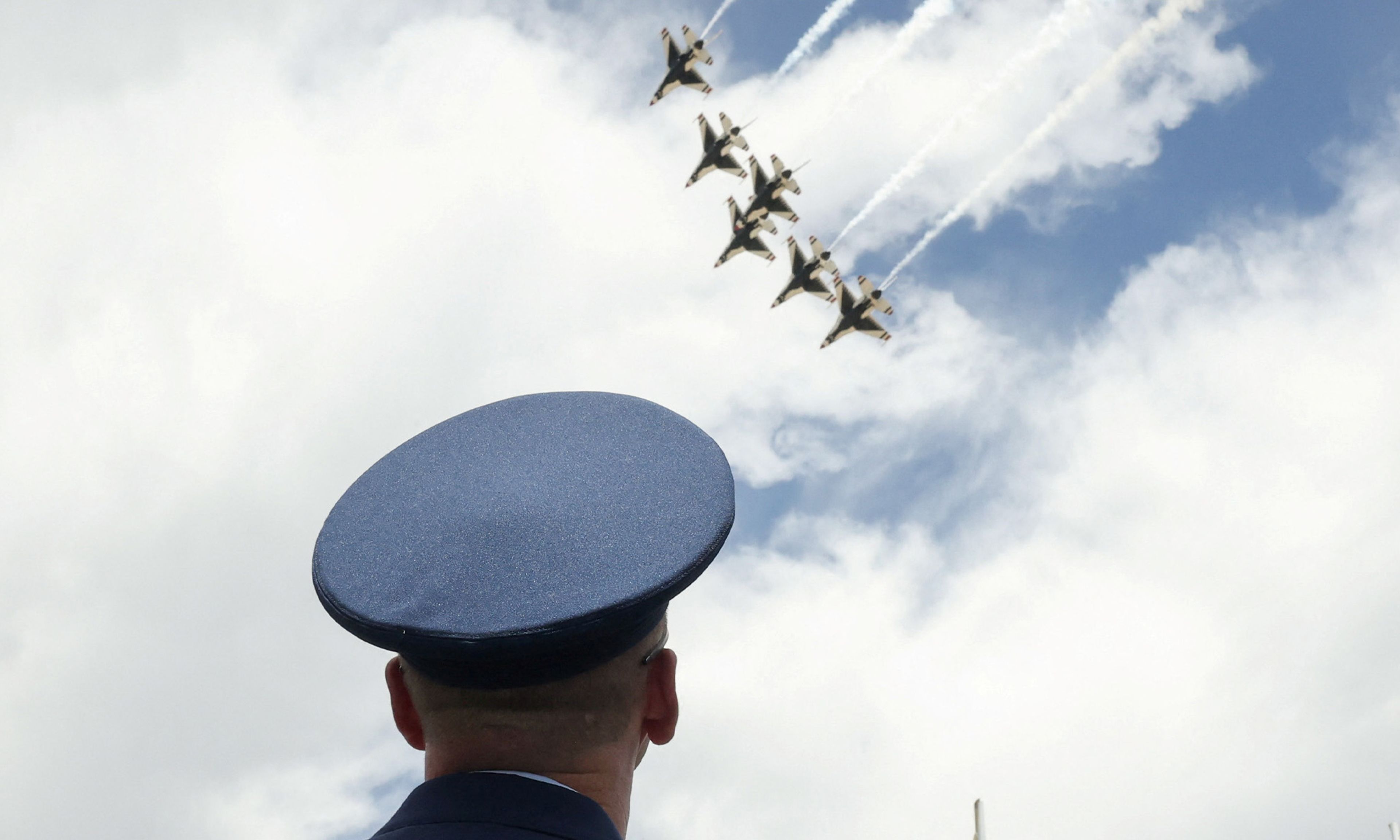
In 1981, I was a “Doolie” cadet at the Air Force Academy where, as freshmen, we were required to memorize several quotations and recite them under duress to the upperclassmen. Every grad has “Schofield’s quote” permanently etched in the gray matter. Oh, the irony, as the first line rolls off! “The discipline which makes the soldiers of a free country reliable in battle is not to be gained by harsh or tyrannical treatment.”
Here we were, being hazed to recite that.
Another memory: About 15 years ago, I was part of a tour group in Sevastopol, Crimea, Ukraine. (I know you know where it is, I just like to see all three words together.) One gentleman in our group recited from memory “The Charge of the Light Brigade.” That he flawlessly recited it made me envious. Your column reminded me of that. It rolled off the printer right on top of “Gunga Din.”
Finally, you inspired me to brush the mental cobwebs off “High Flight,” by John Gillespie Magee Jr. We were required to memorize that as well at the Academy, and I also sang the tenor part for the Catholic Cadet Choir. (I find sung verse easier to remember — don’t you?) No other poem so eloquently captures the joy I’ve experienced in a lifelong love affair with flight. That the author was killed in a flight mishap shortly after he penned the words and mailed them to his parents makes them seem even more sacred.
I shall forever be enraptured (is that a word? I hope it is) by the final words — words made even more famous when our favorite president spoke them in tribute to the Challenger astronauts: “Put out my hand, and touched the face of God.”
Great thanks to that ex-Doolie, and to all other readers and correspondents.





Comments