
The U.S. economy added 248,000 jobs in September, and the unemployment rate dropped to 5.9 percent, according to the Bureau of Labor Statistics’ latest report. But it’s not all good news: This strong jobs number was still accompanied by stagnant wage growth.
This comes after a disappointing month of job creation in August, when it was first reported that only 142,000 jobs were added. After more than 200,000 jobs were added in each of the previous six months, August was not good. It turns out August wasn’t quite as weak as we thought, though: Today’s report revised that number up to 180,000 jobs. (There is some concern that August jobs reports are just unreliable, period, because seasonal adjustment can’t deal with the number of people leaving summer jobs, returning to school work, etc.)
But the good news is that, for whatever reason, August looks like a bit of a fluke. 248,000 jobs in September is still not as fast as we’d like a recovery to be, but it’s noticeably more jobs than need to be created to keep up with population growth, and the past eight months have been a faster average period of job creation than any comparable time during this recovery.
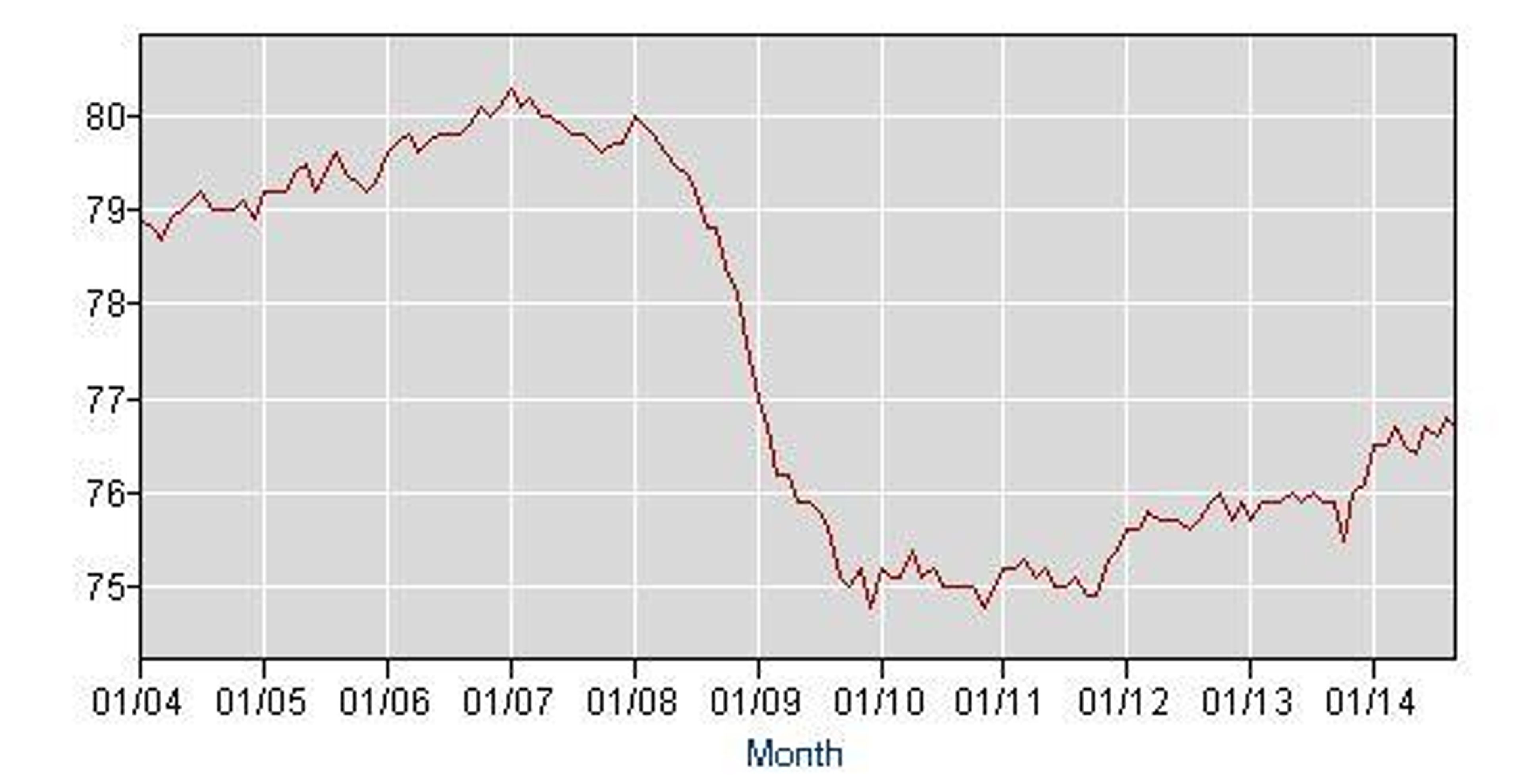
The New York Times’ Neil Irwin points out, for instance, that jobs are up 2.6 million since this time last year, while annual growth in the jobs during the recovery has averaged about 2 million per year. And Michael Strain of AEI drew up this chart, showing that the share of “prime age” workers, 25 to 54 year olds, holding jobs has finally risen:
The bad news: Wages are still not rising noticeably: Hourly earnings did not grow in September, though they’ve risen 2 percent this year as a whole and at that rate during the recovery generally. This outpaces inflation, but not by much. The Federal Reserve’s Janet Yellen regards this as an essential metric when considering how much monetary stimulus the economy needs and can handle without risking inflation. The Fed is set to end its quantitative-easing program this month, however, so her toolbox is not that big, unless she comes up with something new: The only thing the Fed can do is not raise interest rates from the near-0 where they are now, and promise not to raise rates for an extended period of time — and it’s already promised that. (Rates are currently projected to rise around the middle of next year.)
Another bit of bad news: The unemployment rate dropped two-tenths of a percentage point in large part not because of faster jobs growth but because the labor force shrunk. The labor-force-participation rate ticked down, to 62.7 percent, after it had also ticked down in August. That rate had held somewhat steady for most of this year. It will drop almost inexorably due to demographic changes in the labor force.






Comments