
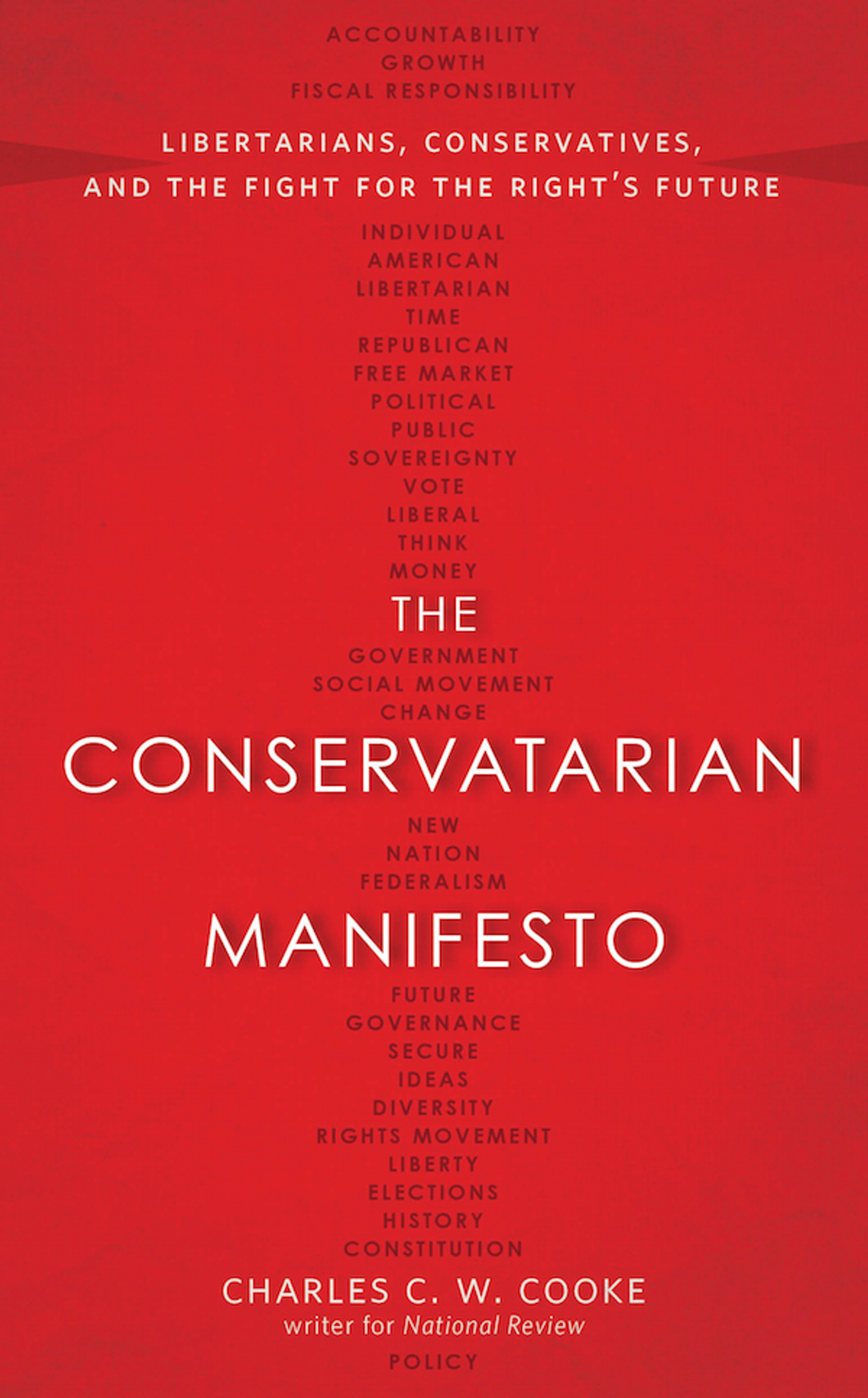
My first book, The Conservatarian Manifesto, is now out in hardback, assorted e-book formats, and audiobook. You can buy it on Amazon here, Barnes and Noble, and a bunch of other smaller stores.
Over two hundred or so pages, I take a look at the growing number of voters on the right who term themselves “conservatarians” or “liberservatives,” and who are keen to explain that when they are around libertarians they feel conservative and that when they are around conservatives they feel libertarian. I attempt to work out how the existing conservative movement — and its vehicle, the Republican party — will be able to accommodate this group, and to placate the sometimes warring factions that it is attempting to bridge.
I also offer my own suggestions as to where the party should come down on each key issue, and I present a sustained defense of federalism, of conscience rights, and of a political settlement that permits dissenters to leave freely and to see more accommodating pastures. Hoover’s Peter Berkowitz was kind enough to review the book here, and to describe my effort as a “first rate contribution” that “demonstrates refreshing common sense, a confident command of empirical realities, and savvy political judgment.”
It has been suggested in some quarters that “conservatarianism” is merely a fancy word for people who claim to be “socially liberal, and fiscally conservative.” It is not. In truth, the questions that we lump together under the banner of “social issues” are all rather different from one another, and deserve to be treated as such. Indeed, as I told Jim Antle on Monday, “social issues”are in fact so dissimilar that the term is all but useless:
For some reason, we describe drugs, abortion, and gay marriage as “social issues,” and we treat them as if they were philosophically or electorally comparable to one another. But they’re not. Structurally, the gay marriage issue revolves around the question, “which of civil society’s institutions with the state recognize and sanction, and in what form?”; the abortion issue centers on the questions of at what point a human life begins and of which protections from violence it should be afforded; and the drug issue comes down to the question of whether the state should intrude in the marketplace and prevent free citizens from owning, growing, transferring, and ingesting substances that effect profound physical or psychological changes. There really is no reason that one should approach these questions in the same manner.
Indeed, to look at the numbers is to realize that voters do not do so. Certainly, young Americans are becoming more “socially liberal” on the questions of gay marriage and the legalization of weed. Young Republicans are, too. But abortion is arguably going in the other direction. Indeed, as Gallup has noted repeatedly, young people are increasingly pro-life. For pundits to suggest as they do that Republicans needs simply to become “fiscally conservative” and “socially liberal” is simplistic. Actually, the party has a broadly popular position on abortion (albeit both parties are extreme in comparison to public opinion), and a generational problem on the issues of drugs and gay marriage.
There are significant differences, moreover, between those who support (or accept) gay marriage or marijuana legalization from the right and those who do so from the left. Indeed, as important as the underlying issues themselves is the manner in which these questions touch upon the role of the state, the federal system, upon the importance of conscience rights and the right to exit, and upon the integrity of the Constitution itself. Will conservatives be ready for the next fights? Will libertarians be willing to join them? And, accepting that there is a generational divide on marriage and drugs, will the traditional wing nevertheless be able to keep younger, libertarian-leaning voters from moving away from them on issues such as immigration, abortion, and national defense? If these are questions that interest you — and if you’d like to read a series of non-polemical essays about the ongoing fight over the future of the Right — I hope you’ll enjoy the book.






Comments