
The latest defense bill that passed the Senate on Friday was considered a “must-pass bill” by many lawmakers — which means a perfect opportunity for lawmakers to indulge in their worse habits. Last week, I mentioned that the defense bill somehow manages to include a land grab — the federal government is designating some wilderness protected in a national defense bill — but there’s more.
Lawmakers appear primarily concerned with pleasing defense contractors and protecting defense jobs back in the district, making economic and security concerns secondary. Via the Wall Street Journal, here’s [a few examples of these unrequested items]:
A-10 WARTHOG: The bill would allot $337.1 million to maintain the A-10 fleet for A-10 operations in fiscal 2015. The Pentagon wants to retire the A-10s to save more than $4 billion over five years.
GROWLERS: The measure includes $1.5 billion to buy 15 Growlers from Boeing, which has its headquarters in Chicago, in the home state of top Senate defense appropriator Dick Durbin. . . . The Pentagon didn’t ask for the money.
F-35 JOINT STRIKE FIGHTER: The fighter made by Lockheed Martin Corp. of Bethesda, would receive four more planes than the Pentagon requested for a total of 38 planes.
The F-35 that’s being over supplied, for those unaware, has a terrible track record. It’s 100 percent over budget and nowhere near a state where it can be used effectively or even safely. Many of the unrequested items, of course, benefit companies in the district of Senate defense-appropriations subcommittee chairman Dick Durbin of Illinois.
Lawmakers are also using this defense bill to renege on their promise to save money starting in FY2016 in exchange for lifting the sequester caps for FY2014 and FY2015, under the Ryan-Murray plan. We can expect, as the WSJ notes, that they will try to get rid of the sequester caps all together — once again revealing why you should never agree to more spending today in exchange for savings tomorrow.
While I understand that the sequester’s across-the-board cuts aren’t the ideal way to chop government, it seems to be the only way Congress is willing to do it, especially when it comes to the Pentagon. Whatever defense hawks might maintain, not every dollar of defense spending enhances national security and not all cuts jeopardize it.
But here’s something that should worry us all, even the most hawkish congressmen:
The act also rebuffs the Pentagon’s request for wholesale changes in compensation benefits for service members. In an effort to curb personnel costs that are rising faster than inflation, Pentagon officials had wanted to increase health care copays and to shrink the housing allowance given to service members, among other proposed changes.
The compromise bill negotiated by leaders of the House and Senate armed services committees allows only small cuts to the housing allowance and small increase to pharmacy copays, putting off larger changes until a report by a national commission on military compensation is submitted.
While we all want our soldiers to be well paid, the Pentagon’s budget is a microcosm of our larger federal problems: That is, health care and pensions are on track to eat up everything else. A report recently released by the Congressional Budget Office shows that, from 2000 to 2014, the fastest growing share of the Defense budget has been pay and benefits:
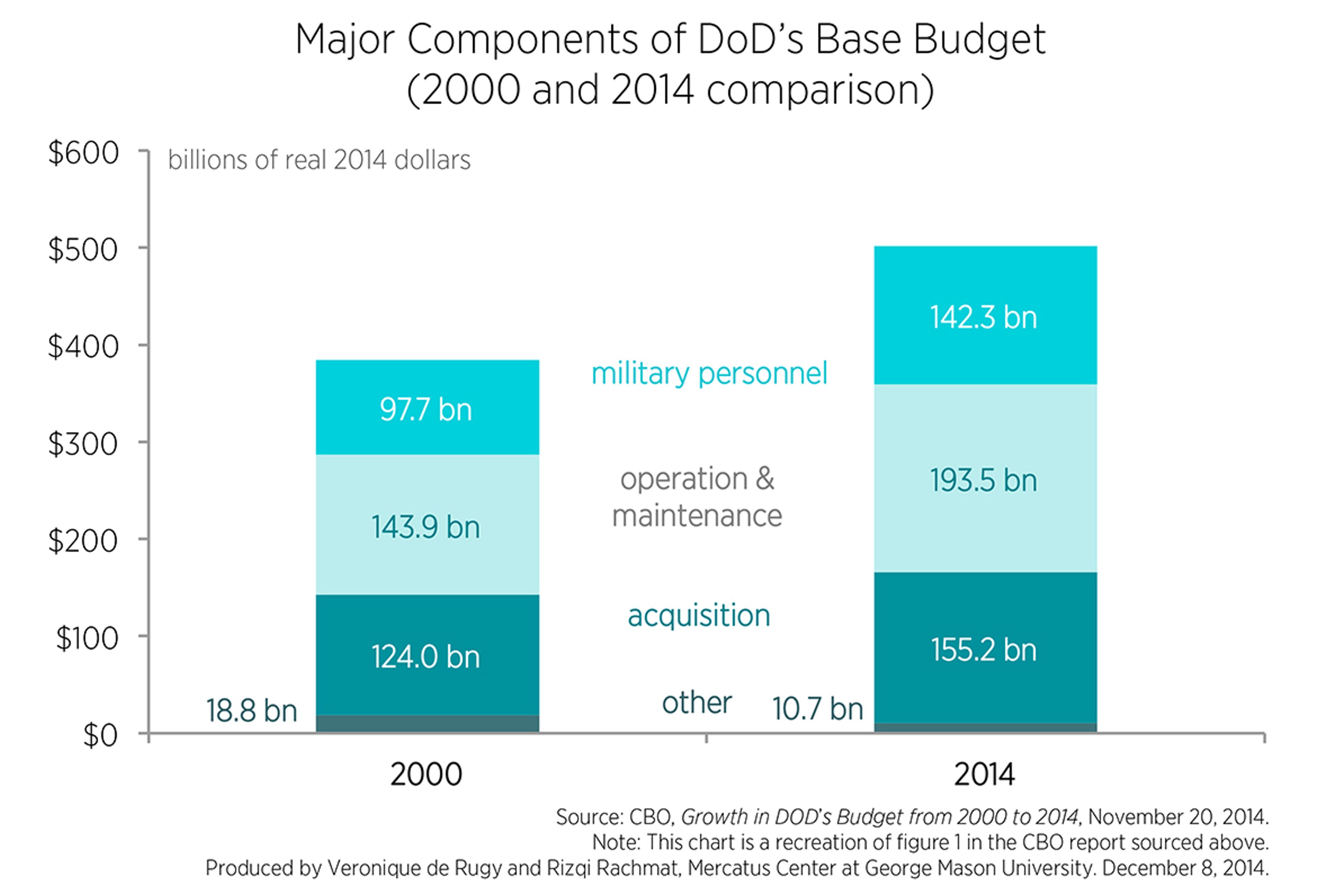
That spending has increased 46 percent in real dollars. If you add the substantial personnel costs contained within the operations and maintenance component (O&M) of the budget, the growth in spending is even more impressive. As I explained over at Mercatus last week:
About one-third of this increase was driven by increases in federal civilian employee pay and benefits, excluding health insurance. The cost of the Defense Health Benefits program doubled, which accounted for another third of the increase in O&M. As the CBO notes, “primary reasons for that growth are the new and expanded TRICARE benefits that lawmakers authorized, including expanded benefits for reservists and their families, and the very low out-of-pocket costs of TRICARE relative to other health care plans.” The rest of the increase in the O&M component can be attributed to rising fuel costs, operations support, and “other.”
AEI — no ally of mine on these issues, usually! — published an interesting report on this issue last July. It concludes:
While the real cost of military compensation per active duty service member rose by 42 percent from 2001 to 2012, the active duty force grew by less than 1 percent. The Pentagon will increasingly need to take great care in balancing all the priorities of military strength. Unless modernization of compensation and benefits comes soon, the only way to meet the spending caps set in the Budget Control Act of 2011 will be to continue to shrink the armed forces or cut other essential portions of the defense budget. The costs of inaction will harm future service members and their families by depriving them of the world’s best training, equipment, and leadership.
I’d differ with AEI slightly: Tradeoffs will be required to face the explosion of health-care and pension spending in the defense budget regardless of whether or not sequester caps are lifted. But reforming military compensation and benefits should be a priority regardless, rather than being undone in a “must pass” defense bill.






Comments