
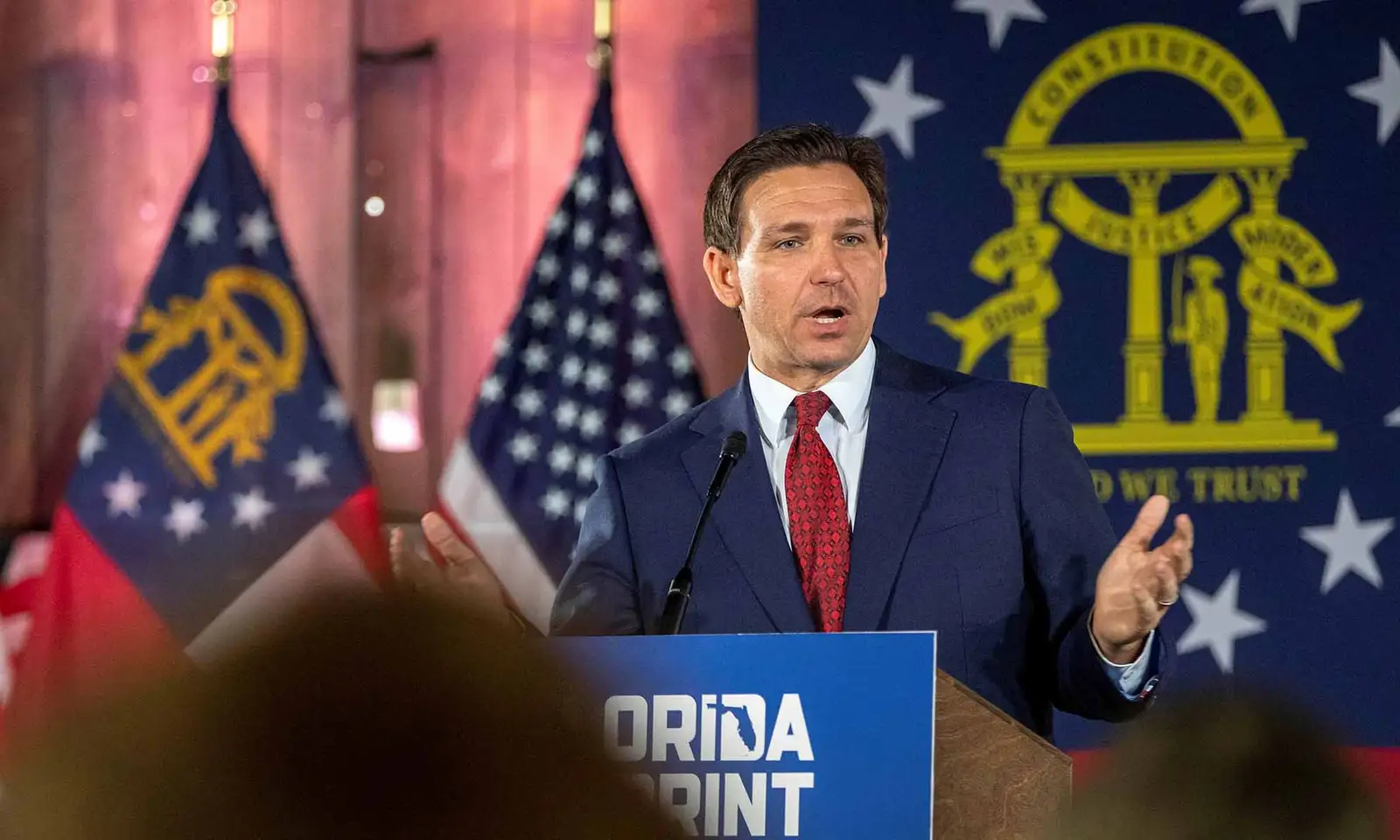
The latest Wall Street Journal poll of Republican voters quantifies the imprecise but general sense that Florida governor Ron DeSantis has been losing ground to Donald Trump over the course of this year. And while there is still plenty of game left to be played in the Republican presidential primary, DeSantis’s camp should be worried.
That survey found that, among self-described GOP primary voters, the lead DeSantis enjoyed over Trump in a head-to-head matchup in December’s WSJ poll has disappeared. In a one-on-one race, Trump now beats DeSantis nationally by 13 points, and Trump has the support of a majority of Republican voters. Between the two politicians, Republicans think Trump is a more decisive leader, stands up for what he believes, has “an impressive record,” shares Republican values, “cares about people like me,” and, remarkably, is the “most conservative” candidate. GOP voters still have the vague sense that DeSantis has the “best chance of beating [Joe] Biden,” but the governor’s electability edge has faded in recent months.
Another headache-inducing finding in this poll — at least at first glance — is the WSJ’s test of Republican voters’ priorities when they are asked to choose between social and economic issues. Describing it as “a potential sign of the power” of DeSantis’s campaign against institutions that have committed themselves to divisive campaigns of redistributive social justice, the WSJ’s survey found that “55% of Republicans say that fighting ‘woke ideology in our schools and businesses’ is more important than protecting entitlements from cuts.” By contrast, just over one-fifth of the GOP primary electorate ranks preserving the nation’s social safety net over putting “wokeness” in its place.
This is an odd framing by the WSJ, partly because these two imperatives are not in conflict. If you were asking me whether “protecting” entitlement reform from automatic “cuts” that would follow an insolvency crisis is more important than pushing back on woke ideologues, I would say that averting the rapidly approaching collapse of Social Security, Medicare, and Medicaid is a more pressing priority. But that’s all this is: an intellectual exercise.
Preventing the disaster that would befall the nation in a debt crisis — avoiding the liquidity and credit crunch that would affect all Americans negatively and severely diminish America’s standing on the world stage — is a pretty big deal. Meting out a comeuppance to those beholden to an anti-American ideological fad that consigns people to immutable demographic hierarchies based on their accidents of birth (a vision for the future of American society I attacked in both my books) is also crucially important. This isn’t an either/or proposition. Republicans can and must do both. Indeed, it must do both and much more.
The WSJ survey is valuable as a measure of Republican voters’ preferences. It is not, however, surprising. What prominent Republican is making a case for entitlement reform? Certainly not Donald Trump or Ron DeSantis. In fact, PACs loyal to both presidential aspirants insist that it’s the other guy who will “mess with” or “take a look at” reforming the nation’s unfunded liabilities. The implication in these candidates’ dueling attack ads is that voters can afford to ignore the ineluctable logic of the math that indicates these programs are on a doomed trajectory.
Entitlement reform is complicated, and voters take their cues from the elected officials and public intellectuals they trust. Right now, all the GOP’s biggest names are either ignoring the impending crisis or promising to preserve the benefits these programs can still dole out to their fortunate recipients — at least for a few more years.
If Republican voters rely on the politicians they trust as a heuristic to navigate a thorny issue such as entitlement reform, their views might change when Republican leadership decides it’s time to acknowledge certain inconvenient actuarial realities. That wouldn’t be historically unusual. But even when the GOP defined itself as a green-eyeshades party, its lower-income-base voters were never sold on the necessity of entitlement reforms. The Republican Party has reconceptualized itself as a “working-class” party, so it makes sense that it has catered to the sensibilities of those voters in the process.






Comments
On “Do GOP Voters Think Anti-Wokeness and Entitlement Reform Are in Conflict?”