
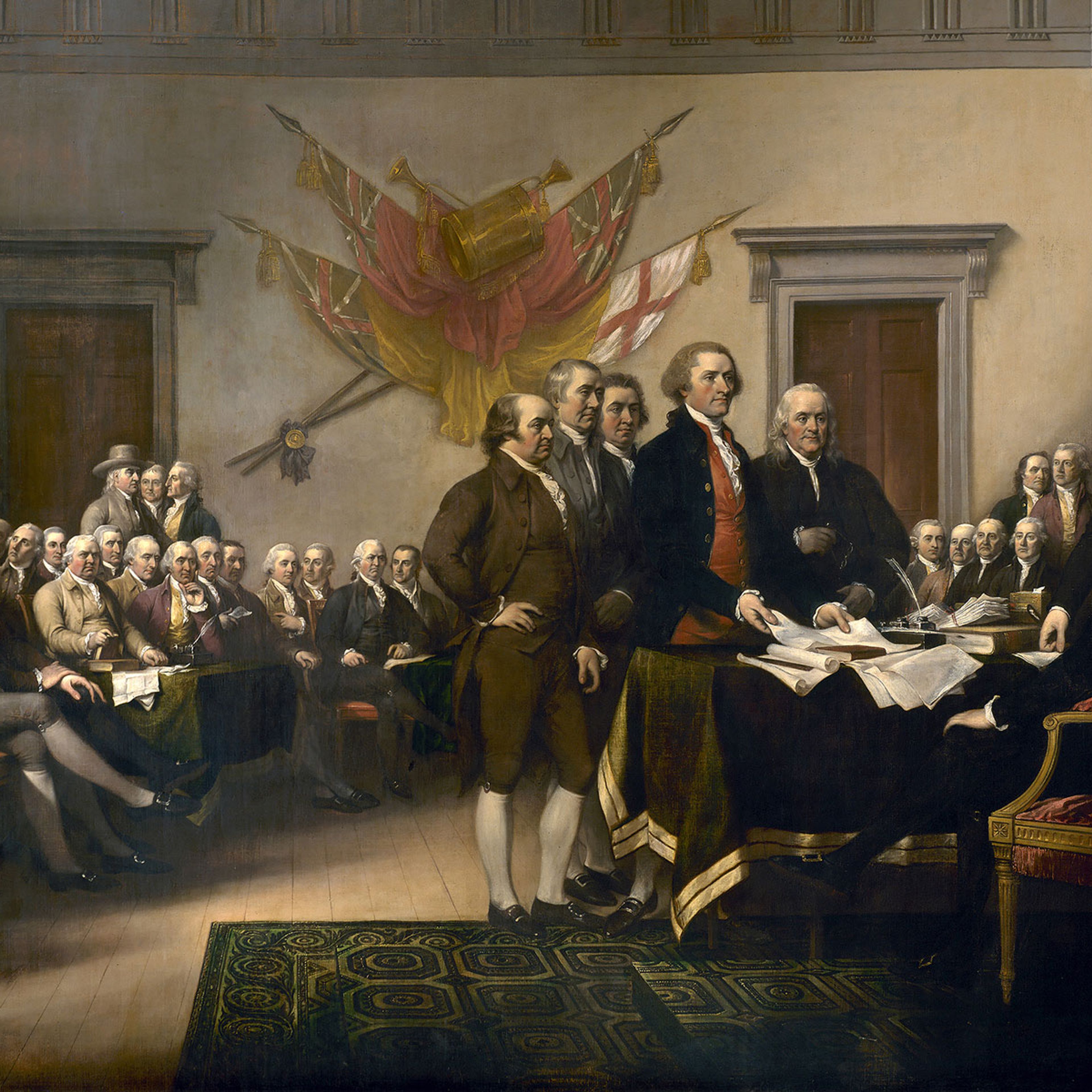
In their great wisdom, the Continental Congress did not leave the drafting of the Declaration to one man, but to a “Committee of Five” which included, most famously, Thomas Jefferson of Virginia — but also John Adams of Massachusetts and Benjamin Franklin of Pennsylvania.
We think of Jefferson as the philosopher of the Revolution, whose unalloyed if lofty libertarianism clearly shines through that most famous sentence of the Declaration — the one that delivered certain self-evident truths from the pages of treatises to the pages of history.
But when I read passage like this one, from a little farther down the page –
Prudence, indeed, will dictate that governments long established should not be changed for light and transient causes; and accordingly all experience hath shown that mankind are more disposed to suffer, while evils are sufferable, than to right themselves by abolishing the forms to which they are accustomed. But when a long train of abuses and usurpations, pursuing invariably the same object evinces a design to reduce them under absolute despotism, it is their right, it is their duty, to throw off such government, and to provide new guards for their future security. –Such has been the patient sufferance of these colonies; and such is now the necessity which constrains them to alter their former systems of government.
– I can only thank Providence that our Founders included not just men with the vision of Jefferson, but men with the caution of Adams and the prudence of Franklin, whose voices I hear all over this passage. There you have, in a few sentences, something like the American conservative synthesis: a fire-eating love of liberty tempered by a deference to tradition and a caution borne of a deep understanding of man’s fallibility. When I say that I am a conservative, this synthesis — this passage — is what I mean.
Lucky inheritors are we, of a group of men who were more than the sum of their parts.
Happy Birthday, America.





Comments