
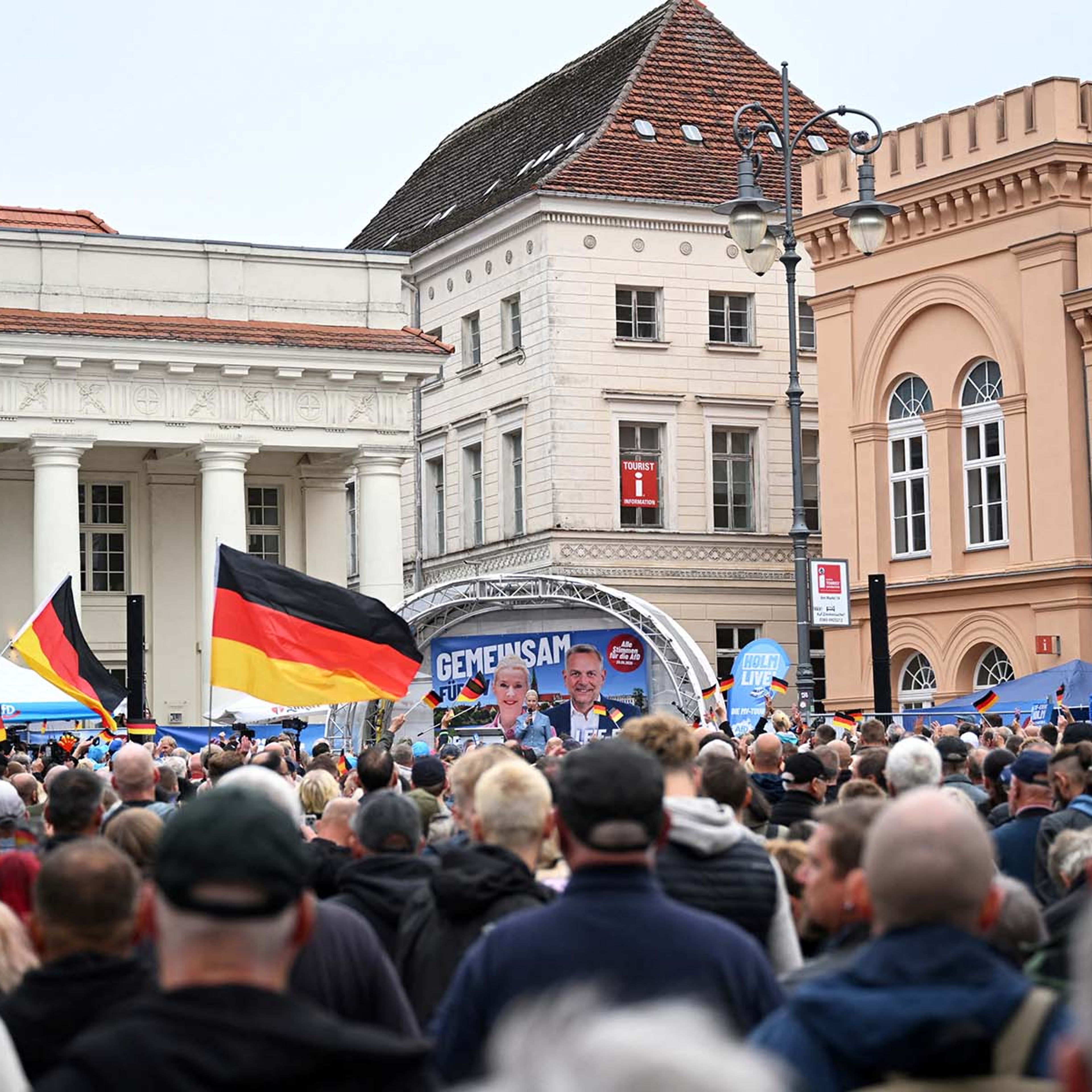
Angela Markel will be looking a little anxiously at three regional elections in Germany tomorrow, one, Saxony-Anhalt, in former East Germany and two (Baden-Württemberg, and Rhineland-Palatinate) in the old west. Support for the populist right AfD appears to be approaching double digits in the latter two, and seems to be running at around 19 percent in Saxony. Even if the AfD does well (and even if Merkel’s party stumbles), it won’t produce a crisis. Merkel is not going to fall any time soon. There is no obvious challenger within her own party, nor is there any obvious constellation of parties to replace hers.
Nevertheless, a bad result will increase the pressure on her ahead of the EU’s next migration summit on Tuesday, a summit that will basically discuss how to deal with the draft deal that Merkel cut with Turkey last week behind her European “partners’” backs.
We will take a look at how the Financial Times, a newspaper that is both eurofundamentalist and generally supportive of Merkel’s approach (“the humanitarian high ground”) to the migrant crisis, described what happened.
But as you read what the FT has to say, remember that this is the Angela Merkel described last year by The Economist as the “indispensable” European, a woman lauded for her moral courage (in reality a blend of panic and narcissism) and, of course, praised by that shrewd judge of what’s right, Hillary Clinton (in Time, the magazine that dubbed Merkel ’person of the year’ – as, incidentally, did the Financial Times):
I have to say that I highly admire Angela Merkel. I’ve known Angela since the 1990s, she and I actually appeared on a German TV show together. I have spent personal time with her. She is, I think, a really effective strong leader and really right now the major leader in Europe, not just in Germany. I admire her political skills and her principles, her strong work ethic. I just find her to be an incredibly important person in the world today and I look to her to see how she’s managed it.
Well, Hillary, what she has “managed” is to be Germany’s worst postwar chancellor.
Behind the backs of some her closest European allies, Angela Merkel…struck a deal with her Turkish counterpart that could very well end the influx of refugees washing up on Europe’s shores — but at a very high price, including an extra €3bn in aid and a visa-free travel scheme.
“The indispensable European”.
And, yes, you read that right about “visa-free”. Part of what Merkel is proposing is visa-free travel between Turkey and the EU.
What could possibly go wrong?
Brits might want to remember that when they are told (as they are by the likes of David Cameron) that remaining in the EU is vital for their security.
Anyway, back to the FT:
It started with a normal, even promising EU process. On Sunday afternoon EU ambassadors in Brussels put the final touches to a summit deal that Donald Tusk, European Council president, saw as a turning point. The western Balkan migration route would be closing and Turkey had agreed to take back non-Syrian migrants. Europe’s tougher approach was taking shape.
A few hours later, and a kilometre down the road, Ms Merkel met Ahmet Davutoglu and Mark Rutte, her Turkish and Dutch counterparts, and blew that deal apart…Unlike Mr Tusk’s version, that came with a higher Turkish pricetag: money, visas, and large-scale resettlement of Syrians from Turkey to Europe. Ms Merkel’s bet was that the deal’s arresting potential would help her at home in state elections next week.
“Her principles”
The FT:
In the event, only a half-deal was possible, mixing parts of the old and new proposal and leaving details to be sorted.…One senior European diplomat directly involved in Turkey discussions said they had “never seen a situation where the EU institutions were so undermined and stabbed in the back”.
…Another eurozone diplomat called her methods “brutal”.
It was “a unilateral, unco-operative approach and there will be a price for this one day”, the diplomat said.
“The indispensable European”.
But one thing Merkel is not, is stupid.
A later FT article explained:
Ms Merkel also blocked a…statement [at the summit] about “closing the western Balkans route” that was a carefully-balanced attempt by European Council president Donald Tusk to bring the Austrian-led border closures under the EU umbrella. Some diplomats suspect she did not want her critics vindicated. “It was simple,” said one senior eurozone official. “She did not like the language because it was supported by Austria.”
“Her principles”.
To be fair, there is another explanation:
But Ms Merkel argues that the disorderly border closures are a stopgap solution that have simply concentrated the crisis in Greece and created horrific scenes on the Greek-Macedonian border — something she foresaw and wanted to avoid. “Greece remains Europe’s responsibility,” she said this week.
Some in Brussels accuse Ms Merkel of hypocrisy. “She pushed and pushed for a deal to wall off the Aegean, while she pretends to have an open-door policy at home,” said one senior EU official. “There is no cap on numbers in Germany. She just wants a cap of zero in Greece. The driving force is domestic panic.”
I’ll leave it to you to decide about the credibility of the deal that she wants to strike with a Turkey that itself is descending rapidly into some kind of darkness


Comments