
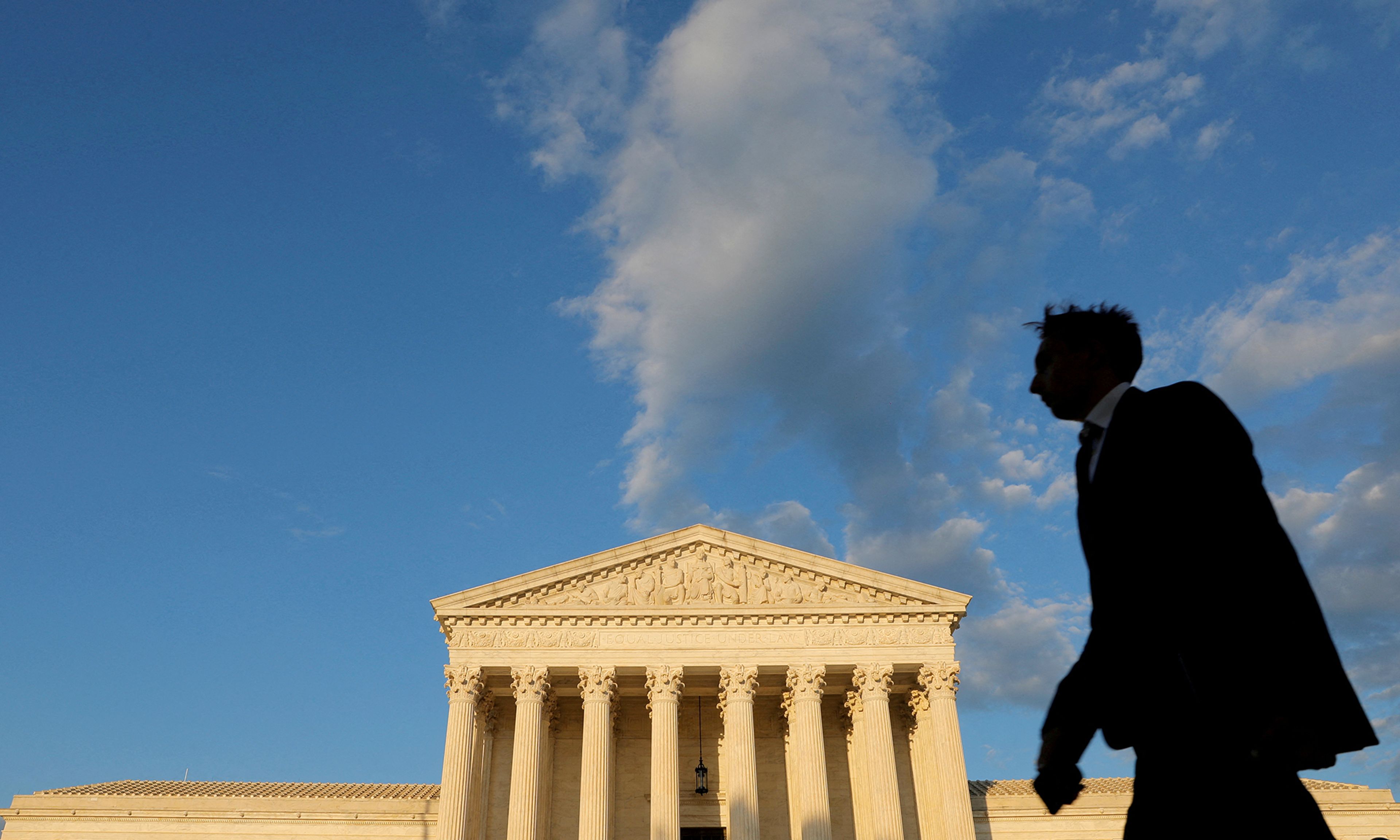
Earlier this month the New Yorker ran an intriguing profile of Jonathan Mitchell, the lawyer who helped Texas shield its restrictive abortion law from pre-enforcement injunctions. Mitchell rejects the prevailing doctrine of “judicial supremacy,” which holds that Congress and the president are bound in all respects by the Supreme Court’s interpretation of the Constitution.
Opponents of judicial supremacy generally argue that court decisions bind only the parties to a case, and other branches need not apply the court’s reasoning any more broadly. Other opponents, such as the law professor Michael Paulsen, go further to argue that Congress and the president may independently reject court decisions in toto if they deem such decisions unconstitutional.
I’m naturally reluctant to make changes to how our governing institutions relate to each other. Then again, it’s hard to suffer through so many politicized court decisions without feeling tempted to go full Paulsen.
Take the recent work of Donald Beatty, chief justice of South Carolina’s supreme court. He and his colleagues were charged with deciding whether the state’s constitution includes a right to abortion. Given the political sensitivities here, one might think that Justice Beatty would be especially careful to avoid the appearance of bias. He should analyze the relevant case law with neutral, dispassionate language — never straying from legal analysis, never suggesting a personal interest in the outcome, right?
Well, here is how he phrases the question presented: “Can the government—by force of law—force a woman to give birth without her consent?” He characterizes the state as an “overseer” that “usurps a woman’s authority to make medical decisions regarding her reproductive health.” He finds it “particularly concerning” that the legislature is majority-male. He even takes the time to insist, dubiously, that a six-week embryo is merely “an amorphous collection of cells.”
In one revealing section, Beatty first praises the U.S. Supreme Court’s Obergefell (same-sex marriage) and Lawrence (same-sex sodomy) decisions without noting that both violated stare decisis. In the very next sentence he condemns the Supreme Court’s overturning of Roe v. Wade as “a catastrophic blow to stare decisis.” Beatty goes on and on with the rhetoric, evincing no self-awareness. He finally concludes rather incredibly that his decision “is neither pro-choice nor pro-life.”
This is not an isolated incident. Court decisions at both the federal and state levels are replete with emotional appeals, false claims, blatant advocacy, and amateur-hour philosophy. Relying on them to resolve the most consequential issues of the day is not the hallmark of a healthy, well-functioning democracy.
But perhaps there is hope. The same New Yorker piece notes that the Supreme Court’s conservative turn may move some progressives into the Jonathan Mitchell camp as skeptics of judicial supremacy. Some are apparently open to jurisdiction-stripping and other measures that would revivify Congress as an independent constitutional authority. For conservatives who have long sought to limit the power of judges, this may be a unique opportunity to strike a deal. Even though the Supreme Court is favorable to conservatives right now, just two seat changes could create the first progressive-activist majority since the 1960s. If that happens, the Left would quickly take any offer to weaken the judiciary off the table.






Comments