
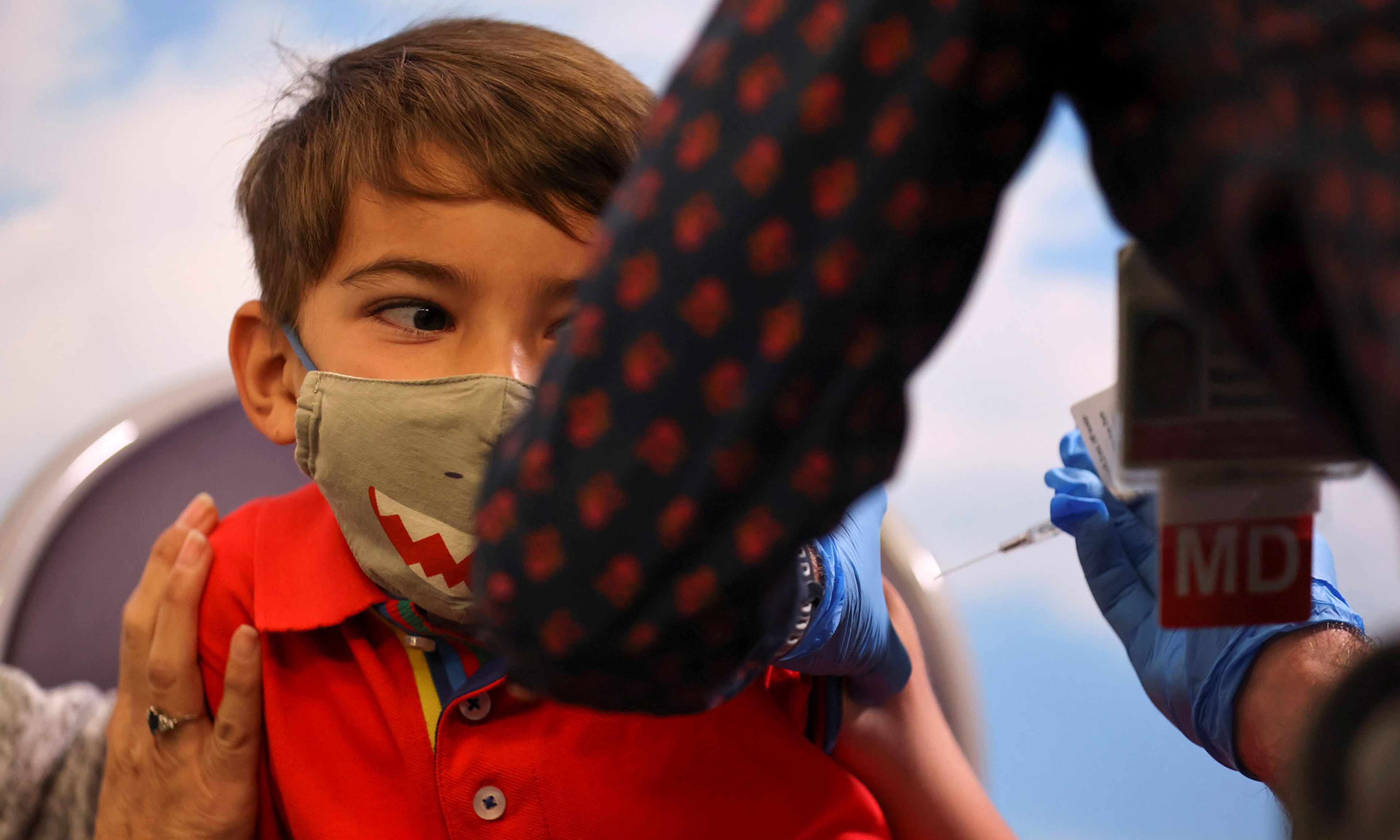
Across the pandemic, it has become obvious that the only truly effective countermeasure has been vaccines that reduce severity of illness and death. It’s a finding that’s held up across every country, and billions of doses of vaccine. At the same time, we’ve also learned that the inherent properties of Covid and its variants tend to overwhelm all other mandates, and non-pharmaceutical interventions — such as mask mandates. The case for vaccinating people middle-aged and older is overwhelming.
Because seriously adverse outcomes for Covid-19 are so rare for the young and healthy, the case for vaccinating the young and healthy has always been somewhat weaker. And this basic reality is reflected in the uptake rate across countries, which is lower for younger populations. When the FDA approved the vaccine for five-to-eleven-year-olds, it did so while FDA members expressed that the vaccine’s utility was limited:
Now the New York Times reports that Pfizer may ask for approval for a vaccine for children from six months to four years old, even though vaccines failed to show a significant result at that age. If you read the report, the word “eager” appears three times in the first few paragraphs. Parents are eager for an early-childhood vaccine, we’re told. (Does that match the the observed behavior of parents who have been slow to get their children vaccinated?) Regulators are “eager” to give approval to an early childhood vaccine. And federal officials are “eager,” too. We are then informed:
Pfizer and BioNTech in mid-December announced that children 6 months to two years old who were given two doses of the vaccine at a tenth of the strength of adult doses produced an immune response comparable to that of young people ages 16 to 25. But among children ages 2 to 4, the response was less robust.
The setback prompted the companies to test a third low dose of the shot in young children. Rather than wait for those results, federal regulators took the unusual approach of encouraging Pfizer to apply for authorization for a two-dose regimen to begin protecting children from the Omicron variant and other possible subsequent mutations, according to four people familiar with the strategy.
In one sense, this isn’t surprising. Kids so rarely have serious Covid outcomes that, in a short time period with a limited number of participants, it was always going to be difficult to demonstrate an effect. And in fact, the trial isn’t even really designed to measure outcomes against the disease — only for evidence of an immune response.
And it’s not surprising that federal officials, having constantly stoked fear of poor outcomes in kids, want to give something to the public to allay that anxiety and fear.
If I had to guess, a tiny dose of a vaccine that has proven safe enough for billions of doses worldwide is probably unlikely to be a serious danger. But the desire for a treatment to exist isn’t a reason to approve an uncertain one.
Approving and encouraging the uptake of vaccine you know to be basically ineffective, because of political pressure, in the hopes that subsequent doses may make it effective seems like a great way of destroying trust in the FDA. It would encourage skepticism in the expanded schedule for childhood vaccines. If there were, God forbid, even a rare adverse event associated with a barely effective early-childhood Covid vaccine, it would create a wave of vaccine skepticism unlike anything we’ve seen before. Would it not?
The pandemic has changed people’s calculations about risk and reward, often for the worse. Has the culture war around vaccines done the same for the FDA?




Comments