
If Republicans are looking for a role model to emulate after they take both houses of Congress tonight, they would do well to turn to President Calvin Coolidge, who was elected to the White House for the first time 90 years ago today. More than President Reagan, Coolidge provides a principled example of how true “small government” leaders behave and the kinds of policies they enact.
First, we have his 1920s tax-rate cuts, which were engineered by Treasury Secretary Andrew Mellon. While the first round of cuts took place under President Harding, Coolidge firmly supported Mellon’s vision. Mellon’s tax plan was rock solid and consistent with all of Coolidge’s previous thoughts and writings on the issue. A few years ago, I wrote about the tax cuts and their impact on the economy:
After five years of very high tax rates, rates were cut sharply under the Revenue Acts of 1921, 1924, and 1926. The combined top marginal normal and surtax rate fell from 73 percent to 58 percent in 1922, and then to 50 percent in 1923 (income over $200,000). In 1924, the top tax rate fell to 46 percent (income over $500,000). The top rate was just 25 percent (income over $100,000) from 1925 to 1928, and then fell to 24 percent in 1929.
As I explained, it is often assumed that broad cuts in income-tax rates only benefit the rich and thrust a larger share of the tax burden on the poor. But detailed Internal Revenue Service data show that the across-the-board rate cuts of the early 1920’s – including large cuts at the top end – resulted in greater tax payments and a larger tax share paid by those with high incomes.
Figure 1 focuses on those earning more than $100,000. As the marginal tax rate on those high-income earners was cut sharply from 60 percent or more (to a maximum of 73 percent) to just 25 percent, taxes paid by that group soared from roughly $300 million to $700 million per year. The share of overall income taxes paid by the group rose from about one-third in the early 1920s to almost two-thirds by the late 1920s. (Note that inflation was virtually zero between 1922 and 1930, thus the tax amounts shown for that period are essentially real changes).
The tax cuts allowed the U.S. economy to grow rapidly during the mid- and late-1920s. Between 1922 and 1929, real gross national product grew at an annual average rate of 4.7 percent and the unemployment rate fell from 6.7 percent to 3.2 percent. The Mellon tax cuts restored incentives to work, save, and invest, and discouraged the use of tax shelters.
The rising tide of strong economic growth lifted all boats. At the top end, total income grew as a result of many more people becoming prosperous, rather than a fixed number of high earners getting greatly richer. For example, between 1922 and 1928, the average income reported on tax returns of those earning more than $100,000 increased 15 percent, but the number of taxpayers in that group almost quadrupled. During the same period, the number of taxpayers earning between $10,000 and $100,000 increased 84 percent, while the number reporting income of less than $10,000 fell.
The whole thing is here.
Better yet, Coolidge understood that tax cuts alone are not a good idea: simultaneous spending cuts are needed to keep government finances on a sustainable path. And cut spending he did! Check out the two tables below:
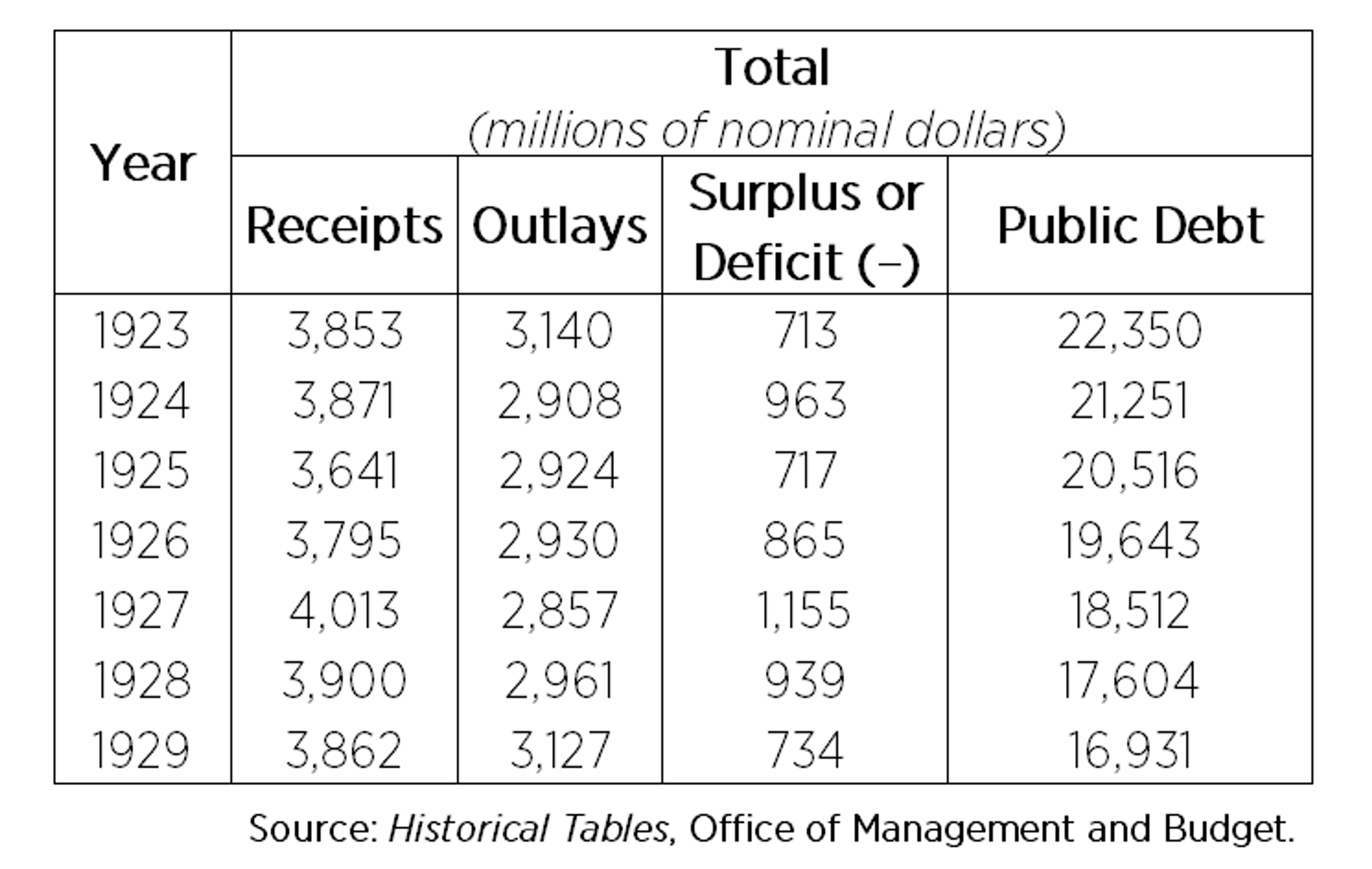
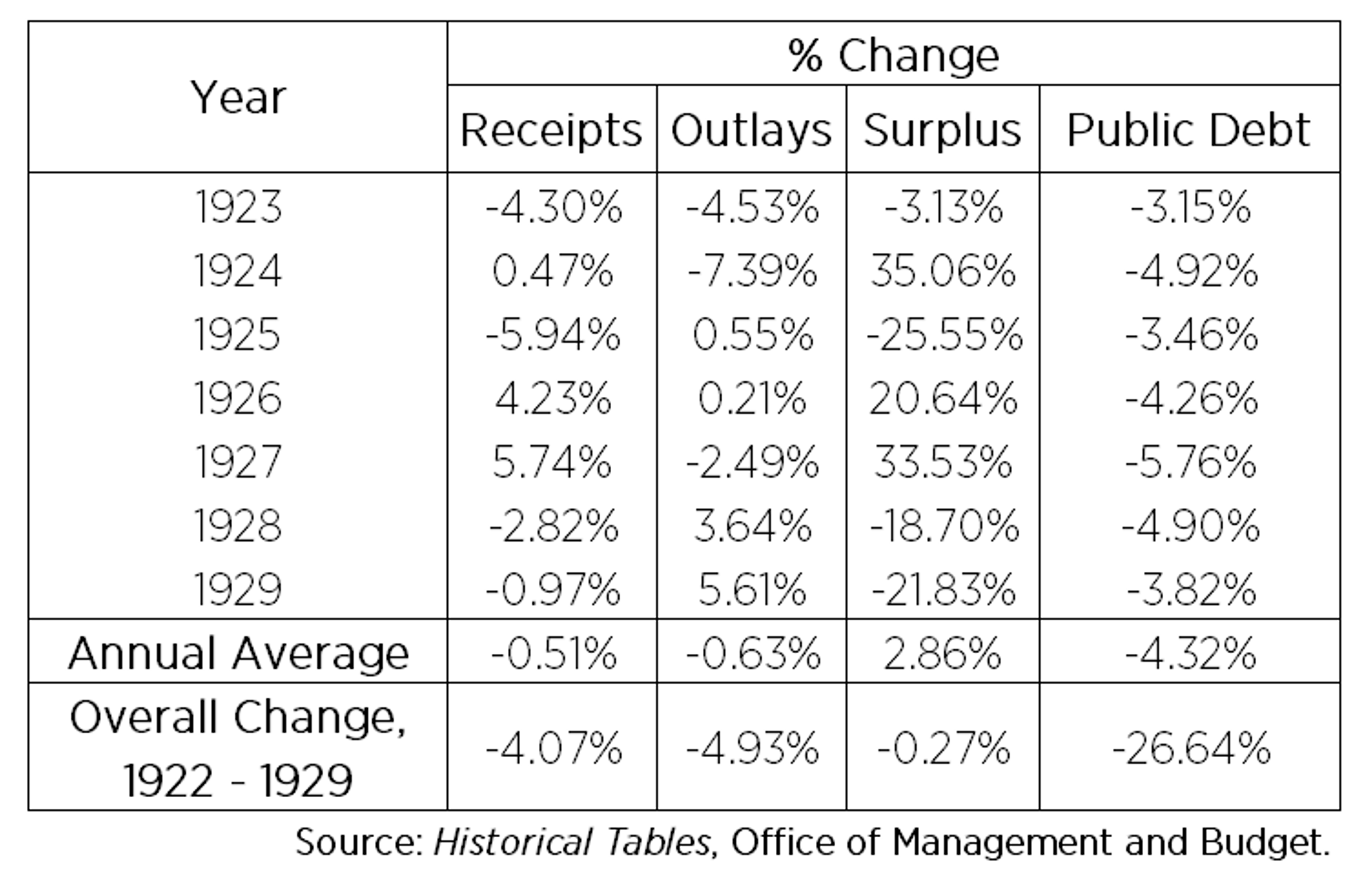
Whether looking at annual averages or overall changes throughout his administration, Coolidge lowered taxes, outlays, and the public debt while maintaining healthy surplus buffers.
By the numbers, Coolidge lowered tax revenues by an annual average of 0.51 percent a year, for an overall decrease of 4.07 percent by 1929. Outlays decreased by an annual average of 0.63 percent, for an overall decrease of almost 5 percent by 1929. Coolidge maintained surpluses, pushing them up by a total of 2.86 percent over his terms. Finally, Coolidge decreased public debt by an annual average of 4.32 percent a year, for an overall decrease of 26.64 percent by 1929.
Not too shabby! Silent Cal’s humble fiscal prudence appears a near miracle to our debt- and spending-weary eyes of the 21st century.
Coolidge remained committed to his small government, fiscal prudence both when it was easy and when it was difficult. This Wall Street Journal article by Diane Furtchgott-Roth gives us a sample of some of his spending cuts:
1. After a flood occurred in the Ohio River Valley and Mississippi River Valley in 1927, Coolidge cut $900 million from the $1.4 billion Congress wanted for flood control, a cut of 64%. All of these dollar figures are from the 1920s, when $1 was worth about $13 today.
2. Between 1923 and 1929, veterans’ pensions declined from $264 million to $230 million, a cut of roughly $34 million, or 13%, even though veterans and their pensions were a popular cause.
3. Federal spending on highway improvements declined from $92 million in 1924 to $80 million in 1929, a cut of 13%.
4. The number of federal workers in the D.C. area declined from 66,290 in 1923 to 59,800 in 1927 (but subsequently rose to 63,904 by 1929). That is a decline of 4% between 1923 and 1929.
5. Federal spending on Bureau of Indian Affairs declined from $45 million in 1923 to $34 million in 1929, down 24%.
Here’s a list of all of Coolidge’s presidential vetos.
Finally, in his autobiography, Coolidge wrote this about politics:
The political mind is a strange mixture of vanity and timidity], of an obsequious attitude at one time and a delusion of grandeur at another time. The political mind is the product of men in public life who have been twice spoiled. They have been spoiled with praise and they have been spoiled with abuse. With them nothing is natural; everything is artificial. A few rare souls escape these influences and maintain a vision and a judgment that are unimpaired.
Candidates elected tonight should ponder this quote and aspire to President Coolidge’s legacy. With the right principles, commitment, and leadership, they too may join the few rare souls who escape the spoiling influences of politics and maintain unimpaired visions and judgment. Nothing less than the country’s future depends on it.






Comments