
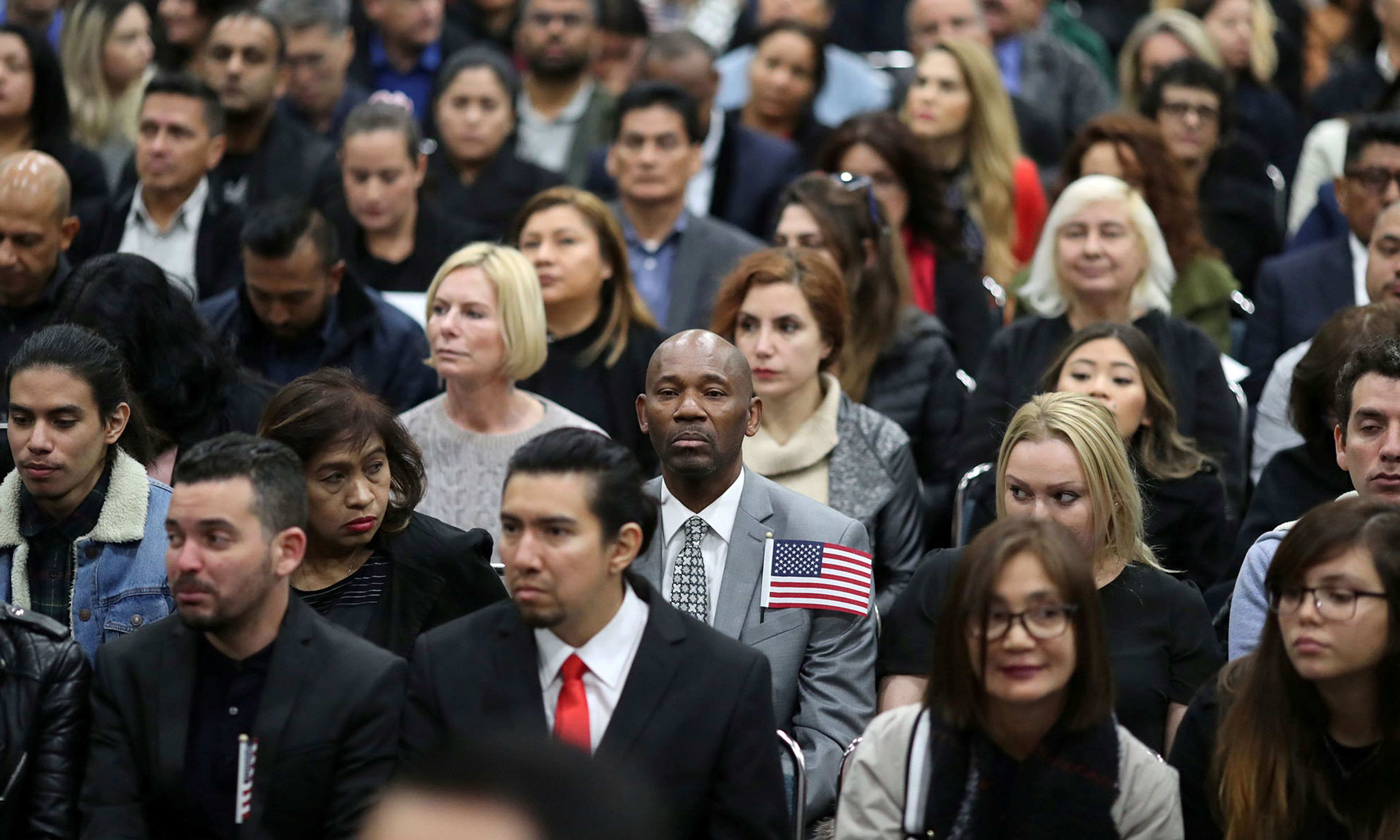
Last month, the Pew Research Center found that 62 percent of American adults believe that immigrants “strengthen the country because of their hard work and talents” while 28 percent say immigrants are “a burden on the country because they take jobs, housing and health care.”
A colleague noticed these numbers changing over time and wondered why skepticism or negative attitudes towards immigrants were so high in the mid 1990s. In 1994, 63 percent of respondents told Pew that they considered immigrants to be a burden.
Jonah once said you could write a good book on how “Reagan’s America” became “Bill Clinton’s America” in just four short years. If you’ll allow me to put on flannel, turn up the Nirvana, and head back to my teen years, I’d argue that the 1994 GOP midterm wave and the national mood that drove it was a big backlash to the political and cultural changes brought about by the 1992 election.
The Clintons and their allies tried to kick off a sweeping cultural revolution on several fronts simultaneously: not-so-subtle positioning of Hillary Clinton as “co-president,” gays in the military and gay rights in general, Surgeon General Jocelyn Elders talking about teaching masturbation in schools. The president talked up diversity and boasted that his cabinet “looked like America” — 13 lawyers. This was the era when rap and hip-hop were going more and more mainstream, with a lot of “gangsta” imagery, freaking out suburban moms the way heavy metal had in the 1980s. All this time, rumors about Clinton’s womanizing continued to percolate; he dined with Sharon Stone a year after Basic Instinct. The infamous “TrooperGate” article that set off the Paula Jones lawsuit came out in The American Spectator at the end of 1993; in May 1994, Jones filed her lawsuit.
The economy was doing fairly well, but in the early-to-mid 1990s, America was in the tail end of a short era of paranoia about Japan becoming an economic powerhouse and taking over the country — depicted in pop culture in Michael Crichton’s Rising Sun, Tom Clancy’s Debt of Honor and Clive Cussler’s Dragon. (This all looks rather silly in retrospect, now that we know that the 1990s turned out to be Japan’s “Lost Decade” of economic stagnation.)
Specific to immigration, I’d argue that immigrants started getting noticed in American communities in the early 1990s in ways that they hadn’t before. You could only do Apu jokes on The Simpsons if enough of the audience shared the observation, “Yeah, it seems like every convenience store is run by Indians.” California had an estimated 1.3 million illegal immigrants in the state in 1994, driving interest in Proposition 187, which prohibited illegal immigrants from using non-emergency health care, public education, and other services.
California’s Republican governor, Pete Wilson, made Proposition 187 a key part of his reelection campaign, and both he and the initiative were popular. Wilson was reelected with 55 percent of the vote. Proposition 187 was approved by California voters, 59 to 41 percent. (The law was later ruled unconstitutional.)
Add up all of these pushes for sweeping cultural changes, driven by a president elected with just 43 percent of the national popular vote, and you were destined to have a powerful backlash. By 1994, the country was fed up with the country’s sudden swerve to the left and in a really conservative mood, and this extended to wariness about immigrants, both legal and illegal.
Looking back, 1994 was a weird apex for all kinds of conservative/right-wing arguments/phenomenon: the salacious Tonya Harding/Nancy Kerrigan story blew up the dignified image of journalism; the television hit NYPD Blue made knocking around suspects look like good police work; the anti-political-correctness comedy PCU came out that year; the summer multiplex featured Arnold Schwarzenegger shooting up Islamist terrorists in True Lies; the O.J. Simpson case was about to exacerbate racial tensions already frayed after the riots in the aftermath of the Rodney King verdict, and the World Series was canceled because of a labor dispute.






Comments