
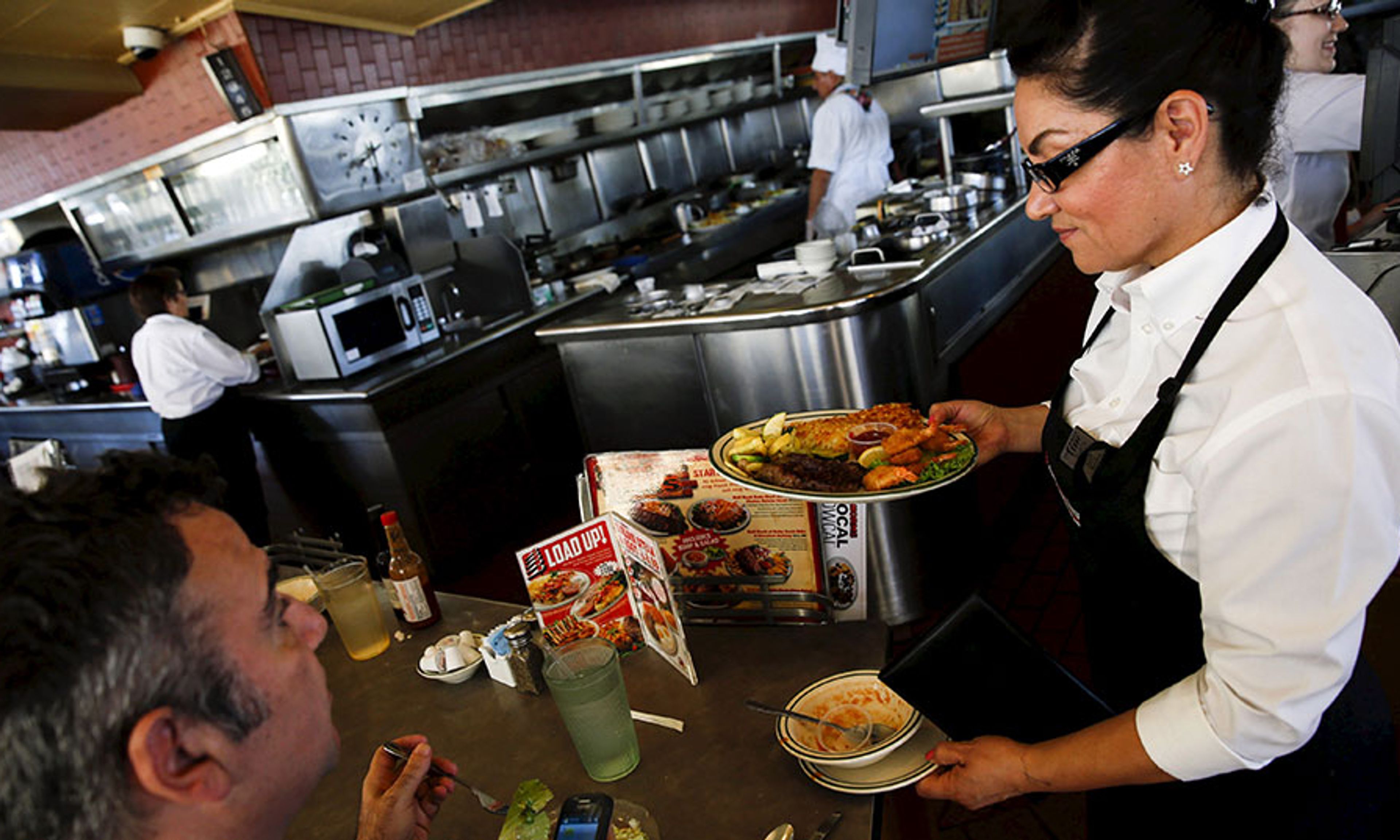
Christian Schneider wrote a smart, historically rooted criticism of the recent practice of universal tipping of service employees — i.e., not just for waiters and other professions that traditionally came with tipping norms, but for baristas, checkout-counter clerks, and so on. I won’t disagree with his criticism of tipping in principle — “in a free country, consumers should be able to tip whomever they want for whatever reason they want” — but I do think he’s a little too sanguine about what a service regime deprived of the generous tipping system would look like.
Let’s start with the matter of principle, which is where we more or less agree. Schneider writes:
Strictly speaking, nobody is “overpaid” or “underpaid.” You either agree to do a job for the amount you’re offered, or you don’t. Your value is entirely set by how much you’re willing to accept to do a job — if you believe you’re “underpaid,” then you can go work somewhere else and make more money.
I do think “overpaid” and “underpaid” mean a little more than that — colloquially, at least, it’s a reference to whether or not the value (in the broader sense of the word than pure market dynamics) you’re providing is equivalent to the payment you’re receiving. That an employer is able to pay you less (or willing to pay you more) than you deserve for a service is not quite the same as saying that, at least according to our general cultural understanding of the terms, the payment is fair. Plenty of lazy bureaucrats in D.C. are overpaid, and in their case, the rate they charge is largely insulated from market inputs of supply and demand. The same is true for checked-out public-school teachers who are just holding on for a few more years until they can cash in on their generous union-provided retirement benefits. And in the private sector, too, one can find plenty of examples of freeloaders and con men who are able to rake in much more than they deserve.
But it’s true that the idea of obligatory and subjective extra costs on top of the actual listed costs is an odd and seemingly irrational institution. I would only suggest that there actually is a good that Americans, as a collective, are paying for with the institution of tipping, which is distinctly higher-quality service than our non-tipping European brethren. Speaking from personal experience — I spent a couple of years living in Europe as a high schooler — one of the immediate things that stood out to every American expat was that European service is almost uniformly worse than its American counterpart.
Schneider, to be clear, isn’t against tipping as such. He’s in favor of retaining “the tip model for servers working in restaurants and others providing personal services,” given that “gratuities provide the incentive for good service. Your waitress isn’t being extra nice to you because she thinks you’re handsome or funny; she is busting her tail for a bigger tip. And your experience as a customer will be better for it.” But “handing you a sandwich or a scone is far different from waiting on you at a table. Your tip doesn’t incentivize better service, so it accomplishes basically nothing.”
I’m not so sure. Again, to use the European alternative as a point of comparison, the lower quality of service is a factor of an environment and work culture in which the kinds of virtues that make for a positive customer experience aren’t encouraged. Call it the tipping equivalent of broken windows theory: The friendliness of the cash-register attendant (and the tipping that such friendliness incentivizes) might not seem like a major factor in one’s experience of an institution, but its downstream effects are.
This is an admittedly anecdotal assertion — albeit one that I’ve heard time and time again from others who had similar experiences — but there is at least some empirical evidence of its basis in reality. A 2010 analysis of the data on the matter reported:
Economists theorize that tipping is the most effective way of providing service workers with reward or incentives that enhance their performance (Conlin, Lynn & O’Donoghue, 2003). Some restaurant managers view it as a management tool which motivates their workers to deliver high quality service to their customers. It also measures the workers’ performance—more and higher tips indicates better service—and identifies dissatisfied customers—low tippers. Studies have shown that tipping frequency and size may be related to the service quality offered to the customers.
It’s your right as an American to eschew tipping as you please. But just don’t be surprised if, in response, the service workers exercise their rights as Americans to provide you with substantially lower-quality service.
Editor’s note: This post has been revised to better reflect the points made in Christian Schneider’s piece.






Comments