
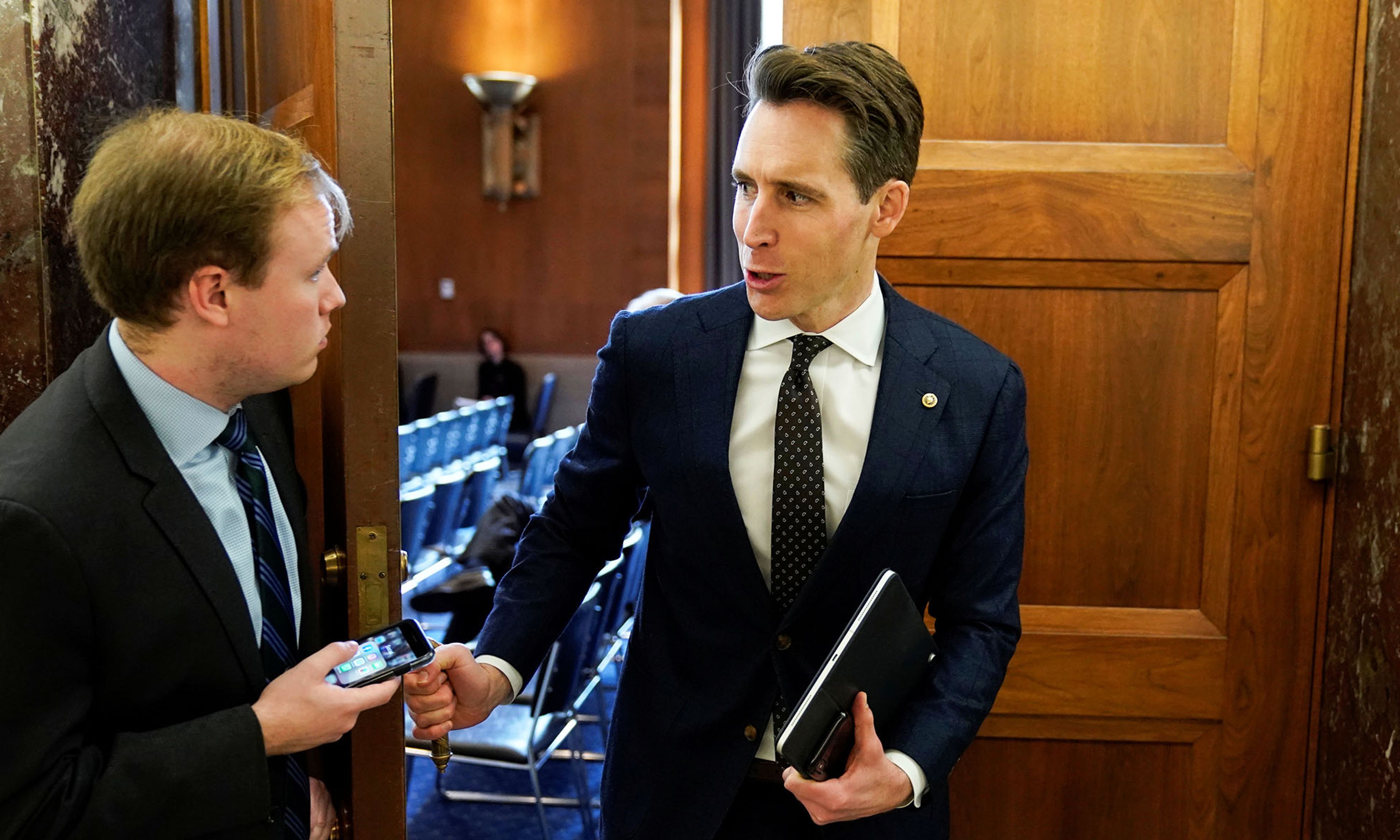
Last Thursday, I had a post at NRO about a letter that Senator Josh Hawley (R., Mo.) sent to the Small Business Administration about the Paycheck Protection Program, which Congress created to help small businesses get federal loans so they can keep paying their employees during the recession caused by the response to the COVID-19 outbreak. His letter concerned the way that the SBA should treat religious nonprofits that apply for aid under the program.
Less than a week later, much of what Hawley wrote seems to be coming true. While most of the letter consisted of Hawley’s argument that the SBA should expand the 500-employee designation to allow a greater number of religious nonprofits to obtain small-business loans, he concluded by warning against discrimination against religious organizations.
“Three years ago, in Trinity Lutheran v. Comer, the Supreme Court reaffirmed the
constitutional rule that the government may not disfavor an organization with respect to a
generally available benefit simply because the organization is religious,” he wrote. Hawley went on to apply the Trinity Lutheran ruling to argue that refusing to expand the size standard for religious groups, after having done so for other types of small businesses, would be equivalent to “targeting religious organizations for special disfavor.”
The following day, Hawley sent a subsequent letter, asking the SBA to clarify that religious organizations are permitted to seek relief from the Paycheck Protection Program. “It is unacceptable that your agencies’ guidance would leave uncertain their ability to gain the relief to which they are entitled by the law Congress passed,” he wrote. “Moreover, the Constitution demands that the government may not discriminate against these religious nonprofits on account of their religious status—whether they engage in sectarian activities or not—in providing this public benefit.”
While some may have thought Hawley was sounding the alarm unnecessarily, it turns out he was right to be concerned. The Trump administration has issued guidance reinforcing Hawley’s assertion, but already some opponents are arguing that religious groups should not be eligible for federal aid.
“In a development that could challenge the Constitution’s prohibition of any law ‘respecting an establishment of religion,’ the federal government will soon provide money directly to U.S. churches to help them pay pastor salaries and utility bills,” stated an NPR article early this week.
The same article quotes Alison Gill, legal and policy vice president of American Atheists, who said, “The government cannot directly fund inherently religious activities. It can’t spend government tax dollars on prayer, on promoting religion [or] proselytization. That directly contradicts the Establishment Clause of the First Amendment. This is the most drastic attack on church-state separation we have ever seen.”
Here it is helpful to recall the Supreme Court ruling in Trinity Lutheran, which found that a Missouri program that denied a grant to a Christian school for playground resurfacing, while extending the grant to similar non-religious groups, violated the Free Exercise Clause of the First Amendment. Based on that ruling, it seems likely that any move to sue the federal government over extending a loan programs to religious nonprofits and non-religious small businesses alike would not be viewed favorably by the courts.






Comments