

At the beginning of the month, the U.S. government canceled a previously scheduled intercontinental ballistic missile test, to ensure the test could not be “misconstrued” by Russia. Many observers saw it as a reasonable or even wise step to ensure Russia did not misperceive it as an American nuclear attack. But others, like the Washington Examiner‘s Tom Rogan, argued that the decision sent the wrong signal to Vladimir Putin: “It is nonsensical to offer an olive branch in face of a sword being waved in your face. Putin, a leader inculcated by the KGB in the mastery of deception, manipulation, and brinkmanship, acts with and will not be disabused of this KGB mentality by American hesitation.”
Whatever you think of the decision to cancel the scheduled missile test, the sense of just what is too easily misconstrued by Russia or escalatory or provocative seems pretty fuzzy these days. On Monday, NATO launches Cold Response, a long-planned training exercise in Norway.
This training exercise will be a big one — approximately 3,000 U.S. Marines will join roughly 30,000 military forces from 27 NATO ally and partner nations. Approximately 220 aircraft and more than 50 ships will take part in the exercise, including two aircraft carriers, the HMS Prince of Wales and the USS Harry S. Truman.
The Norwegian armed forces even made a slick English-language video previewing the training operation:
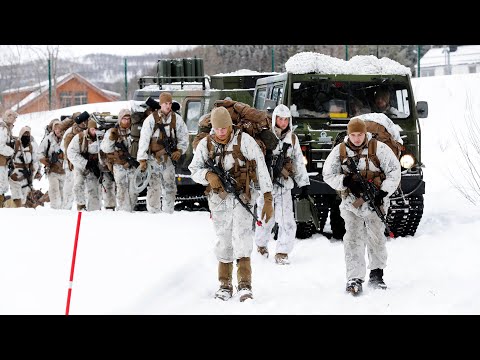
The Norwegian military states, “This exercise is a central arena for testing the deployment of the NATO Response Force, and for Norway it is important to test its system of receiving, catering for and managing the allied reinforcements arriving in Norway.” (Notice no one says who those forces would be deploying to fight, or why Norway would need those NATO reinforcements. But looking at a map, there’s a big country on the other side of that northernmost eastern border.)
NATO is quick to emphasize that “this year’s exercise was announced over eight months ago. It is not linked to Russia’s unprovoked and unjustified invasion of Ukraine, which NATO is responding to with preventive, proportionate and non-escalatory measures.” Norway informed Russia about the exercise back in January and invited Russia, as well as all member nations of the Organization for Security and Co-operation in Europe to observe the exercise; Russia declined the invitation.
Portions of the exercise will occur in Norway’s “High North,” above the Arctic Circle, but Norwegian authorities emphasize that “there is a solid distance to Russia, and we are very much aware of what areas we operate in and for our not moving too close to Finnmark.” (Finnmark is the Norwegian county that shares a border with Russia.)
The NATO exercise is likely to proceed without incident. But it is a little surprising that a routine, regularly scheduled missile test is considered too dangerous at this moment while a major NATO exercise involving tens of thousands of troops, more than 200 airplanes, and two aircraft carriers off the coast and in a country bordering Russia isn’t.