
Writing in The New York Times this morning, UC Berkeley Law School Dean Christopher Edley Jr. makes the case, he thinks, why the 50 states should be allowed to borrow money directly from the U.S. Treasury. His reason:
We did this for Wall Street and Detroit, fending off disaster. It’s even more important for states.
Also,
To make matters worse, several states have country-sized G.D.P.’s, but none has the macroeconomic tools of an independent country. Every state except Vermont has some sort of balanced budget requirement that prevents it from weathering a recession by running up big deficits to keep teachers employed, students in college, welfare payments flowing and construction humming. Nor can New York and California stimulate their economies by, say, printing more currency. Instead, states are managing huge budget crises with the only tools they have, cutting spending and raising taxes — both of which undermine the federal stimulus.
This is well and fine but the reason why states are in such a sad state of affair isn’t that they can’t print money or don’t have enough revenue. Instead it is that for the last five years they have increased spending without any considerations for the possibility of a downturn–even though they have a constitutional obligation to balance their budget each year.
These were fat years and most states’ revenues grew massively. The May 2009 issue of Reason Magazine for instance, had a great story called Failed States where we read that:
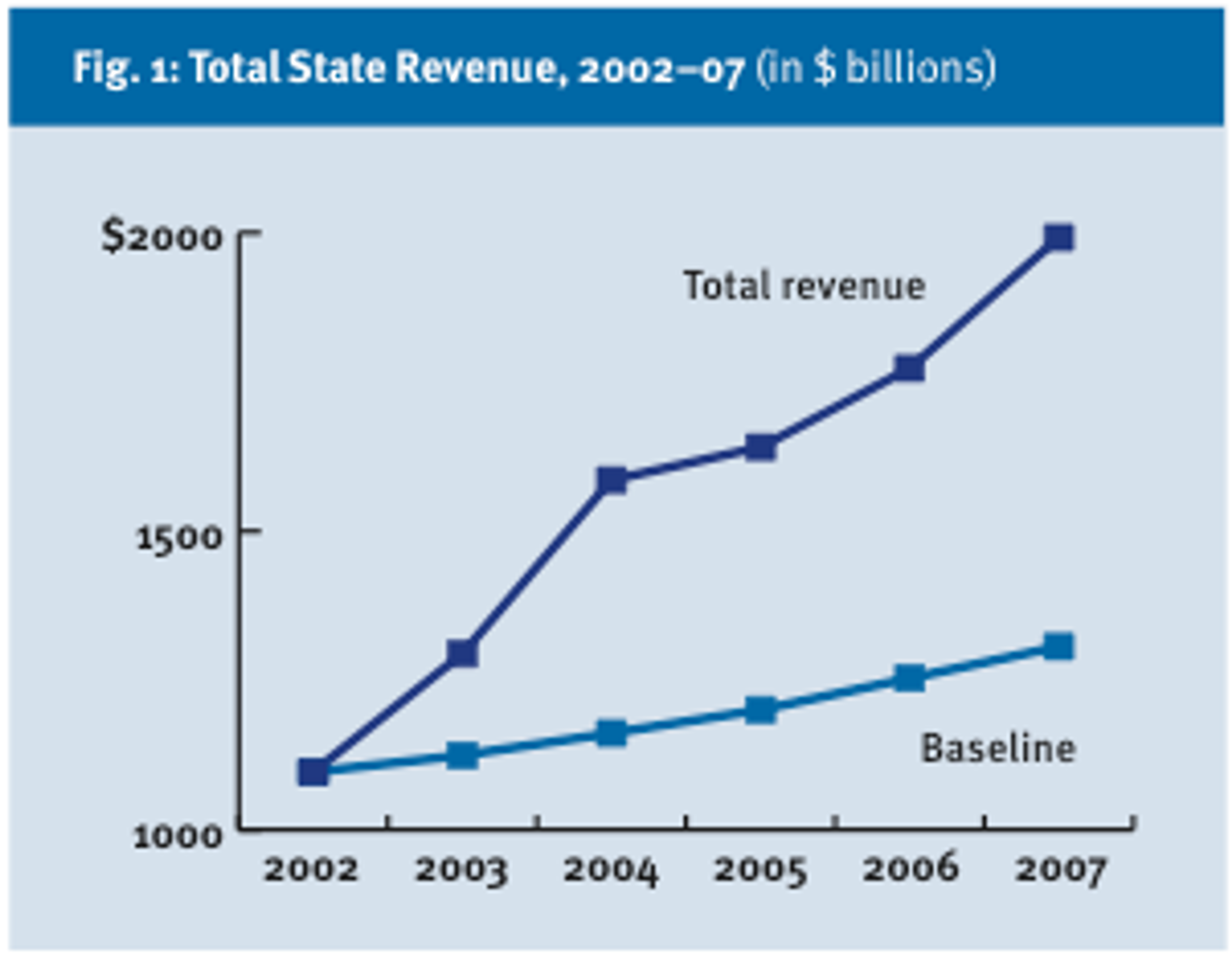
In the five years between 2002 and 2007, combined state general-fund revenue increased twice as fast as the rate of inflation, producing an excess $600 billion. If legislatures had chosen to be responsible, they could have maintained all current state services, increased spending to compensate for inflation and population growth, and still enacted a $500 billion tax cut.
Better yet, we shouldn’t forget that the states are constantly getting money from the federal government. In California, Mr. Elbey’s state, about 30 percent of the state’s revenue come from the federal government. During the good years and during the bad years. This chart shows that total revenue collected by the states doubled during the five years prior to the recession:
However, no plans were made to set some money aside for the bad years. And it’s not as if these downturns aren’t predictable. In fact, just five years earlier, in 2002 the National Governors Association issued a press release saying the “states face the most dire fiscal situation since World War II.” In other words, recessions happen and the states should know to plan ahead. But they don’t.
But it’s not just that they don’t plan ahead, it’s also that they don’t learn from their mistakes. Back in 2003, a USA TODAY analysis showed that in the mist of the recession, states continued to increase their spending. The trick: most of the budget cuts being proposed in the name of fiscal responsibility sake were not declines in spending from the previous year’s. Instead, they were reductions in spending increases that were approved when the U.S. economy was booming. Here is Dennis Cauchon on the issue:
For example, Minnesota legislators approved spending based on an expected 13.4% jump in tax revenue over the next two years. But tax collections are expected to rise 6.6%. The result: $4.6 billion must be cut. But those cuts would be from planned spending; actual spending is still expected to rise from present levels.
In fact, spending by state and local governments rose at an annual rate of 4.2% in the first nine months of 2002, slightly lower than during stronger economic times, the federal government reports. After adjusting for inflation, spending increased 3.3%.
And the Reason article notes that:
From 2002 to 2007, overall spending rose 50 percent faster than inflation. Education spending increased almost 70 percent faster than inflation, even though the relative school-age population was falling. Medicaid and salaries for state workers rose almost twice as fast as inflation.
So really, if states are in trouble today it’s not for lack of revenue. It’s because of their spending binges. Giving them tools to spend more isn’t a good idea.






Comments