
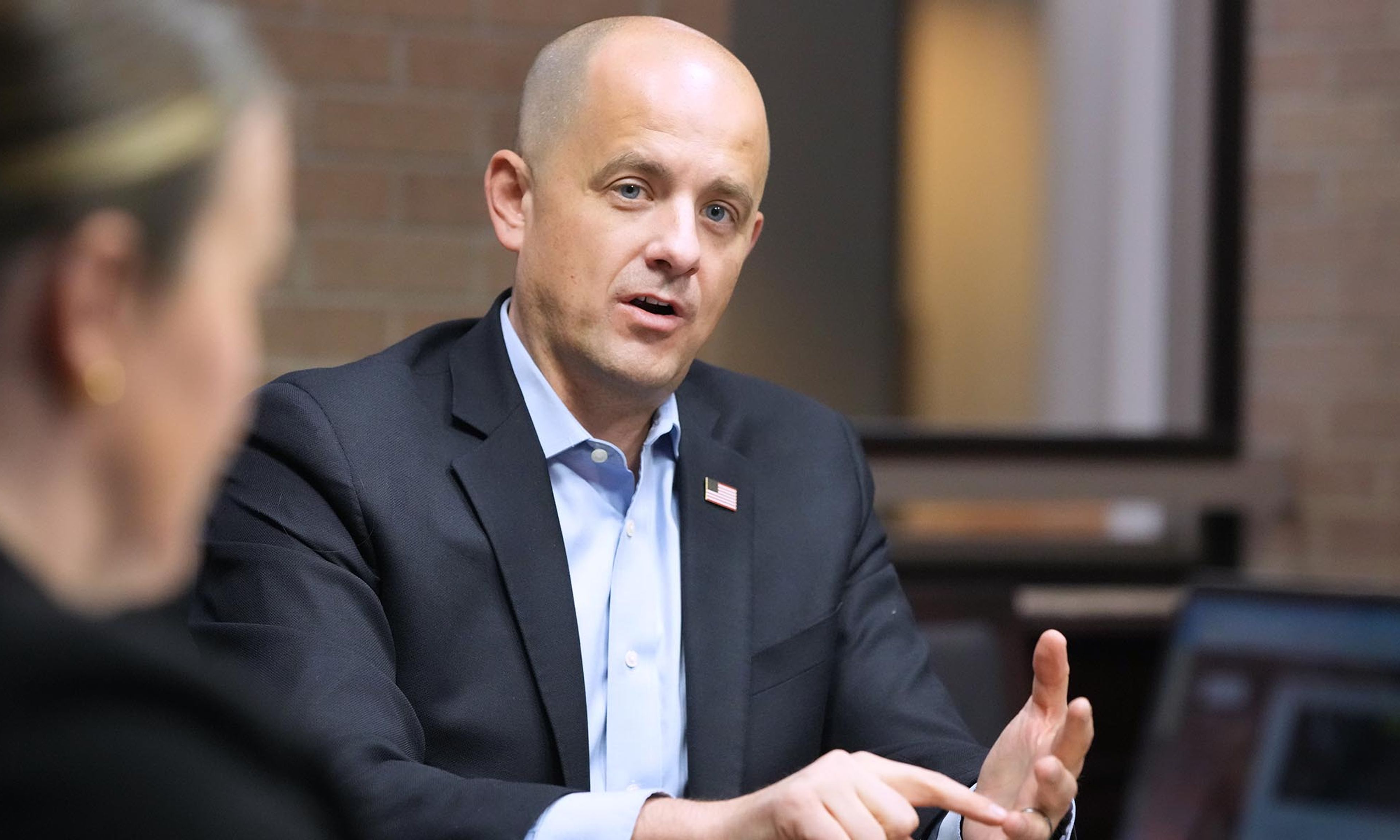
In our editorial endorsing Mike Lee for reelection, we noted one of the drawbacks for Utah of the essentially fraudulent campaign of the shape-shifting Evan McMullin: If McMullin kept his campaign pledge to caucus with neither party — and thus voted for neither party to control the Senate — he would be locked out of the system of two-party control that hands out committee assignments: “In practice, McMullin would have to pick a side if he intends to serve on any committees. Even if that takes the form of abstaining from a vote where a Republican vote would be decisive, the effect of the choice would be the same.” Conn Carroll at the Washington Examiner, who spent seven years working in the Senate, makes the same point:
What McMullin is either too ignorant to know himself, or he is hoping Utah voters are too ignorant to know themselves, is that while winning a Senate seat does entitle you to vote and speak on the Senate floor, it does not entitle you to any committee assignments. The number of senators on each committee is negotiated between the Republican Party and the Democratic Party every two years. Their final agreement always reflects the power breakdown between the two parties based on the number of senators each party has in its caucus. . . .
Without joining a caucus, McMullin would not have a seat at this negotiating table. Neither party is obligated to give him a seat on any committee. And unless he agrees to join a caucus, as [nominal independents Bernie] Sanders and [Angus] King have, neither party has any reason to want to give him a seat on any committee. [Emphasis added]
Given that this week has seen two polls with Lee up 10 and 19 points, this is all likely to be academic at this juncture, but Jim Swift at the Bulwark insists that Carroll is demonstrably wrong, and has demanded a correction. I consulted a number of people familiar with Senate procedures, and on closer inspection, Swift is the one grasping at straws. There is no reason for Carroll or the Examiner to correct anything; at most, there is a disagreement of opinion about how a power play would unfold between one senator and the other 99. Swift’s thesis is that McMullin, if elected, would automatically get seats on prime Senate committees without joining a caucus because the rules say so:
As the Congressional Research Service states: “Senators must serve on two ‘A’ committees[,] may serve on one ‘B’ committee, and [may serve on] any number of ‘C’ committees. Exceptions to these restrictions are sometimes approved by the Senate.” These letter designations rank the desirability of Senate committees in just the way you’d expect: “A” Committees are better than “B” committees, and both are better than “C” committees. Regardless of whether he caucuses with one of the parties, McMullin is guaranteed placements on at least two “A” committees. . . .
Most senators receive assignments based on their party affiliation; in the case of [King and Sanders] the independent senators chose to caucus with one of the parties, and received assignments as other members of that party (i.e., the Democrats) did. Even if hypothetical Senator McMullin refuses to follow suit, he will still receive committee assignments, as stipulated in Rule 25 of the rules of the Senate: “each Senator shall serve on two and no more [“A”] committees.” [Emphasis added]
But which party would surrender seats to make room for him? The fundamental problem with Swift’s analysis is that Senate rules are not self-enforcing. A lone senator can raise a point of order under the rules, but even if the Senate parliamentarian agreed with him, points of order under the rules are ultimately adjudicated by a vote of the full Senate.
This is not to say that Senate rules are wholly meaningless. Unlike the House, the Senate has rules beyond just the will of a majority. The House essentially reinvents itself every two years, with the new majority having the power to do whatever it wants. The Senate, by contrast, has continuing membership: Only a third of Senators, at most, are presented to the voters for reelection at each biennial election. Senators therefore consider themselves part of a continuing body, bound by rules established by long tradition and not lightly rewritten. An important corollary to that, however, is that the Senate also has a lot of unwritten rules — norms of individual, caucus, and institutional behavior — and those are often just as important as the written rules (and these unwritten rules include the internal, written rules of the party caucuses, which address committee assignments).
As we have seen in recent years, Senate norms can collapse when one party sees an advantage in breaking them. But the process for allocating committee assignments between the two parties by negotiated agreement of their leaders is of benefit to both parties — and of particular benefit to three groups: (1) the party leaders (whose power is enhanced by their role in doling out committee assignments), (2) the maverick members of the caucus (who can get plum assignments as a means of inducing their cooperation), and (3) the junior members of the caucus (who would be likeliest to lose committee spots if the party gave up a few at the margins).
Senators will extend courtesies to a lone colleague when those courtesies are not very costly. They will vote to sustain the powers and prerogatives of lone senators that they expect to wield themselves on other days. But when a lone senator is demanding something against the interests of an entire caucus, that is another matter. And if he sets himself simultaneously against the interests of both caucuses, he is likely to find no more than a small number of maverick votes, at most, in his corner. He is apt to find himself entirely alone. That is, as Swift concedes, a particular likelihood when the senator is newly elected and has no pre-existing working relationships with other senators.
As Carroll explains, and as Swift more or less concedes, the formal rules regarding committee assignments exist mainly to provide a structure for negotiations between the two party caucuses, conducted by their leaders. When the election season is over and each party knows how many seats it will hold, a resolution is prepared organizing the Senate under a new majority. That resolution allocates a certain number of seats on each committee to the majority party, and a certain number to the minority party. Each party leader then allocates those seats to his own membership (including independents who vote with the caucus). Even Senate Rule 25(c) formally acknowledges that committee sizes are subject to this process, for the specific purpose of ensuring that the majority party gets a majority of the seats on each committee for members of its caucus:
By agreement entered into by the majority leader and the minority leader, the membership of one or more standing committees may be increased temporarily from time to time by such number or numbers as may be required to accord to the majority party a majority of the membership of all standing committees. When any such temporary increase is necessary to accord to the majority party a majority of the membership of all standing committees, members of the majority party in such number as may be required for that purpose may serve as members of three standing committees listed in paragraph 2. No such temporary increase in the membership of any standing committee under this subparagraph shall be continued in effect after the need therefor has ended. [Emphasis added]
Mitch McConnell, having a certain number of seats to allocate to his caucus, will have no incentive to surrender them to someone who won’t join it and might jeopardize his control of committees when his party has a majority. The same is true of Chuck Schumer. Rather than being entitled to committee seats, McMullin would have to threaten to bring the whole Senate to a standstill by refusing unanimous consent — a tool customarily used on a number of matters at the start of the year to organize the new Senate. He would, in effect, have to make himself enough of a belligerent nuisance that one or both parties decided to pay him off so as not to alienate him entirely. But this is also a path that would quite likely draw him into the orbit of whichever party decided to give him seats belonging to its own caucus — and that is more likely to be the Democrats.
History illustrates this.
The last senator who didn’t caucus with either side was Wayne Morse, an Oregon Republican who quit the party in protest over Richard Nixon’s being chosen as Dwight Eisenhower’s vice president. It did not go well for Morse or his constituents. Morse remained outside both caucuses for the entire 83rd Congress in 1953–54, and made a theatrical point of doing so. At the outset of the new Congress, as Swift notes, both the new Republican majority leader, Robert Taft, and the new Democratic minority leader, Lyndon Johnson, refused to give up space for Morse on the two “A” committees he had sat on previously (labor and armed services), although when he pressed the issue and required a vote of the full Senate, they did allow him seats on two undesirable committees that he described as “garbage can” assignments (the D.C. and public-works committees).
Morse argued that depriving him of his full entitlement of committee assignments under the rules effectively deprived Oregon of its equal suffrage in the Senate, an argument that got him nowhere. He accused the Republican majority of “terrorism,” and as political scientist Ralph Huitt wrote in 1957, “It is hard to convey a sense of the bitterness with which Morse attacked the liberal Democrats and their party leader” when they didn’t side with him either. This didn’t win him many friends on either side of the aisle. A colleague relented and gave up a seat on the labor committee, the most sharply divided committee in the Senate at the time, where Morse typically voted with the Democrats. But Morse was shut out of the armed-services committee by an 81–7 vote. LBJ, in fact, held his junior members in line in good part by breaking with Senate tradition at the time to insist that all his freshman members get “A” committee assignments.
There is another angle to the Morse precedent that Swift overlooks. The Senate started off 1953 with a 48–47 Republican majority — this was before the statehood of Alaska and Hawaii, so there were 96 senators. After the new administration was sworn in on January 20, the tie-breaking vote was held by Nixon. At that point, therefore, Morse’s vote to give one party the majority was unnecessary: If he had voted with the Republicans, Taft would have a 49–47 majority; if he had voted with the Democrats, Nixon would break the 48–48 tie, as Kamala Harris does in the current 50–50 senate. So, when the committee assignments were handed out, Morse’s standing alone had no effect on the control of the chamber.
However, there were quite a lot of vacancies in that Senate, mostly caused by deaths, including Taft’s on July 31, 1953. Republicans thus spent most of the year from August 1953 to July 1954 as the majority in a chamber in which they were either tied or outnumbered by one vote, while the Democrats had more than a one-vote majority only for two days while awaiting the arrival of a new Republican in the week before Easter:
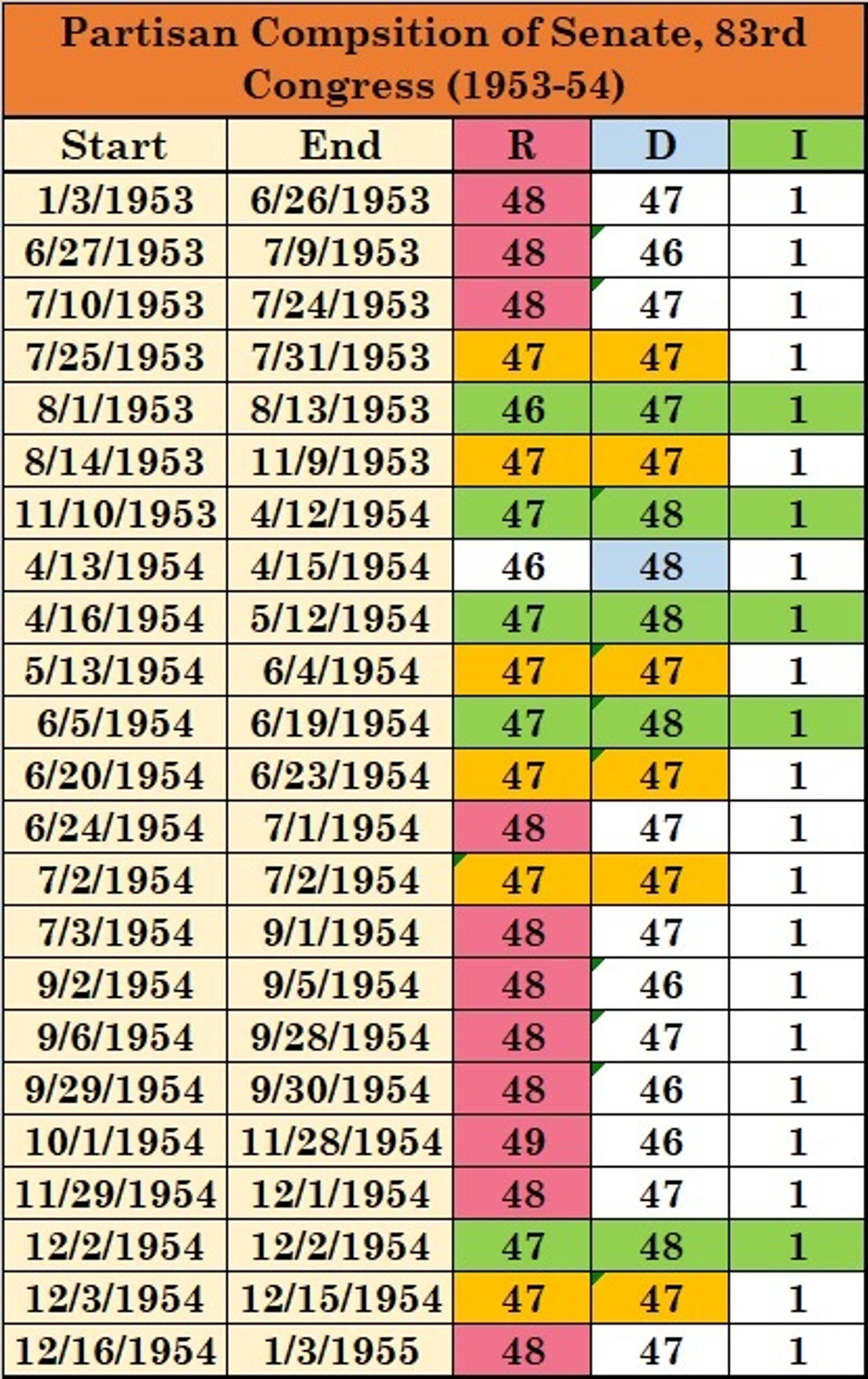
As Huitt notes of this period, “Deaths in the Senate had changed the party ratio to 48-47-1 in favor of the Democrats, but the votes of Morse and the Vice President kept the Republicans in organizational control.” So, even from outside the caucus, Morse did not hold himself entirely outside the decision to award control to one side of the chamber, as McMullin insists he would. And, of course, Morse’s position proved unsustainable: He joined the Democrats when they regained the majority in 1955, going where his stance on the national Republican Party and ticket had logically led him. That rewarded LBJ’s hard line in favoring his junior members over Morse, and LBJ went on (with Morse in his caucus, where he stayed until 1968) to become probably the most powerful Senate majority leader in history.
The same dynamic would inevitably replay itself with McMullin if he were elected, making an independent posture untenable and a caucus with the Democrats the probable outcome. His sagging position in the polls reflects that Utah’s voters are not fooled, and do not intend to give him that opportunity.




Comments