
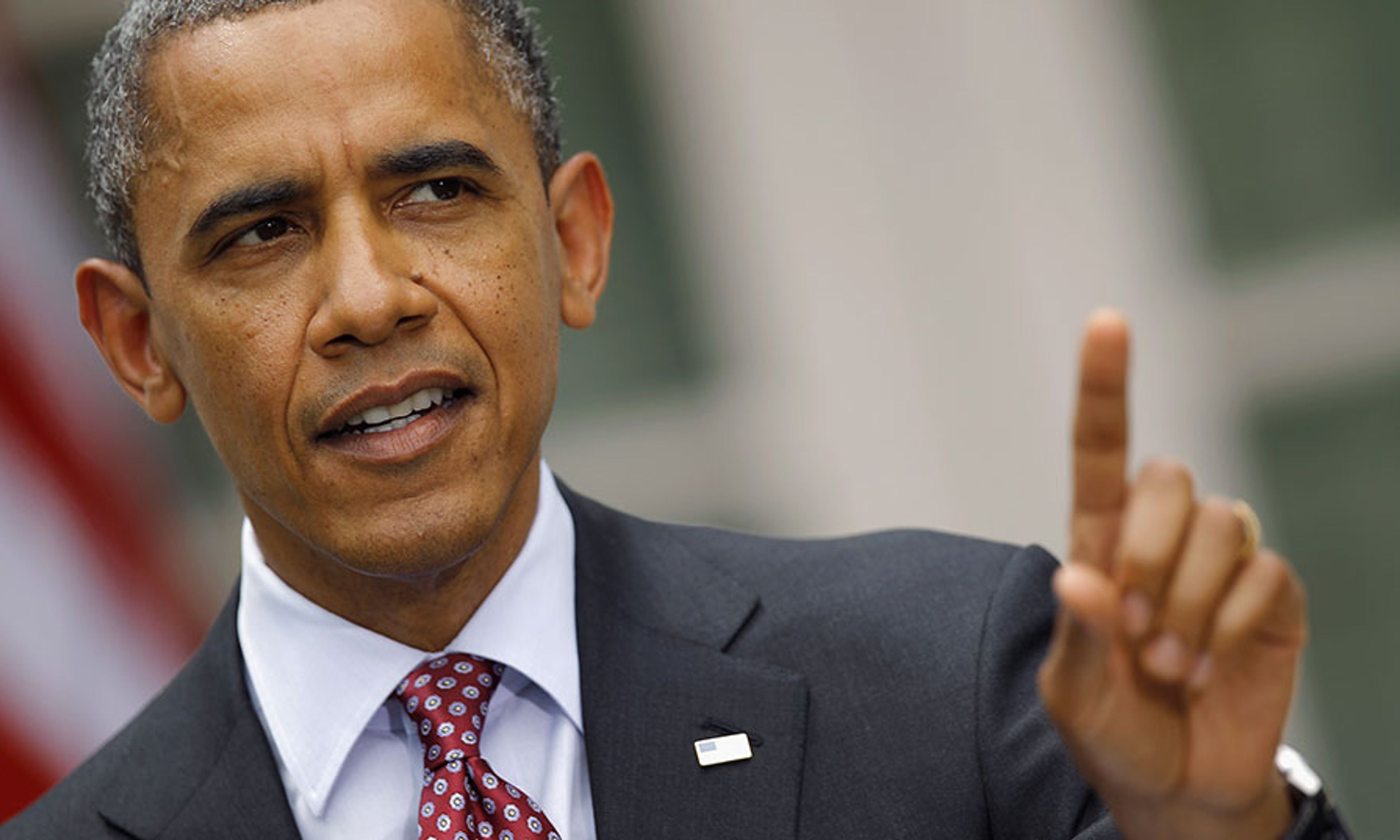
About Eric Holder’s declaration that we are, turns out, “not in a time of war,” Andy of course makes just the right point — namely, that all those legal justifications for actions (what few of them) we have been taking against various terrorist outfits in the Middle East and Africa are predicated precisely on our being “in a time of war,” and that those justifications would seem to be seriously imperiled by our, in fact, not being so.
But the deeper problem is, of course, one of language in general, and of this administration’s inclination to manipulate and distort language to its constantly obfuscatory ends.
Eric Holder’s use of World War II as the benchmark to determine whether we are presently “in a time of war” is sly — because many Americans probably would agree that we are not “in a time of war,” if America, circa 1942, is the standard. No one is being drafted, we’re not rationing sugar; it doesn’t feel like war felt then.
But that is only minimally related to whether or not we are at war (in any meaningful sense of that word), which the administration admits when it is legally expedient, and denies when it is politically problematic.
As I wrote in September, the administration has scrupulously avoided employing the language of “war” in its public statements:
We are going to “degrade” the Islamic State and — cross our fingers — “destroy” it, [President Obama] said in his [September 11, 2014] speech. It will be a “counterterrorism campaign” to “eradicate a cancer.” . . .
There is John Kerry, toeing the line: “War” is the “wrong terminology” for American actions against the Islamic State, he told reporters on Thursday. This is “a very significant counter-terrorism operation.”
And this is, of course, not the first time the administration has had trouble with the W-word. Dethroning Qaddafi in Libya was not a war; it was a “kinetic military action.” Other martial imagery is to be avoided: Movement of Russian soldiers and materiel into Ukraine? An “ongoing incursion”; definitely not an “invasion.”
This is language being used as an instrument to obscure and confuse.
But politically convenient falsehoods are one thing, and at least have the advantage of implying reality lurking in the background. The trouble with the administration’s language may not be one of language, but one of perception.
For the president, the attorney general, and so many of their ideological kin, what is true seems to have only a very tenuous connection with physical events out there, in the world; their philosophical commitments seem to require that the truth of any matter be, instead, a product of long and scholarly cogitation (hence Obama as professor-president). But there is, clearly, little careful study. Rather, all that happens out there, in the world, is processed and intellectualized and passed through the appropriate ideological filters before what is really going on can be determined. Thus it happens that terrorists in Iraq and Syria may shout “Allahu Akbar!” and quote the Koran before beheading Christians and even call themselves the Islamic State — but that they have nothing to do with Islam, not really.
That would make the words that follow not deliberate falsehoods, but expressions of the “truths” constructed in their heads. That possibility is, to my mind, far more troubling.
There is much more that could be said about such a posture to the world (the philosophical roots are deep, and not necessarily sinister), but it seems clear that the only war the Obama administration cares to wage is one on words.





Comments