
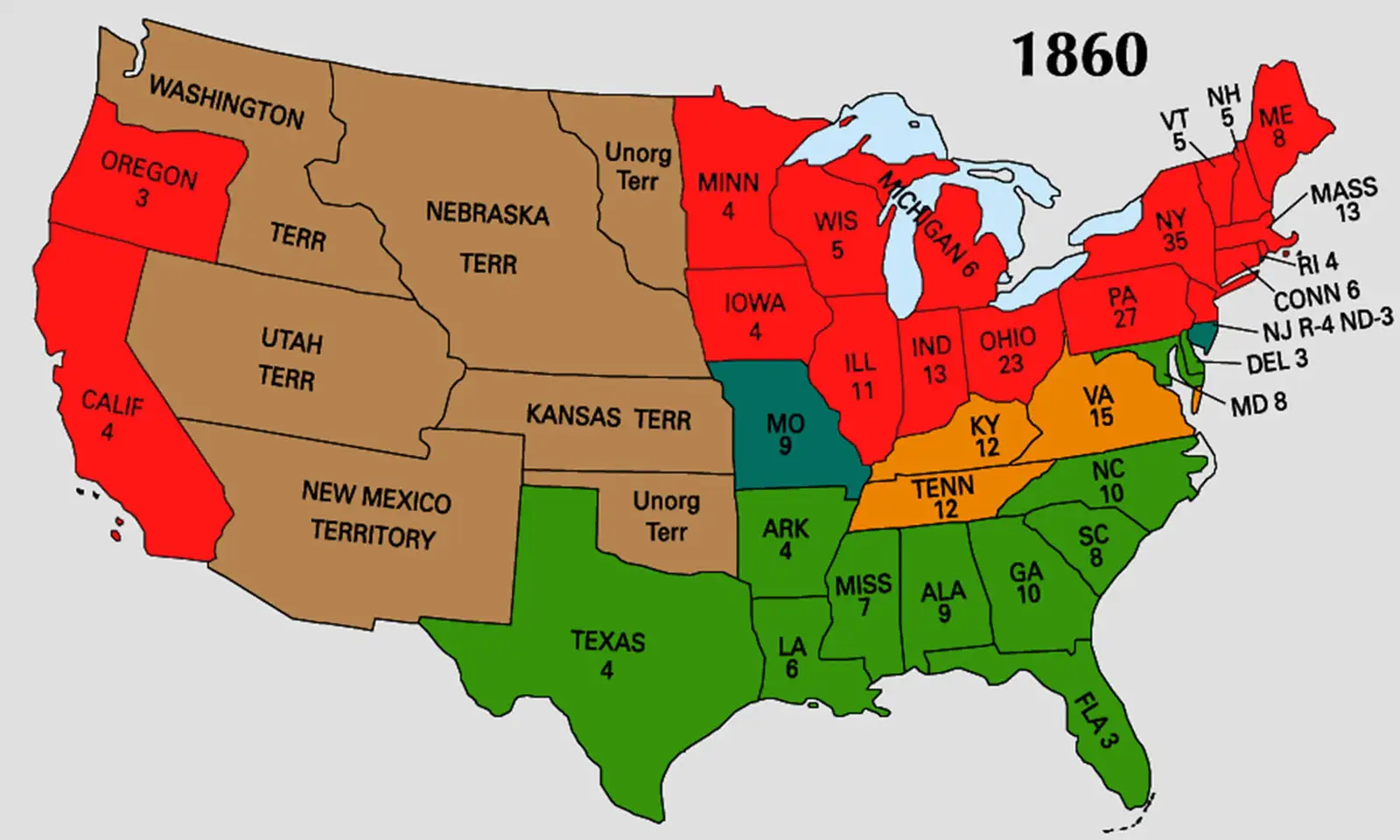
I was running some numbers while working on my book, and while the history is a staple of the best commentary on the period, putting it in graphical form really jumped out at me. The popular vote era (i.e., when most states began selecting their electors by a popular vote that was tabulated and published) began in 1828, when all but two states (South Carolina and Delaware) held a popular vote for president. From 1832-60, only South Carolina continued the old method of the legislature selecting electors. For most of this period, the country was evenly divided between slave states and free states, although neither their populations nor their actual electorates were the same. And any measure of polarization between the two is understated by the absence of South Carolina, the most militantly pro-slavery state from the 1832 nullification crisis to its secession in December 1860. Still, we have enough voting data to measure the degree of divergence between the free-state vote and the slave-state vote in presidential contests.
The columns on the far right represent how far Democrats ran ahead in the slave-state popular vote compared with the free-state popular vote, both in raw vote percentage and in the two-party vote (if we exclude third-party candidates, who drew a significant share of the free-state vote in 1832, 1848, and 1856, and the slave-state vote in 1856 and 1860). I have combined here the regional Whig vote in 1836 (when the party ran an eccentric strategy of regional favorite-son candidates in different states) and the two Democrats in 1860 (when the party nominated Stephen Douglas and a Southern rump bolted the convention and nominated John Breckenridge):


Comments
On “Partisan Sectional Polarization and the Civil War”