
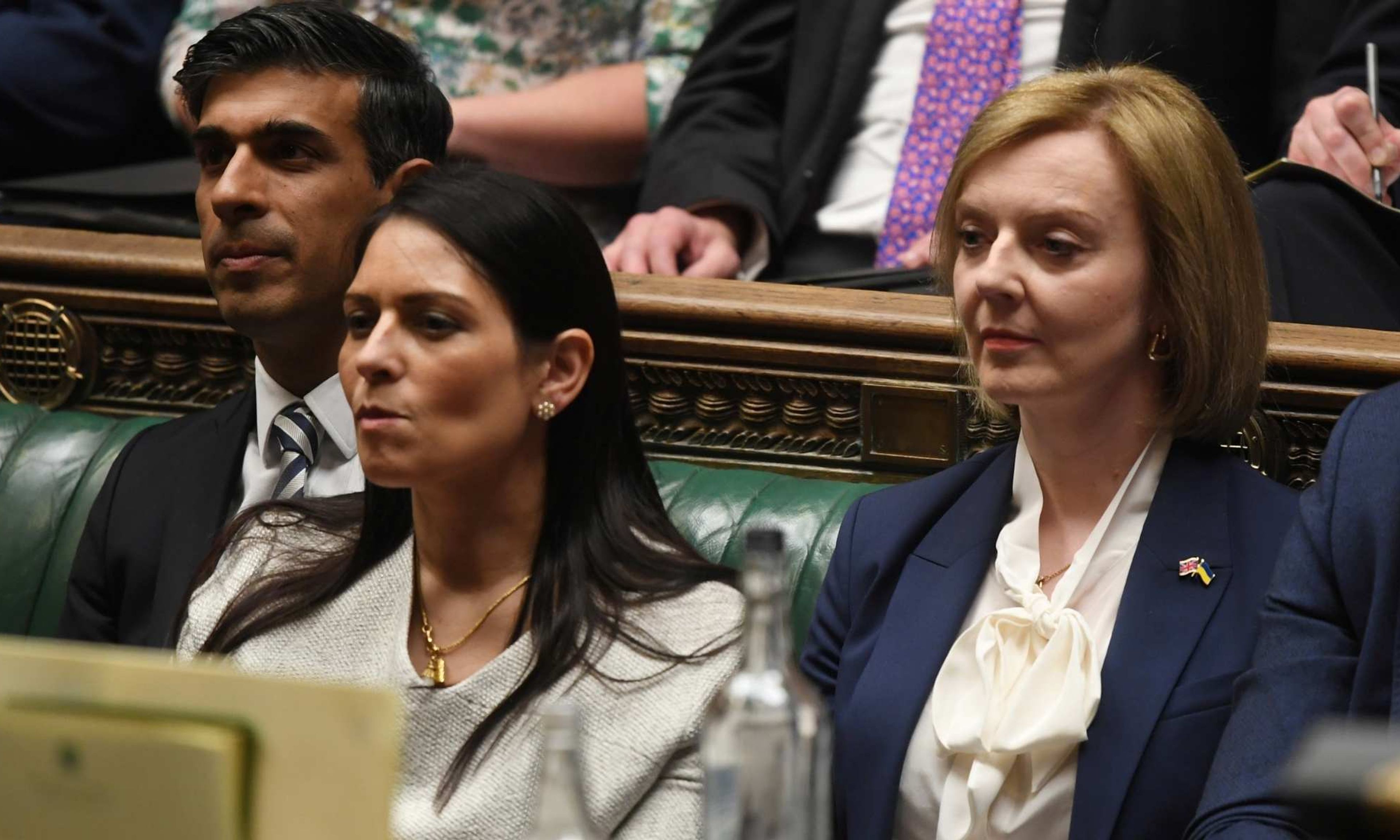
Yesterday, the Tory Party dodged a nuclear missile when it chose former chancellor Rishi Sunak and foreign secretary Liz Truss to be the final two candidates for the party leadership. They now go on a series of debates around the country in front of ordinary party members who then choose between them by September 5. I’ll discuss the choice between them lower down, but know straight off that they’re both decent, able, and essentially conservative people. The nuclear missile was the third — and mercifully rejected — candidate, Penny Mordaunt. And that she got as far as the final three (with almost a third of Tory MPs supporting her) is itself a strong criticism of rampant ideological confusion within the Tory Party.
In government, Penny Mordaunt was a firm, even an extreme, advocate of gender ideology. As a junior minister she had told the Commons, in terms meant to end the argument, that “trans men are men and trans women are women.” She also fought hard (fortunately, unsuccessfully) to keep non-gendered language that would have replaced “women” in legislation. And she cooperated closely with the gender-activist pressure group, Stonewall, even as it was losing respectability. As this gradually became a factor in the campaign, Mordaunt, a lively, attractive, and buoyant personality, denied it. Others responded with evidence for these and other charges. Worse, she had published a book outlining her plans for Britain. Last weekend was a race: Would she make it into the final two candidates before people read the book? The book won. Potential Tory voters read the full Woke agenda via the media — praise for China, more laws against “hate speech,” politically correct criticism of a 1970s UK sitcom It Ain’t Half Hot, Mum on grounds of its racism, homophobia, sexism, etc. — plus breezy thoughts on British identity, this, that, and the other. That would probably have ended Mordaunt’s chances with the Tory-activist voters anyway. Among MPs, it probably lost her just enough votes to leave her on 105 — 8 behind Truss on 113.
But how had a junior minister with woke opinions radically at odds with any rational conservatism done well enough to get almost a third of Tory MPs anyway? The answer is that the Tory Party is in a sad state of galloping ideological confusion, and it has been since the pandemic upended government policies across the board and undermined the party’s traditional beliefs. It retains two Tory fundamentals — Brexit and tax cuts — both of which really date from the Thatcher era (yes, Brexit too). Otherwise, individual MPs feel increasingly free to follow their own paths in very different directions, forming mutually hostile pressure groups and eroding the common sense of conservatism. That explains why almost 30 of them tried to run for the leadership.
Boris Johnson himself must accept a good deal of responsibility — not all — for this confusion. He yielded too much power to the scientific and medical technocrats in government, accepted the lockdown, draconian restrictions on personal freedom, and government spending they demanded, and thus oversaw a vast increase in state power and spending. He then had to pay the bills. Boris had not wanted these policies, but he shrank from fighting the technocrats, who were supported by both the media and an authoritarian, risk-averse public opinion. Most of those who now condemn him for this policy and its consequences were strongly urging it at the time. Unfortunately, his casual discarding of conservative ideas didn’t stop at Covid-19. He embraced an extreme version of green politics and Net Zero, which will also add vastly to government spending. He also avoided cultural battles against Wokeness. In particular, he quietly dropped the sober, hopeful, and scrupulously documented Sewell Report on racial disparities (commissioned incidentally by another ethnic Tory woman, Munira Mirza in the Downing Street policy unit) — because it had been denounced by the Left’s captive race-relations industry. And refusing to fight on those kind of issues — gender theory, erosion of historical truth, the weakening of national identity, racial consciousness-raising in academic and business life — destroys a much more important capital than finance capital.
That was the Tory confusion in which Mordaunt’s embrace of gender theory and radical wokeness in general passed largely unnoticed even though it caused quite a number of disputes within government. And it’s a pretty bloody important problem, because it signifies that conservatives have forgotten what conservatism means — at least among Tory MPs.
Despite this central problem within the party, I ended my recent National Review article on an optimistic note. The first few rounds of the leadership election had shown an unexpected vitality in Toryism in the form of ethnic-minority candidates from unconventional Tory backgrounds with bold and well-argued conservative views. Most of the leadership candidates on the day before nominations closed were from ethnic minorities. Not only was the race’s front-runner, former chancellor Rishi Sunak, one of three cabinet-level candidates from Asian backgrounds, but also three women candidates, two from ethnic-minority families, had broken through from lower ministerial levels to electrify the race by their articulate rejection of the Left’s racial politics, their embrace of patriotic language, and their general competence and self-confidence. One of them, Attorney General Suella Braverman, whose parents had migrated from Commonwealth countries to Britain, even described herself as “a child of empire.” Their emergence drove the Left both mad and nervous that their ability to deliver such arguments in unembarrassed terms would make them formidable opponents and shift a key debate in U.K. politics.
If that nervousness now itself eroded, it would indeed signal a political shift — indeed two political shifts. The first is that, as in the United States, the newer BAME generations (that’s the blanket U.K. term to describe Black, Asian, and Minority-Ethnic people in official bureaucratic language) are increasingly active in right-wing politics, rising to the top in its councils, and doing so not via minority quotas and preferences but by, well, ability and excellence. The second is that they seem likely — to judge from their performances in the leadership debates — to strengthen the conservative rather than the liberal wing of Toryism. All this generated excitement among Tory activists in the country and among right-wing commentators in conservative media from the Daily Telegraph to the television news channel, GBNews.
But that excitement was more evident outside Parliament than among Tory MPs.
It was almost as if the leadership election was running in two different countries. Within Parliament, it was an election of factions and calculations, minor shifts in votes that nonetheless doomed one candidate and preserved another, one candidate’s faction “lending” votes to another to ensure the defeat of a third, and all the black arts of retail politics as seen in the 18th century and in the elections of the Oxford University Conservative Association in my (non-Oxford) days.
The running-order of candidates in the parliamentary battle scarcely ever wavered. Rishi Sunak and Liz Truss were at or near the top of the list throughout the campaign, and though Penny Mordaunt threatened to defeat Truss just along the way, the final two were Sunak and Truss at the end. Polls outside showed candidates — including senior cabinet ministers — rising, falling and even disappearing in popular opinion. Inside, they had no impact. Other events were none of them dramatic and serious enough to influence the parliamentary votes that loyalty, bargaining, and the hope of advancement had dictated.
Outside Parliament, opinion polls in the country showed that Tories and voters increasingly preferred the insurgent candidates from the lower ranks, in particular the junior minister, Kemi Badenoch, a young woman engineer by training who had been born in England but brought up partly in Nigeria from where her parents had originally emigrated. She proved an eloquent, witty, and formidable candidate. In one-on-one match-ups of all the different candidates, she defeated every other one. The same match-ups showed that Rishi Sunak would lose to most of the other five or six.
None of that mattered. This was a parliamentary election, and the MPs have used their power to ensure that the two final candidates from whom the Tory activists will select the next leader are acceptable to them. But, of course, it does and will matter in national politics, and matter greatly, from now on. Of the outside candidates, I would guess that Kemi Badenoch, the establishment insurgent Tom Tugendhat (of whom more another time), and Suella Braverman will now be major cabinet ministers and future contenders for the Tory leadership in three years (if the Tories lose the next election) and in eight or nine (if they win it.)
And, of course, there’s another contender we shouldn’t forget. No, not Penny Mordaunt. She has her supporters and apparently the will to persist — she turned up today in the Commons to show her critics that rumors of her desultory work performance had been greatly exaggerated. That was a brave (and eloquent) rebuke to her critics, including me. But I think her ship has sailed. My reference above was to Boris Johnson.
Boris is out, but not down. He put on a bravura display of flamboyant leadership in the days since he resigned under pressure. Several Tory donors are abandoning the party and funding a campaign to force it to put his name on the ballot paper alongside those of Sunak and Truss. It probably won’t succeed, but it’s not the only example of popular disquiet at his removal. A demonstration of Tories angry at his defenestration took place outside Downing Street last week. (When did you last hear of a demo by angry Tories?) His record in government, though mixed, had some remarkable achievements, above all Brexit. He remains an international figure — not only in Ukraine — who represents cheerful resistance to oppressive technocracy at a time of popular restiveness. There was an odd note of regret and shame from the Tories in the parliamentary send-off he received yesterday. There will shortly be a revisionist history of the media-cum-establishment campaign to oust him — how many lies did he tell compared to those of his media critics? And he’s quite simply a remarkable public figure who, in the words of Arnold Bennett: “He has contributed to the great cause of cheering us all up.”
Don’t count him out yet.
And Rishi Sunak and Liz Truss. Good and decent Thatcherites, they both tell me.
I’ll get back to them tomorrow.



Comments