
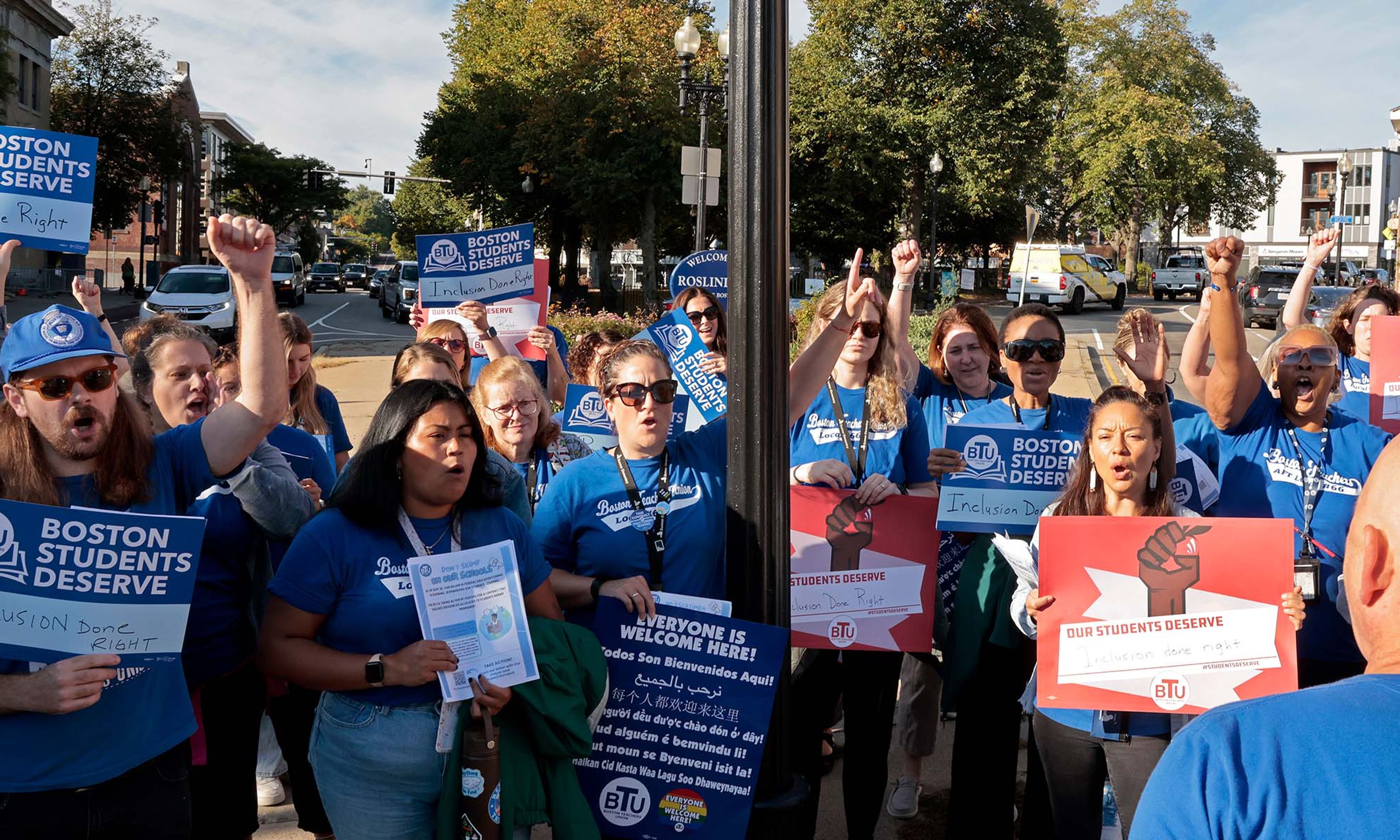
Brittany Bernstein reports that parents in Massachusetts are suing local teachers’ union leaders for the harm they caused by going on strike last year. “When teachers go on strike, they are placing their own demands ahead of their students’ needs,” their attorney said. “Families endured real harm, and they deserve justice. These unions need to be held accountable to show others nationwide that these actions will not be tolerated.”
He’s absolutely correct, but as he also acknowledged, what the teachers’ unions did was not merely harmful. It was illegal.
Strikes by public-school teachers are illegal in 37 states. Massachusetts is one of them. In fact, all public employees in Massachusetts are prohibited from striking.
Massachusetts General Laws, Chapter 150E, Section 9A(a) says, “No public employee or employee organization shall engage in a strike, and no public employee or employee organization shall induce, encourage or condone any strike, work stoppage, slowdown or withholding of services by such public employees.”
The way punishment works for breaking this law is that the employer files a petition with the Massachusetts Department of Labor Relations. The Beverly, Mass., school district did that. Then, the Commonwealth Employment Relations Board (CERB) determines whether an illegal strike occurred. Considering that the union publicly voted to strike, that was easy.
The CERB’s report on the Beverly strike shows complete disregard for the law by the teachers’ union and its president, Julia Brotherton:
- On November 7, 2024, the CERB ordered the union to cease its illegal strike.
- The union failed to comply and continued the strike on November 8, so the CERB got a preliminary injunction to stop the strike. That meant that a state judge had ordered the union and Brotherton to return to work and publicly state that the strike was over and illegal.
- The union failed to comply with the court order. On November 12, the district filed a complaint for civil contempt against the union and Brotherton, requesting fines of $50,000 per day, plus a $10,000 escalator for each day that the strike continued.
- The court granted the district’s request on November 13 and again ordered the union to stop the strike or pay $50,000 per day plus the $10,000 escalator in fines.
- The union’s response to that was to allege that the school district was engaged in unfair labor practices and not bargaining in good faith. It only alleged this after it began its illegal strike.
- Rather than follow the CERB’s order, the court’s first order, or the court’s second order, the union paid the $50,000 fine on November 13 and the $60,000 fine on November 14.
- Then, on November 15, the union filed a motion with the court to say it didn’t have the money to pay the $70,000 fine due that day. Again, they could just follow the law and do their jobs, but that’s not what they were interested in.
- The school district countered that the fines clearly weren’t working and requested that the court come up with another way to enforce its order.
At this point, the CERB report says, “In light of the Union’s representation that it has run out of monies to pay the fines, it appears that some other order besides coercive fines is required to bring the Union into compliance with the Law.” Correct. This is where, if Massachusetts cared about its students or taxpayers, a criminal prosecution of the union leaders would have begun.
Brotherton and any other union leader encouraging the strike (as encouraging a public-sector strike is also illegal and was forbidden by the court orders) should have been arrested for criminal contempt of court. Persistent disobedience of multiple court orders in denying public services can and should be treated as a crime against the community.
But Massachusetts union leaders know that their Democratic allies in government aren’t really going to enforce the laws on the books against them. So they behave as the Beverly teachers’ union did.
The union is fully aware that its actions were illegal. It didn’t dispute the findings of the CERB. And a Massachusetts Teachers Association FAQ document clearly states, “According to the current law, it is illegal for public employees or employee organizations to engage in a strike.”
The FAQ document goes on to describe the enforcement process and concludes, “If the injunction is granted, failure to comply with the judge’s order could result in a finding of contempt, which could be accompanied by an assessment of coercive fines and, in very rare instances, even jail time.” The union willfully and knowingly broke the law, but it knows actual punishment for its crimes is “very rare,” so it breaks the law anyway.
Imagine the outrage if a corporation behaved this way. Such outrage would be justified. But even if a corporation disregarded the law just as recklessly, the consequences of the union’s lawlessness are worse, because the union is a government-backed monopoly. Parents of students in the Beverly school district don’t have anywhere else to go to receive public education.
That means the government has an especially strong obligation to enforce the law against illegally striking public-sector unions. But Massachusetts politicians would rather curry their favor than serve the public. It’s disgraceful.
And also, abolish public-sector unions.



Comments