
There have been even more twists and turns since I last wrote (briefly) in NRO on the UK election race. Below is the latest set of polls on voting intentions:
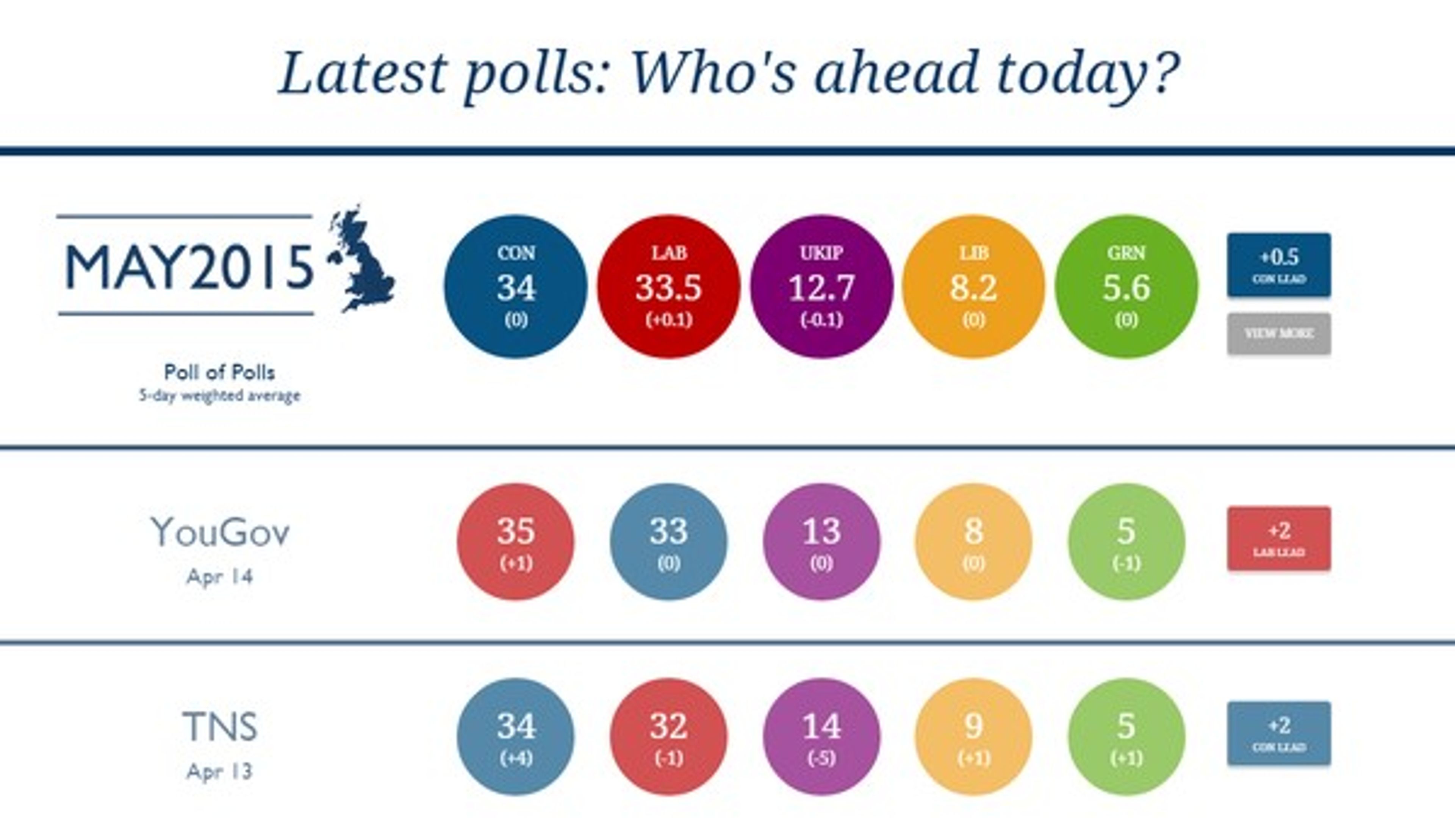
As you can see, the first line above is the average of five days of polling, including the two polls most recently taken. What they demonstrate collectively is as near a dead heat as you can expect in a close election campaign: a Tory lead of 0.5 percent. But the average conceals quite wide differences between different polls — and in particular between telephone polls (which tend to show the Tories ahead) and online polls (which give Labour the advantage.) By this time next month, we will understand these discrepancies better, but until voters actually cast votes, we can only hazard certain informed speculations. Here are a few:
‐We shouldn’t be at all surprised by the wide variations in different poll findings — given what we know of the current divisions in UK politics.
For instance, we know that Labour is reeling before the advance of the Scottish National Party in what was previously Labour’s northern redoubt. We also know that the Tories have long been weak in the North of England; that Labour is showing signs of weakness there too, largely because of the sex scandals (involving Asian men who were exploiting white adolescent girls) in safe Labour seats; and that UKIP is therefore likely to win votes from both parties and maybe threaten Labour in some seats. Several commentators believe that UKIP is gradually replacing the Tories as the main challenger to Labour in the region (or, rather, three regions) — which would be bad for Labour in the 2020 election but worse for the Tories this time around. Add to that the difficulty of predicting how any constituency is likely to vote when, unlike in most elections, it’s choosing between four or more candidates who will win a significant number of votes — and what you get is an election in which a turn of the kaleidoscope produces random, uneven, and unexpected results. Look out in particular for two things: large regional variations in the “swing” between two parties; and seats — maybe many in number — that swing heavily against the national trend. Indeed, look out for no national trend: This election is unpredictable in triplicate.
‐That said, on the evidence so far, the Tories are still failing to break out from the field as they were plainly expecting to do. Labour isn’t doing so, either. Both major parties are like long-distance runners, each passing and re-passing the other. And these are early days — more than three weeks to the winning post — so much may change. But there are signs of nervousness in the Tory ranks. For instance, though their main claim to office is that they are the prudent and successful party of economic managers — their slogan being “Competence or Chaos” — they have nonetheless promised to spend massive amounts on the health service and other public services that are nowhere seriously costed in their manifesto. Chancellor George Osborne was embarrassed in a television interview when he was unable, when asked repeatedly, to give a persuasive answer to the salient question: Where will the money come from for all these handouts? They can’t do too much of that without putting their main claim to reelection at risk.
‐Responding to earlier polls, two shrewd electoral psephologists — Andrew Stuttaford (of this parish) and Iain Martin (of the website that makes the political case for capitalism, Cap-X) — suggested that UKIP was on a downward trend in the polls. That seems to be true, and it was probably inevitable, all things being equal. But all things may not be equal — the UKIP manifesto, for instance, seems to be a better costed document than the Tory manifesto (yes, improbably, I know), and as I argued elsewhere, UKIP’s total vote is declining more slowly than most pundits predicted. Look at the figures above; they show UKIP polling at 13.5 percent, with some sign that they are rising again. Whatever the future holds, moreover, most observers believe that the UKIP vote will be substantial. Martin, one canny Scot, thinks they will end up with nine percent of the total vote. That was my own estimate from the morrow of the Eastleigh special election, until yesterday. I am now inclined to think it may be slightly higher — say, 11 per cent. But no one thinks that it will go down to three per cent — which was UKIP’s share of the vote in the 2010 election. And when six per cent of the vote is taken away from the major parties, it is bound to have an impact on them.
Maybe this is all “inside cricket” to Americans, and therefore uninteresting. It shouldn’t be. What is being tested here are the appeals of something like liberal Republicanism in the form of Cameron Conservatism, a variant of Hillary’s post-economic progressivism as channeled through Ed Milband, and, last but not least, the conservative resistance to both brands of the new politics in the form of UKIP’s peasant rebellion. Both progressivist ideologies have lost — and gained — something in translation. UKIP has gained a good deal of sophistication from two decades in the vineyard. But six years after the financial crash, the successes and failures of all three will tell us something, maybe a lot, about the direction of our own politics.






Comments